
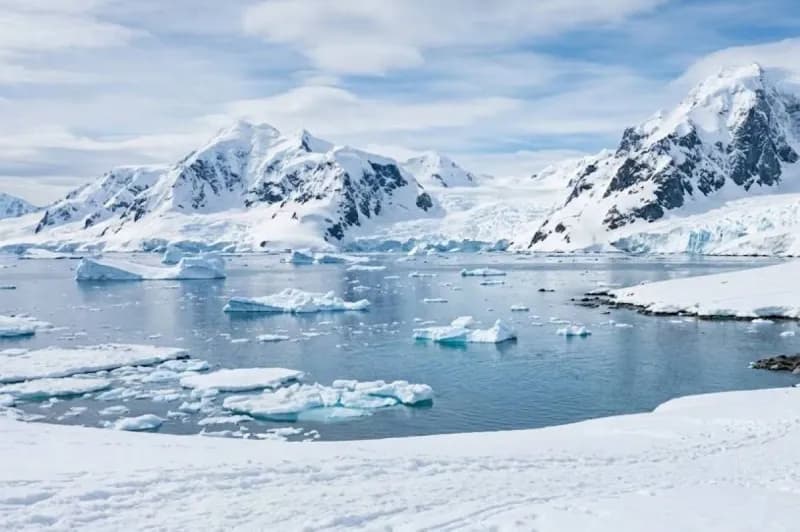
About 34 million years ago, Antarctica — the white continent — began undergoing a massive transformation that gave rise to the oldest and largest ice sheet on Earth, at a time when the planet was far warmer than it is today and the North Pole was still free of ice.
Scientists had long believed that falling levels of atmospheric carbon dioxide were the primary driver of Antarctica's freezing, as they cooled the planet sufficiently for ice to form. Yet this hypothesis left a puzzling question unanswered: why did Antarctica freeze alone, while ice formation at the North Pole was delayed by millions of years?
A new study published in the journal Science proposes a different explanation, suggesting that deep geological movements and the uplift of the continent's surface played a decisive role in the birth of this enormous ice mass.
According to the researchers, the story began tens of millions of years ago when Antarctica separated from Africa during the breakup of the supercontinent Gondwana, triggering deep disturbances in Earth's mantle. Those disturbances unleashed what are known as "mantle waves" — slow sub-surface currents that contributed to the uplift of parts of East Antarctica.
Over millions of years, vast areas of the continent rose by approximately 1.5 to 2 kilometres, forming plateaus and mountain ranges, among them the Gamburtsev Mountains, which today lie buried under more than a kilometre of ice.
This uplift played a fundamental role in lowering temperatures, as air temperature drops sharply with increasing altitude, creating conditions suitable for snow to accumulate and gradually transform into a permanent ice sheet.
The researchers explained that topography was not merely a secondary factor but a primary element in triggering the freezing process, as the newly formed highlands provided a cold environment that allowed ice to persist throughout the year.
The study reveals that Earth's climate history was not shaped solely by changes in the atmosphere, but was also influenced by continental drift and deep geological processes. Rocks and mountains that appear fixed on human timescales can reshape the planet's climate over millions of years.
These findings represent a further example of the profound interconnection between Earth's geology, climate, and the evolution of life — where a slow movement beneath the planet's surface can determine the fate of entire ecosystems across the ages.