
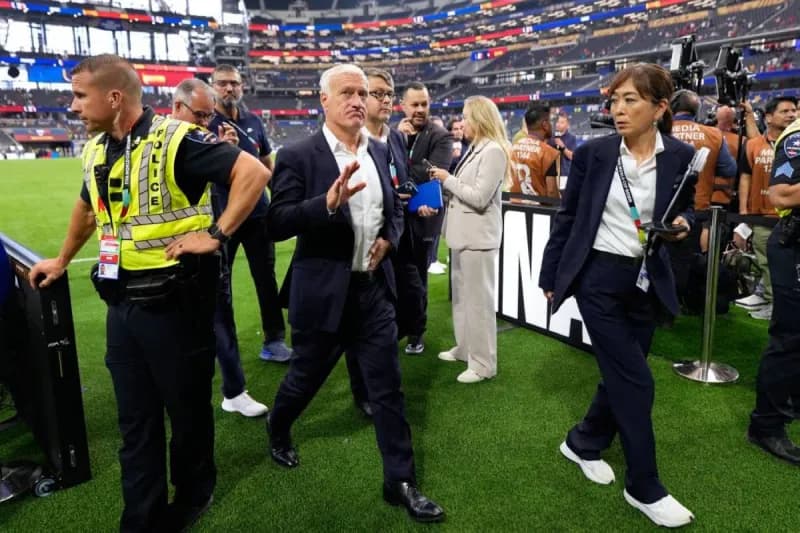
Didier Deschamps concluded his World Cup journey in disappointment after France fell to Spain in the semi-finals, ending his hopes of leading Les Bleus to a third world title. Yet he departs the tournament having cemented his name as one of the greatest managers in World Cup history, with achievements that will be difficult to replicate.
Deschamps, 57, announced in January last year that the 2026 World Cup would be his final assignment as France head coach, bringing to a close a 14-year tenure during which he guided the national team to the summit of world football.
He had previously won the World Cup as a player in 1998 and as a manager in 2018, making him only the third person to achieve that feat, alongside Brazilian Mario Zagallo and German Franz Beckenbauer.
Although Deschamps's final match was not the final he had hoped for, the game against Spain produced a new historical milestone: he became the manager to have taken charge of the most matches in World Cup history, with 26 games, surpassing the previous record of 25 that he had shared with German Helmut Schön.
France failed to produce their customary level against Spain, managing only 10 attempts on goal — their lowest shot tally of the 2026 edition — while their expected goals figure stood at just 0.3, a performance far removed from the displays they had produced in earlier rounds, despite entering the match as strong favourites to reach the final.
Speaking after the match, Deschamps said this was not the right moment to discuss his future, adding that going out in the semi-finals rather than the final changes nothing on a personal level.
He said he feels immense pride in what the team has achieved over the years and in the journey through which he led France to the highest level, while acknowledging that the defeat is painful, but that it is part of football.
During the Deschamps era, France became a model of technical stability in international football. He led the team to the UEFA Euro 2016 final, won the 2018 World Cup, reached the 2022 World Cup final before losing on penalties to Argentina, and has now reached the semi-finals of the 2026 edition — making him one of the managers most consistently capable of keeping his side in the latter stages of major tournaments.
Deschamps won 20 of his 26 World Cup matches, losing only 3, a success rate that reflects the scale of his achievements over more than a decade in charge of the French national team, who reached the quarter-finals or beyond in 4 consecutive major tournaments under him.
The upcoming third-place match may not be the ideal farewell for a manager of his stature at a tournament of the World Cup's magnitude, but Deschamps will depart by the grandest of doors — as one of the managers who will leave an enduring legacy in the history of French football, and one of the most prominent figures to have left a permanent imprint on the World Cup itself.