
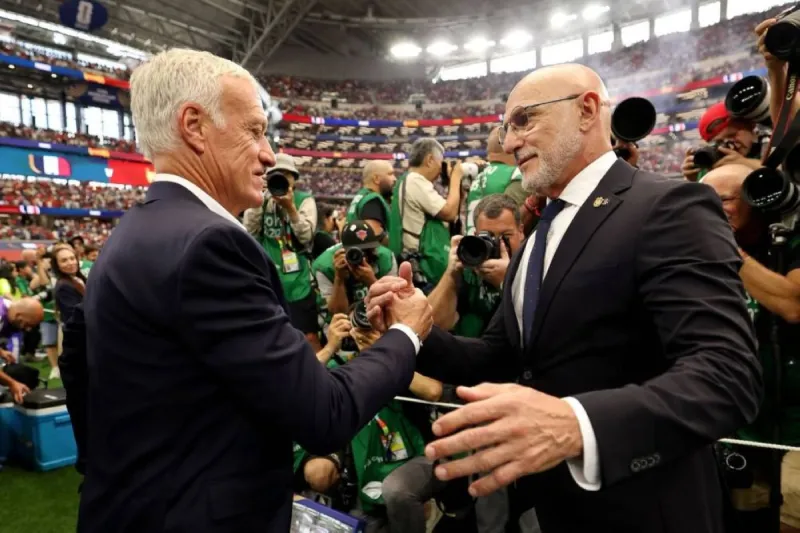
Spain confirmed their right to a place in the 2026 World Cup final with a deserved victory over France in the semi-final, delivering a footballing display that proved La Roja are the most complete side at this tournament.
Spain's win over France was not merely a match victory but a tactical masterclass in how to turn an opponent's strengths into a double-edged sword — transforming an asset into a liability. Luis de la Fuente, the Spain coach, showed himself to be a fox who knew exactly how to suffocate the French side and their lethal attack.
De la Fuente entered the match knowing that the key to defeating France lay not in matching their attacking firepower but in denying them the ball from the outset. The Spain coach executed his plan with precision, relying on a high press, possession, and collective movement to close down space.
The real battle was in midfield, not a contest between strikers. Spain's midfield asserted its dominance over the engine room, preventing France from building attacks in any organised fashion, reducing their play to disconnected individual efforts that lacked cohesion and accuracy.
What Deschamps had feared — and had emphasised before the match, stressing the importance of competing with Spain for possession rather than sitting back defensively — came to pass. He knew that losing the midfield battle would hand his opponent control of the game.
Spain succeeded in cutting off the supply lines to Kylian Mbappé, Ousmane Dembélé, Michael Olise, and Bradley Barcola, and later to Désiré Doué after he came on. The ball never reached them in situations that would have given them the advantage of pace or one-on-one duels, rendering the French attack completely incapable of finding solutions.
The Spanish press closed every avenue of play. Whenever France tried to play out from the back, they found one Spanish player pressing, another covering the space, and a third winning the ball back, leaving the French side trapped in a rhythm entirely dictated by their opponents throughout the match.
Spain's superiority was not only defensive; it was also evident in the quality of their attacking transitions. Every ball won was converted into an organised attack, with quick passing exchanges and constant movement that unsettled the French defence and forced it to retreat.
The first goal came from a penalty after sustained pressure forced the French defence into an error, while the second perfectly encapsulated De la Fuente's philosophy — a collective move that ended with a brilliant exchange of passes before Pedro Porro slotted the ball into the net.
Deschamps, by contrast, appeared unable to alter the course of the match. Despite attacking substitutions at the start of the second half, France remained far below their best and could not regain control or sustain any meaningful pressure on Unai Simón's goal.
De la Fuente once again demonstrated his tactical superiority over Deschamps, completing a third consecutive victory over him in major tournaments: following the win in the UEFA Euro 2024 semi-final, then the UEFA Nations League semi-final, and now the World Cup semi-final.
Perhaps the most important takeaway from this match is that Spain did not win through individual brilliance or an opponent's mistake, but through a complete system that combined defensive discipline, midfield control, relentless pressing, and attacking effectiveness.