
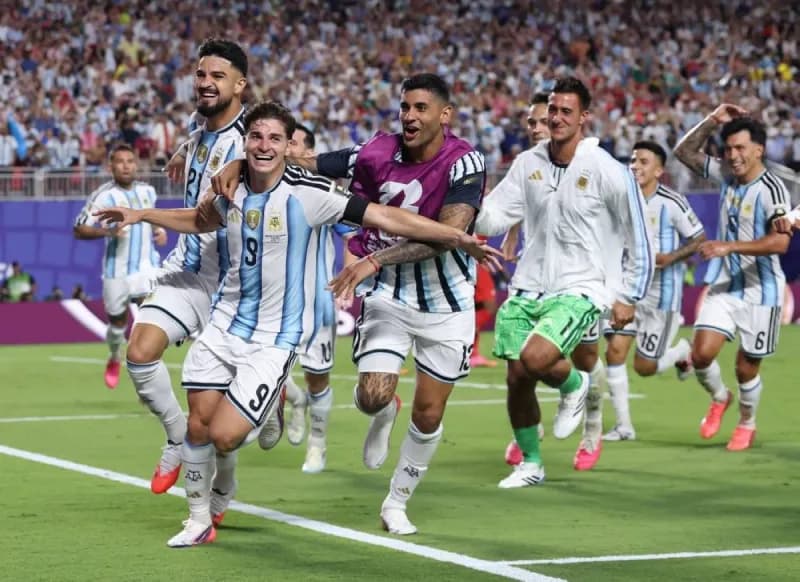
A refereeing expert has said a new officiating protocol has intensified already heightened tensions over the integrity of refereeing at the World Cup, after a fresh controversy involving Argentina triggered another wave of fan complaints.
The defending champions' run to Wednesday's semi-final has been accompanied by repeated complaints from their opponents over refereeing decisions, with speculation spreading on social media that the tournament is being tilted in favour of Lionel Messi's side.
The controversy reached a peak on Saturday during the quarter-final in which Argentina defeated Switzerland, when Breel Embolo was sent off for a second yellow card for simulation — an incident linked to a new Video Assistant Referee protocol that Switzerland coach Murat Yakin described as "unacceptable".
Reuters contacted FIFA for comment.
The "misidentification" protocol is one of several cases in which VAR is now permitted to intervene under amendments applied from the 2026–27 season and the current World Cup, placing a new and, critics argue, insufficiently tested mechanism under public scrutiny on football's biggest stage.
"I don't think this protocol should have been implemented at all, because its scope is far too broad," said Christina Unkel, a refereeing analyst for British network ITV and a former international match official.
She added: "What I find difficult to accept is that we are not just changing the identity of the player who received the card — we are changing the original decision itself, from awarding a free kick in one direction to a completely opposite ruling. We are rewriting the basis of the decision."
"I think this officially puts us in the realm of re-refereeing, which is exactly the zone that VAR has been trying to stay away from from the very beginning," she continued.
Rather than dampening the controversy, Argentina's benefit from the protocol — which drove critics on social media to coin the term "VARgentina" — appeared to deepen public frustration.
Unkel told Reuters: "This new expansion of the protocol, without adequate testing and without a genuine understanding of whether it serves its intended purpose, is like a powder keg. I feel we are just waiting for the final spark."
'Complete erosion of trust'
The narrative had been taking shape since the group stage, when Algeria demanded Messi be sent off after he stamped on Aissa Mandi's calf in the first half. The referee declined to show a red card, and Messi went on to score a brilliant hat-trick.
Days later, Algeria filed a complaint over refereeing errors in the match, according to a source who spoke to Reuters.
Criticism continued after Argentina's round-of-16 win over Egypt, when the Egyptian side scored in the 62nd minute before the goal was disallowed following a VAR review that found an infringement during the build-up.
The referee also declined to award Egypt a penalty later in the match before Argentina scored the winning goal in the 92nd minute.
The Egyptian Football Association said a number of refereeing decisions had a direct impact on the result of the match.
Unkel said she did not consider the incidents in either of the two previous matches to constitute serious refereeing errors, noting that officials are often the easiest target for fan anger when results do not go as hoped.
However, she pointed to other off-pitch issues that had compounded supporters' sense of doubt.
FIFA's handling of certain red card cases at the tournament came under greater scrutiny this month after American striker Folarin Balogun narrowly escaped a one-match suspension while English defender Jarell Quansah was handed a two-match ban.
"I think public trust has completely eroded at this point," said Unkel, who also serves as president of Tampa Bay Sun FC's women's team. "I have covered many major tournaments, both in this role and during my time in refereeing, and I have never witnessed this level of controversy — and not just on social media."