
After the 2026 tournament expanded from 32 to 48 teams, FIFA has begun studying the idea of raising the number of participants to 64, starting from the 2030 World Cup.
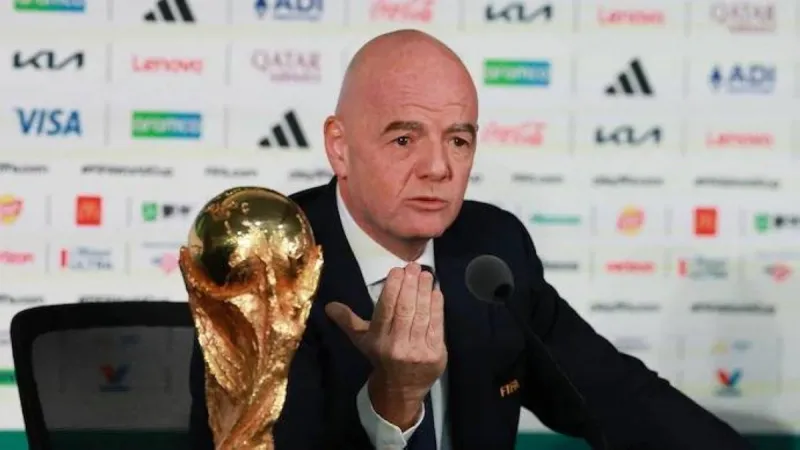
According to The Athletic, FIFA president Gianni Infantino said the idea of expanding the World Cup to 64 teams would be studied within the federation's competent bodies. The decision officially opens the door to the largest possible edition in the tournament's history, just a few years after the first expanded edition featuring 48 teams.
The idea was previously proposed by the South American Football Confederation (CONMEBOL), particularly given that the 2030 World Cup carries a special centenary significance, marking 100 years since the first World Cup was held in Uruguay in 1930.
The next edition is scheduled across 6 countries on 3 continents: Spain, Portugal and Morocco will host the bulk of the tournament, while Uruguay, Argentina and Paraguay will host symbolic opening matches in celebration of the centenary.
In numerical terms, moving to 64 teams would mean adding 16 teams on top of the new format adopted for 2026. It could also raise the number of matches to approximately 128, compared to 104 matches under the 48-team format. According to widely circulated proposals, the simplest structure might involve 16 groups of 4 teams each, followed by a knockout stage. This system appears cleaner than the 48-team format, which uses 12 groups and qualifies the top two teams from each group along with the best third-placed sides.
Infantino defended the idea on grounds of inclusivity, arguing that the World Cup must give "the whole world" a chance to dream, and that the participation of more countries accelerates the development of football on less-represented continents. Under this argument, smaller nations improve when they enter the tournament, compete against higher-level opposition, and gain funding, attention, and a new generation inspired to dream of participating.
Critics, however, see the other side of the equation: the more teams involved, the greater the risk of declining match quality, the weaker the value of continental qualifying, and the more the tournament resembles a vast global festival rather than a rigorous elite competition. UEFA president Aleksander Čeferin has previously described the idea of a 64-team World Cup as "a bad idea," warning that excessive expansion could undermine competitiveness and diminish the value of qualification.
For FIFA, expansion means more participating countries, more satisfied federations, more markets, more audiences, more broadcasting rights and more sponsors — all of which translates into more nationally held dreams that can be commercially sold.