
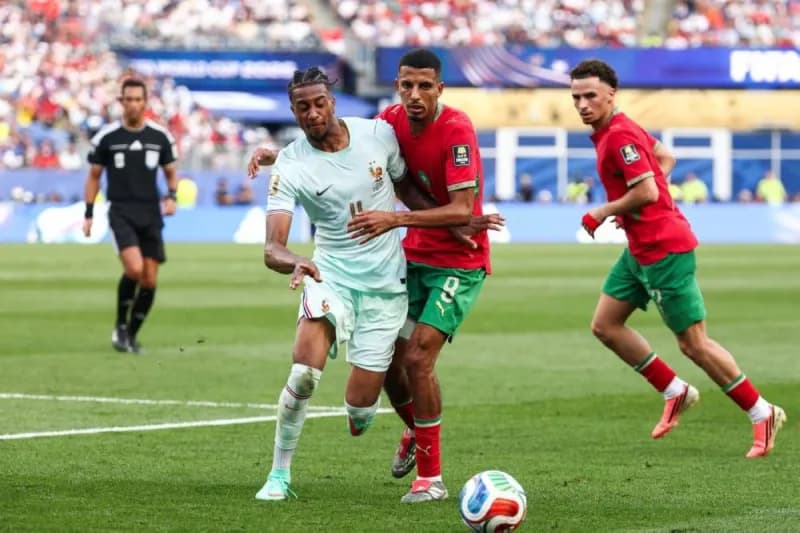
Despite the bitter exit of the Moroccan national team from the World Cup following their defeat at the hands of France, the latter deserved the victory, having asserted its technical and physical superiority for most of the match, benefiting from the quality of its attacking players and its effectiveness in front of goal.
France reached the semi-finals of the 2026 World Cup in the United States, Canada, and Mexico after eliminating Morocco with a brace from Mbappé and Dembélé in the quarter-finals, ending the Atlas Lions' dream of reaching the semi-finals for the second time in history.
The French national team produced one of its strongest performances of the current tournament, entering the match with high pressure and attacking intensity, relying on continuous movement and the pace of Kylian Mbappé and Ousmane Dembélé, which forced the Moroccan defence to drop deep early and stripped it of the ability to build organised attacks.
First-half statistics revealed the scale of French dominance, with France registering 13 shots to Morocco's one, creating several clear-cut chances, including a penalty missed by Mbappé, while decisive saves by Yassine Bounou kept the score level.
Despite the brilliance of Bounou — who was Morocco's best player and saved his side from certain goals — France's relentless pressure reflected the gap in the quality of chance creation, as the course of the match made clear.
The decisive blow came in the second half when France increased the tempo of its attacking play, exploiting the fatigue that was visibly affecting Morocco's players and the decline in their physical output as a result of the enormous effort they had expended throughout the tournament, which reduced their pressing levels and defensive recovery compared to previous matches.
France made the most of that decline in the best possible way, as Mbappé scored the opening goal in the 60th minute before setting up Dembélé to add the second, effectively finishing the match in 6 minutes.
The speed of transition from defence to attack played a central role in France's superiority, with the midfielders successfully delivering the ball quickly to Mbappé and Dembélé, while Morocco struggled with slow defensive recovery and a loss of defensive balance.
Mbappé stood out as the most influential player in the match, not only scoring the first goal but continuing to threaten the Moroccan defence with his constant movement and creating the second goal, reaffirming once again his value in big matches.
On the other side, the Moroccan team lacked attacking solutions and was unable to impose its usual style of possession play or quick counter-attacks, managing only limited attempts that posed no real danger until the final minutes.
Morocco were also affected by the absence of Ismail Saibari, who had provided between-the-lines solutions and effective linkage between midfield and attack throughout the tournament — something the team sorely missed against French pressure, diminishing their ability to retain possession and create chances.
Despite the World Cup exit, this performance does not diminish the value of Morocco's journey, having reached the quarter-finals and delivered a strong tournament. However, France demonstrated the gaps in individual quality, pace, and effectiveness, and deserved their place in the semi-finals thanks to their tactical, technical, and physical superiority.