
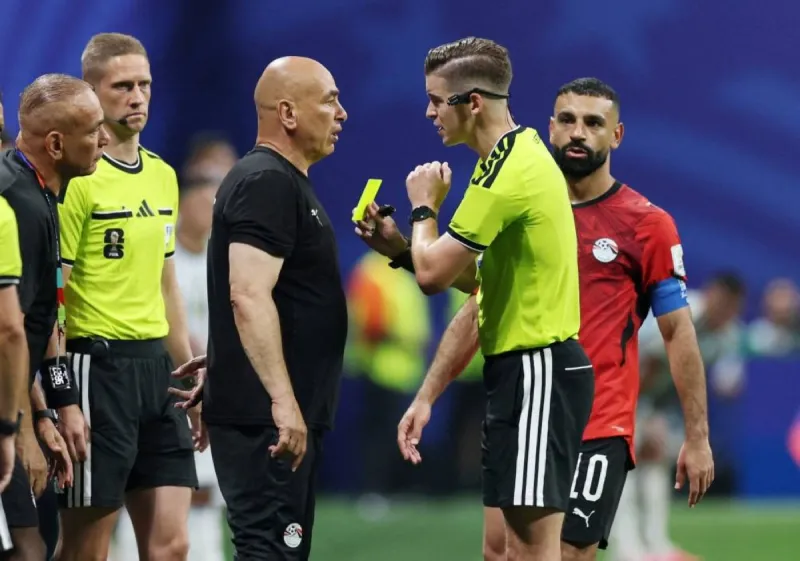
The Egypt-Argentina clash in Atlanta was no mere thriller that ended with a dramatic comeback for the title holder — it became one of the most controversial matches of the 2026 FIFA World Cup, after a series of refereeing decisions ignited debate that extended far beyond Egyptian supporters.
While the Argentine national team celebrated a hard-fought passage through, criticism mounted from former world-class stars who questioned how certain decisive situations were handled, particularly given that VAR intervened in one incident while overlooking a review of others.
Analysts and former players expressed bewilderment at the failure to review some contentious moments — especially those occurring before Argentina's winning goal — in contrast to the decisive intervention that disallowed Egypt's equaliser.
The controversy centred on two main incidents. The first was the disallowance of Mustafa "Ziko"'s goal in the 58th minute following a VAR intervention, on the grounds of a foul on Marwan Attia at the start of the move — a decision that drew protests even though replays showed a coming-together the referee deemed a foul.
The second incident involved Argentina's winning goal in the 90+3rd minute, with Egyptians contesting what they saw as a challenge on Mohamed Salah and a holding foul on Hamdi Fathy inside the penalty area before the goal was scored, with no VAR intervention — raising questions about the inconsistency in handling similar situations.
Stars such as Thierry Henry, Alan Shearer, Ian Wright, Rob Green and Jamie Carragher all waded into the controversy, focusing on the inconsistency in VAR application and arguing that refereeing fairness requires greater clarity and a uniform approach to similar incidents. The debate reopened questions about VAR's role in major tournaments, and whether it delivers full justice or leaves room for decisions that can change the fate of matches.
Thierry Henry
Former France international Thierry Henry commented on Egypt's 3-2 defeat to Argentina, saying: "I am not taking anything away from Argentina in any way because they have world-class players, but I do not think they deserved to win this game. Egypt put in a tremendous effort to build a two-goal lead — they defended bravely, attacked with confidence and deserved every part of that advantage."
He added: "The turning point, in my opinion, was the refereeing. I did not agree with the penalty awarded to Argentina earlier in the match, and after that it felt as though every big decision was going against Egypt. Whether people agree or not, those moments changed the rhythm of the game and gave Argentina the momentum they badly needed."
He concluded: "Egypt will leave this tournament feeling deeply aggrieved because they were so close to one of the greatest victories in their history. Sometimes football is decided by moments of genius, and sometimes by controversial decisions. Tonight, I think the refereeing will be debated just as much as the football itself."
Patrice Evra
Former France and Manchester United left-back Patrice Evra commented on the disallowed Egypt goal in the second half, saying: "I don't care what people will say, but the Egypt team was robbed and football has become sterile."
He continued: "The Egyptian player won the ball, drove forward with it, and the move ended with a wonderful goal — then you see someone spending two minutes searching for a trivial reason to disallow it."
He added, via the Prime Video network: "VAR's job is to correct clear errors, not to erase wonderful footballing memories. But it seems the referees were looking for a justification to save Argentina."
He went on: "If Argentina had scored the same goal, no one would have looked for a foul."
He further stated: "Egypt should have been leading 2-0 after outworking and outfighting Argentina, and now the Egyptians have to fight against disappointment."
Evra concluded his remarks by saying: "Egypt were not lucky today."
Rob Green
Former England goalkeeper Rob Green, speaking during Fox's coverage of the match in reference to the foul that led to Ziko's goal being disallowed, said: "Surely, that is not the type of incident that falls within the scope of a VAR review," adding: "The incident happened the full length of the pitch away from the play."
Alan Shearer
Former England captain and all-time Premier League top scorer Alan Shearer also criticised the decision-making process, writing on social media: "Either both incidents are fouls or neither of them are. But they told us VAR would not be re-refereeing matches."
Ian Wright
Former Arsenal striker Ian Wright pointed to the incident involving Salah, telling ITV: "If you are going to go back to a challenge for Argentina on the edge of the penalty area to disallow a goal, you have to go back to this specific incident involving Mohamed Salah. He was impeded. Whatever we say it was a slight touch, he was impeded and then the ball moved to the other end of the pitch."
Jamie Carragher
Former Liverpool defender Jamie Carragher questioned the consistency of VAR application, saying: "If that incident had happened in the Premier League, La Liga or Serie A, the goal would have stood even after a VAR review."
Mark Halsey: VAR's contradiction
Former English referee Mark Halsey criticised the way VAR handled the decisive incidents in the Egypt-Argentina match, affirming that the decision to disallow Mustafa "Ziko"'s goal raised questions about the standard for intervening in "clear and impactful" errors.
Halsey told The Sun that the VAR intervention to disallow Ziko's goal was a mistake, after the officiating team went back to the start of the move to call a foul on Marwan Attia, resulting in the goal being disallowed and Argentina being awarded a free kick instead.
Halsey said the fundamental question was: did the foul warrant a VAR intervention? He explained that Ziko's goal was the type that viewers do not want to see disallowed for minor physical challenges, adding that the VAR decision to intervene was incorrect and that the goal should have stood.
The former referee pointed out that the bigger problem emerged when comparing this incident to the Mohamed Salah situation before Argentina's winning goal, in which the player was challenged inside the penalty area with no VAR review of the incident.
Halsey added that this constituted a "contradiction" in the application of the technology, explaining that if the challenge on Martinez at the start of Egypt's move was sufficient to disallow the goal, then the Salah incident should also have been reviewed and could potentially have resulted in a penalty being awarded to the Egyptian side.
Halsey stressed that the solution lies in standardising VAR criteria, saying the technology must either intervene in both types of situations or in neither, because inconsistent treatment of similar incidents opens the door to further debate about refereeing fairness.