
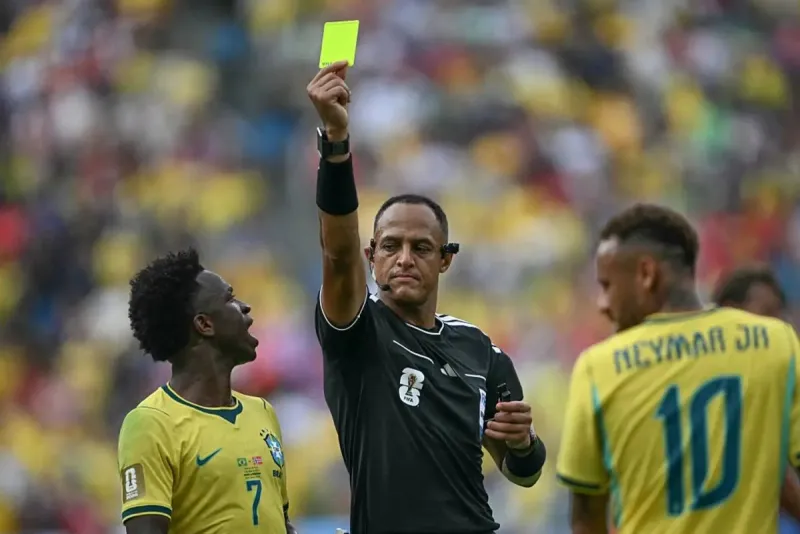
As the 2026 World Cup approaches its decisive rounds, the battle is not confined to qualification on the pitch alone — a number of the tournament's most prominent stars are fighting another battle against the threat of yellow cards, with 17 players now at risk of missing the semi-finals should they receive another booking during the quarter-final matches.
FIFA regulations place several major national teams in danger of losing key players at the most critical stage of the tournament, even though the stated goal has always been to ensure the biggest stars feature on football's greatest stage.
FIFA's decisions on suspensions sparked controversy during the tournament, particularly after it suspended a potential punishment against Cristiano Ronaldo at the start of the competition — a move that allowed the Portugal squad to benefit from their veteran captain's services, but which simultaneously opened the door to debate about the fairness of how the regulations are applied.
The suspension of bans against Argentina's Nicolas Otamendi and Ecuador's Moisés Caicedo was similarly handled amid those developments, while the case of Folarin Balogun drew further criticism of FIFA's disciplinary system, following the controversy that surrounded it and the political interventions linked to it. As the quarter-finals get under way, a number of teams now face the prospect of losing important players should they advance to the semi-finals.
FIFA regulations stipulate that a player who receives 2 yellow cards during the group stage is suspended for the next match, whether that is the final group-stage round or the knockout rounds. When the knockout phase begins, a fresh count starts — but the yellow-card slate is only wiped clean after the quarter-finals.
This means that any player who has accumulated 2 bookings from the round of 32 through to the quarter-finals will be suspended for 1 match — which could fall precisely in the semi-finals. Although no player is currently suspended due to an accumulation of cards, 17 players are walking a tightrope ahead of the last-eight ties.
The list of players threatened with a semi-final suspension includes 4 from the Morocco squad: Achraf Hakimi, Ismaël Diop, Redouane Halal, and Bilal El Khannouss. The Atlas Lions need to exercise caution, especially as their clash with France demands intense focus against an opponent possessing numerous attacking options.
England are among the teams most exposed to the risk of absentees, with 4 players facing potential suspension if they receive a yellow card against Norway: Declan Rice, O'Riley, Marc Guéhi, and Jude Bellingham. The prospect of Bellingham's absence is the greatest source of concern for manager Thomas Tuchel, given the pivotal role the Real Madrid star plays in midfield and attack. Jarell Quansah will also be absent for the quarter-final against Norway through suspension after being sent off in a match played at the Azteca stadium.
France took an exceptional step by lodging an appeal with FIFA against the yellow card Michael Olise received against Paraguay. If the appeal is accepted, the player will face no risk of missing a potential semi-final against Spain or Belgium should France get past Morocco — but midfielder Manu Koné remains under threat of suspension and will need to proceed carefully during the quarter-final fixture.
Switzerland enter their match against Argentina carrying 3 players at risk of suspension: Granit Xhaka, Denis Zakaria, and Miro Muheim. All 3 received their bookings during the gruelling match that stretched to 120 minutes against Colombia.
As for the other 4 quarter-finalists, each has just 1 player at risk of suspension: Argentina's Gonzalo Montiel, who is not expected to be in the starting line-up against Switzerland but remains at risk of missing out if he comes on and is booked; Spain's Ferran Torres, who is also not expected to start against Belgium; Norway's Antonio Nusa, who may find himself out of the starting eleven after Andreas Schjelderup shone as a substitute against Brazil; and Belgium defender Brandon Mechele, who is a key figure in the Red Devils' back line and is playing his first World Cup at the age of 33 — he received a yellow card for a deliberate foul on Senegal's Ismaïla Sarr in the round of 32.
In the advanced rounds of the World Cup, a small detail such as a yellow card can be enough to alter the fate of an entire national team. As the 8 remaining sides dream of reaching the semi-finals, managers will have to balance physical intensity and high pressing on one hand against avoiding the loss of their key players on the other. In a tournament where only 1 match separates a team from the final, a yellow card can sometimes prove more decisive than a goal.