
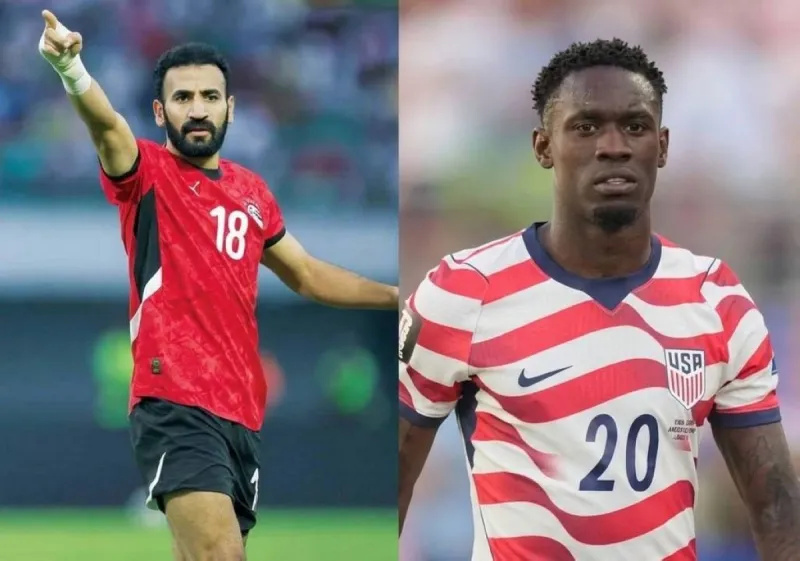
FIFA has reopened the debate over how it applies its own regulations, after contrasting treatment of two cases that drew widespread attention during the 2026 World Cup: one involving American striker Folarin Balogun, the other Egyptian midfielder Mohanad Lashin — a situation that prompted many to question the consistency of the international federation's disciplinary standards.
The controversy erupted after FIFA decided to suspend the ban imposed on Balogun following his direct red card, making him eligible to play against Belgium in the round of 16. The decision came after a striking intervention by US President Donald Trump, who announced that he had asked FIFA President Gianni Infantino to review the incident, arguing that the red card was unwarranted and describing the referee who officiated the match as having a "suspicious past."
The decision drew strong objections from the Belgian Football Association, which said it had requested a copy of the ruling that authorised Balogun's participation, only for FIFA to reject the request, characterising the correspondence as a procedurally inadmissible appeal. The Belgian federation said it had received no official explanation of the legal basis on which FIFA had acted, and announced it would continue to defend the principles of fairness and equal competition.
The Egyptian Football Association, by contrast, encountered an entirely different response. It submitted a formal request to have the yellow card shown to Mohanad Lashin rescinded, arguing that the offence did not warrant a booking — a cancellation that would have saved the player from suspension against Australia due to the accumulation of cautions.
FIFA formally rejected the request and informed the Egyptian team that the punishment would stand and that Lashin would miss the match, holding firm to its rules on the accumulation of yellow cards with no exceptions.
Although both cases involved the suspension of players from World Cup matches, FIFA's handling of each prompted extensive questions within sporting circles. While the federation suspended the execution of Balogun's ban and allowed him to play, it simultaneously upheld Lashin's suspension after rejecting the Egyptian federation's request to cancel the yellow card that caused him to miss the match against Australia — a game Egypt went on to win on penalties — opening the door to debate over whether the regulations were applied consistently in both instances.
While FIFA maintains that each case is examined according to its own regulations and legal circumstances, critics argue that what occurred demands greater transparency in explaining the reasoning behind decisions, in order to avoid accusations of double standards and to preserve the confidence of national associations and fans in the fairness of the competition.