
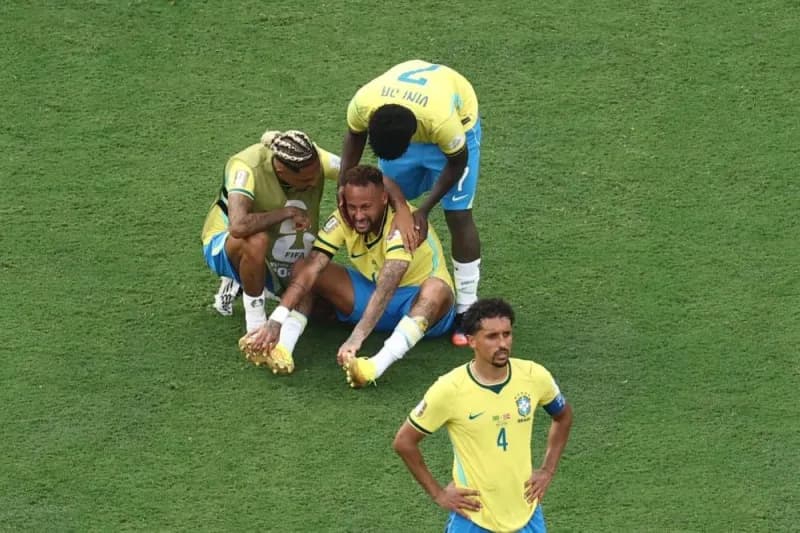
Norway succeeded in eliminating Brazil in the round of 16 of the World Cup with a deserved 2-1 victory, in one of the tournament's biggest upsets, after outperforming their opponents tactically, physically, and mentally to book a place in the quarter-finals, while the Brazilian national team bowed out early for the first time since the 1990 edition.
The Norwegian victory was the result of the well-crafted plan drawn up by coach Ståle Solbakken, who shut down the defensive depth, reduced space for the playmakers, and then relied on quick transitions and the physical power of Erling Haaland, combined with organised pressing that unsettled the Brazilian side throughout.
The statistics reveal the full extent of Norway's dominance: the team controlled 66% of possession against Brazil's 34%, and registered 5 shots that hit the posts and crossbar compared to 4 for their opponents, even as the Brazilian side finished the match with a higher total number of attempts overall.
The 14th minute proved to be the first turning point in the match, when Bruno Guimarães squandered a penalty that goalkeeperØrjan Nyland saved brilliantly, giving his teammates a major psychological boost and denying Brazil an early goal that could have changed the entire course of the contest.
Nyland's impact was not limited to the penalty save; he imposed his presence throughout the match with his positioning and composure in dealing with crosses and shots, keeping his country's side in balance until the final minutes under sustained Brazilian pressure.
Haaland delivered when it mattered most. Despite being tightly marked throughout the game, he used his exceptional ability to score the first goal with a powerful header, before sealing the match with a precise long-range strike. He also dominated aerial duels, providing his team with a constant outlet under pressure.
Substitute Andreas Schjelderup, introduced by Solbakken in place of Antonio Nusa, also contributed to increasing Norway's attacking effectiveness with his movement between the lines and pace on the left flank.
Schjelderup created both of Haaland's goals, exploiting the spaces that opened up as Brazil pushed forward, confirming the coaching staff's astute reading of the game and turning the substitution into the most influential decision of the second half.
The brace reflected Haaland's ability to make the most of half-chances, requiring only a limited number of touches inside the penalty area, reaffirming his effectiveness and extraordinary qualities as an exceptional striker.
Brazil, by contrast, struggled with slow build-up play and passing, found it difficult to penetrate the defensive density, and lacked attacking variety, with most attempts reduced to individual solutions and no ability to break down the defensive organisation imposed by Norway.
Carlo Ancelotti was unable to find tactical solutions to break through the Norwegian defensive block, and his substitutions failed to produce the desired change, while the Seleção continued to struggle in defensive transitions — a weakness Norway exploited efficiently until the final whistle.
The match confirmed that collective organisation and tactical discipline prevailed over big names. Norway delivered a near-perfect performance in every respect, while Brazil paid the price for wasting chances, poor tactical management of the game, and a failure to capitalise on the small details at the right moments.