
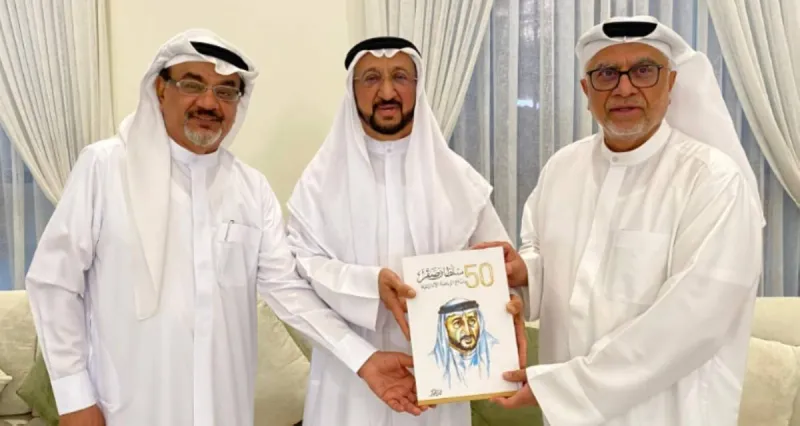
The council of Dr. Ibrahim Kaldari witnessed a notable extension of the cultural and sporting movement in the United Arab Emirates, with the launch of the book Sultan Saqr: 50 Years with UAE Sport, which chronicles the rich sporting and administrative career of Sultan Saqr Al Suwaidi, former Secretary-General of the General Authority for Youth and Sport and former Under-Secretary of the Ministry of Youth and Sport. The launch ceremony — whose content was crafted and presented by researcher, historian and media personality Mohammed Al Jouker — became a unifying national platform that hosted deep discussions about the current state and future of UAE sport, and reviewed landmark milestones from a career spanning more than half a century, running parallel to the founding of the Union in 1971, during which Al Suwaidi embodied a unique model of an all-encompassing sporting leader who accompanied the country's sporting renaissance from its very first building blocks.
During the book's discussions, Sultan Saqr Al Suwaidi affirmed that the UAE, with its capabilities, resources, and unlimited support from its wise leadership, is fully capable of repeating the historic World Cup qualification scenario achieved at Italy 1990. He explained that returning to global platforms and producing new honorable achievements for the country requires carefully considered plans and the construction of a sporting system with genuine professionalism, noting that the greatest responsibility at this stage rests with the sporting administration and the leading minds who run the game, who must operate with a professional mindset that keeps pace with global development. Regarding players, Al Suwaidi stressed that relying solely on the internal professionalism currently applied in the country is no longer sufficient to make a real difference on the international scene, arguing that playing professionally abroad in strong Arab and world leagues is the true gateway to taking the national team to the World Cup finals over the next four years — something that would guarantee the emergence of shining stars who raise the UAE's name high, through a comprehensive administrative and technical system that does not rely on preparing the player alone but encompasses the entire ecosystem.
The book documents golden pages from Al Suwaidi's life story. Born in Dubai on 7 January 1951, he received his education between the UAE, Egypt, and Britain, becoming the only Emirati administrator to have held leadership positions in the majority of the country's sporting bodies, moving across four major federations — football, volleyball, table tennis, and swimming — in addition to his efforts with the National Olympic Committee and the General Authority for Youth and Sport, and his representation of the UAE people as a member of the Federal National Council. Those present recalled Al Suwaidi's pioneering role as the first president of the UAE National Olympic Committee upon its founding in 1980, which marked a strategic turning point that steered UAE sport toward official participation in regional, continental, and international tournaments, relying on careful planning that began with spreading a culture of sport among young people, supporting local clubs, and qualifying national cadres to assume administrative duties.
The council's discussion touched on the varied chapters contained in the book, which recorded the contours of Al Suwaidi's childhood and the family environment in which he grew up. He spoke with loyalty and pride about the profound influence of his paternal and maternal grandmothers in instilling values of authenticity and love, and the most prominent formative role of his mother Shreena bint Abdullah Al Dabbous Al Suwaidi, his sister Bakhita, and his wife Aisha bint Abdulaziz Al Shamsi, who were a genuine support to him throughout his professional and personal life. The book also addressed Al Suwaidi's prominent role during the founding phase of UAE sport: he was an active member of the third formation of the UAE Football Association between 1974 and 1975, serving as its Secretary-General, and he represented the country in the founding of the Arab Football Union in 1976 in the Libyan capital Tripoli, maintaining his membership on the Arab Union's Executive Council for 24 consecutive years, during which he presented substantive proposals that contributed to the development of Arab tournaments.
Historian Mohammed Al Jouker and those present elaborated on Al Suwaidi's prominent international and domestic presence: he was a constant bundle of activity, representing the country at the Olympic Games in Montreal in 1976, the FIFA World Cup in Argentina in 1978, and the World Cup in Spain in 1982, in addition to heading the UAE delegation and chairing the temporary committee overseeing the national team that achieved the footballing miracle of qualifying for Italy 1990. His contributions also extended to membership of the Supreme Organising Committee for the 6th Arabian Gulf Cup in 1982 and the 12th edition in 1994, the vice-presidency of the 1996 AFC Asian Cup hosted by Abu Dhabi, and the chairmanship of the Executive Bureau of the Organising Committee for the FIFA World Youth Championship in 2003, alongside his attendance as an honorary guest at the Sydney Olympics in 2000, his participation in the United Nations International Youth Conference in Lisbon that same year, and his 22-year membership on the Executive Council of Arab Ministers of Youth and Sport.
The session included a moment of reverence and remembrance for the wise paternal vision of the founding leader, the late Sheikh Zayed bin Sultan Al Nahyan, may God rest his soul, whom Al Suwaidi took as a role model and whose approach he followed in laying the administrative and educational foundations for the youth and sport sector. Those gathered recalled Sheikh Zayed's historic joy at the achievement of qualifying for the 1990 World Cup, as he was described as the happiest Emirati and Arab at this accomplishment, achieved when the UAE was only 18 years old and in only its second qualifying campaign — an unprecedented footballing feat worldwide.
Those present echoed Sheikh Zayed's moving words during his historic reception of the players in Al Ain, when he told them: "You have brought joy to your families, your homeland, and the Arabs. Great victories are made by men of ambition and determination." He affirmed on that occasion that building people and producing men through stances and mutual giving is the true wealth of nations, not money alone — words that gladdened the hearts of the athletes and remained a guiding light illuminating the path of sporting work in the country.
At the close of the national session, those present concurred that Al Suwaidi's resignation from his post as Secretary-General of the General Authority for Youth and Sport in 2006 — to make way for fresh blood — was not the end of his contribution but rather an immortalisation of his eventful history, which has become an authentic and inseparable part of the sporting and institutional memory of the UAE. They affirmed that the biography presented in Mohammed Al Jouker's work represents a reference document for future generations to learn about the struggle of the founding generation, to draw on values of sacrifice and self-reliance, and a genuine impetus to review the current administrative frameworks in order to revive the sporting system and bring UAE football to the global championship platforms and major international arenas that the country deserves, based on its historical and present-day achievements.