
Nobel Prize-winning Egyptian author Naguib Mahfouz could never have imagined, when he sat down to write his trilogy — Palace Walk, Palace of Desire, and Sugar Street — that what he had set down between the lines and across those pages would one day become reality on the football pitch.
The Egyptian football story of this period rejected outside interference and answered only to the nation and its devoted sons. Mahfouz's pen moved across the pages to declare that freedom and glory could only be achieved by the arms of Egypt's own sons — and so it has proved. In the trilogy, politics was the pitch and freedom was the football, and the result was decided before the opening whistle.
The 2026 World Cup arrived to make its judgment without seeking anyone's opinion. It declared plainly that Egyptian football with an Egyptian coach is something else entirely. Hossam Hassan stamped his brilliance on the leadership of the Pharaohs, going unbeaten at the World Cup in this edition — a magnificent level and a distinguished performance that restored to the fore the value of the home-grown coach for all national teams.
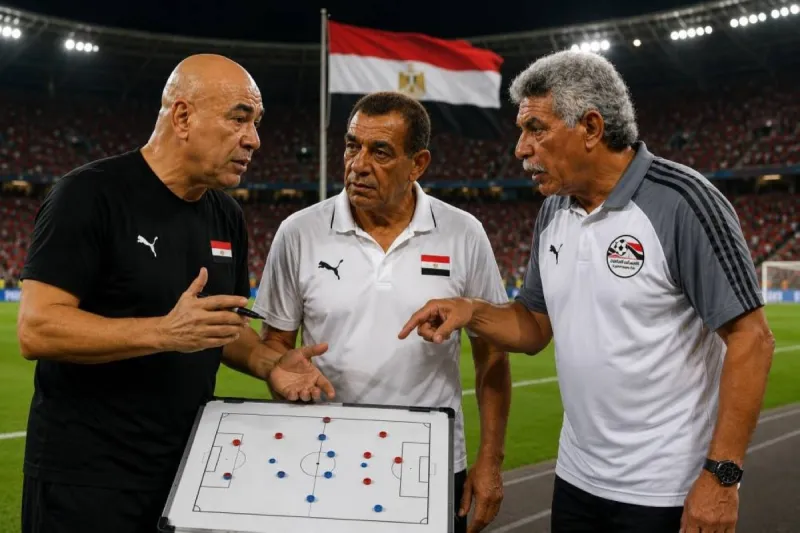
'The General', Mahmoud El-Gohary, was the first to begin narrating the football trilogy. The 1990 Italy World Cup and the Africa Cup of Nations resembled Palace Walk. After him, Hassan Shehata — 'The Teacher' — took up residence in Palace of Desire with three consecutive African titles, a rare and exceptional achievement, before Hossam Hassan — 'The Dean' — appeared to us from Sugar Street with a performance of the highest order at the 2026 World Cup.
The general of Egyptian football
Mahmoud El-Gohary, nicknamed 'The General', is one of the most important coaches in the history of Egyptian football. Before he took charge of the Egyptian national team in September 1988, the relationship between Egyptian football and the World Cup was little more than memories and old newspaper headlines announcing the Pharaohs' first-ever World Cup appearance — specifically the second edition in 1934 in Italy. El-Gohary, together with the stars of the national team — led by the twin brothers Ibrahim and Hossam Hassan, and the in-form Ahmed Al-Kass and Hisham Abdel Rasoul — guided Egypt to the 1990 World Cup in Italy. Egypt drew 1-1 with the Netherlands in their opening match, drew 0-0 with Ireland, lost by a single goal to England, and were eliminated in the first round.
Introducing professionalism
Following qualification for the 1990 Italy World Cup, Mahmoud El-Gohary took the decision to introduce a professional system in Egypt and encouraged some Egyptian players to pursue professional careers in Europe. Although the professional system in Egypt has, by universal acknowledgment, yet to fully bear fruit, it is recognised that many positive signs have emerged — lacking only awareness and commitment. It is also acknowledged that the Egyptian player now strives with every effort to move to a better league, and that El-Gohary established regulations capable of managing the transfer of talented players to Europe rather than allowing them to leave for free without their clubs benefiting.
El-Gohary was not content with World Cup qualification alone. Eight full years later, he led Egypt to the Africa Cup of Nations title in 1998 in Burkina Faso, with a 2-0 victory over South Africa in the final. He thus became the first person to win the Africa Cup of Nations as both a player and a coach, having lifted the trophy with the Egyptian national team in 1957 and 1959, when he was also the tournament's top scorer.
'The Teacher' — the title hunter
Hassan Shehata, or 'The Teacher', is one of the most important players in the history of Egyptian football. Shehata moved into coaching immediately upon retirement and recorded successes with numerous Egyptian clubs. On 12 October 2004, the Egyptian Football Association decided to dismiss Italian Marco Tardelli from his position as technical director of the Egyptian national team after all hope of the Pharaohs qualifying for the 2006 Germany World Cup had evaporated. Association president Essam Abdel Moneim then announced on 28 October 2004 the appointment of Shehata as 'temporary' technical director, succeeding Tardelli.
Before being announced as technical director of the Egyptian national team, Shehata had already achieved considerable success with several Egyptian clubs, and had also won the 2003 Africa Cup of Nations with the Egyptian youth team. He went on to achieve many important accomplishments during his time coaching the Pharaohs from 2004 to 2011 — making him the longest-serving technical director in the history of Egyptian football. His most prominent achievement was leading the national team to win the Africa Cup of Nations three consecutive times, in 2006, 2008, and 2010, making him the only coach to win 3 consecutive African titles.
7 titles
With Hassan Shehata, Egypt became the African nation with the most Africa Cup of Nations titles, with 7. He also elevated the Egyptian national team to ninth place in the FIFA world rankings, and received the CAF award for the best coach in Africa in 2008. He was ranked the best coach in Africa in 2010 by the International Federation of Football History and Statistics, and was selected among the 5 best coaches in the history of the African continent.
'The Dean' and the 2026 World Cup
Hossam Hassan — or 'The Dean' as Egyptian football fans call him — has a biography as a brilliant striker that needs no elaboration. He is one of the finest players ever to grace Egyptian, Arab, and African football, and he also had a professional career in Europe. Before the World Cup began, even the most pessimistic observers did not believe the Egyptian national team was capable of advancing from the group stage. Questions swirled between dream and reality, with no shortage of differing answers. Hossam Hassan alone believed that fate was keeping happy events in store for him — that he was capable of making decisions and rising to any challenge.
A watershed moment
What Hossam Hassan has delivered with the Egyptian national team at the 2026 World Cup represents a watershed moment in the life of Egyptian football, and perhaps Arab and African football too. It is a resounding cry that the national coach is the most deserving person to coach his country's team — he is the one who plants love of the homeland in the hearts of his players during training sessions, reminding them that millions of their compatriots long for that joy. He is the one who knows the national anthem by heart, who weeps in moments of happiness and grieves when a dream slips away. It is a message to every Arab country: you must rely on the national coach, because he best understands the identity of local football and the nature of his players, and knows how to deal with them both psychologically and technically, while the foreign coach remains a more suitable option for clubs than for national teams.
Erasing 40 years of memories
'The Dean' Hossam Hassan's numbers with the Egyptian national team at the 2026 World Cup have shattered stereotypes and erased memories that Egyptian football fans had been carrying for 40 years. He is the one who brought something new, opened a door to dreams, and changed the football landscape. What has been achieved so far at the 2026 World Cup is the beginning of a new era of ambition. Securing a place in the round of 16 — after a thrilling victory over Australia on penalties, 4-2, following a 1-1 draw after both regular and extra time — is more than enough, setting up a heavyweight encounter with Argentina, the title holders, next Tuesday at a stadium in Atlanta, in a match that has attracted enormous worldwide anticipation.