
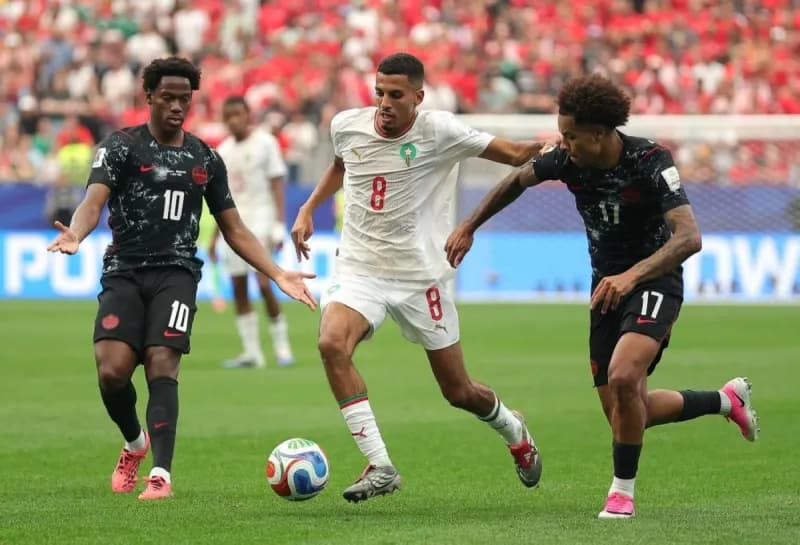
Morocco's national team once again demonstrated its ability to handle knockout matches, securing a deserved 3-0 victory over Canada to book its place in the quarter-finals of the 2026 World Cup.
The Moroccan win came after a 180-degree turnaround in performance between the first and second halves, as sharp and astute tactical reading helped shift the balance of the match. The interventions of technical director Mohamed Wahbi, made at precisely the right moment, transformed Canada's advantage into a Moroccan awakening that delivered the victory.
A disappointing start
Canada dominated the first half, successfully dragging the match into individual duels and direct one-on-one battles. This approach stripped Morocco of its ability to control the ball and maintain possession as usual, curtailed the effectiveness of the link between midfield and attack, and forced players into errors under pressure.
The early departure of Ismail Saibari through injury also affected the attacking structure, as the team lost one of its players capable of holding the ball between the lines. This made it harder to build out of Canada's press in an organised manner and weakened the available options in the final third.
Restoring balance
But after a first half that was the worst the Atlas Lions had produced in the tournament, Wahbi redistributed roles in midfield. The introduction of Sofiane Mrabti gave greater solidity to the midfield line, while Chamseddine Talbi provided additional dynamism in transitions, and the team gradually recovered its balance.
Performance improved quickly thanks to the restored midfield equilibrium. Defensive positioning also improved, and ball recovery became faster, which reduced the spaces that Canada had exploited during the first half.
The magic of the first goal
Azzedine Ounahi's goal — which earned him the player-of-the-match award — came early in the second half and gave Morocco a clear morale boost, but it also carried significant tactical value. It forced Canada to push forward and leave space behind their lines, providing Morocco with better conditions to apply its preferred style of rapid transitions.
The experienced players capitalised intelligently on Canada's forward surge, particularly through Ibrahim Diaz. The performance was marked by greater composure in decision-making, reduced risk in passing, and a reliance on ball circulation when needed, before exploiting space the moment play shifted into an attacking phase.
Quick transitions emerged as one of the most important keys to Moroccan supremacy, as the team moved from defence to attack with a limited number of touches and coordinated movement between midfield and forward players, making it difficult for the Canadian defence to reorganise.
Morocco's victory proved that the difference was made not by physical or technical superiority alone, but by the speed of adaptation to the flow of the match and the quality of tactical decisions. Wahbi quickly identified the weak points and intervened at the right moment, giving Morocco a clear advantage in the second half and guiding the team to the quarter-finals on merit.