
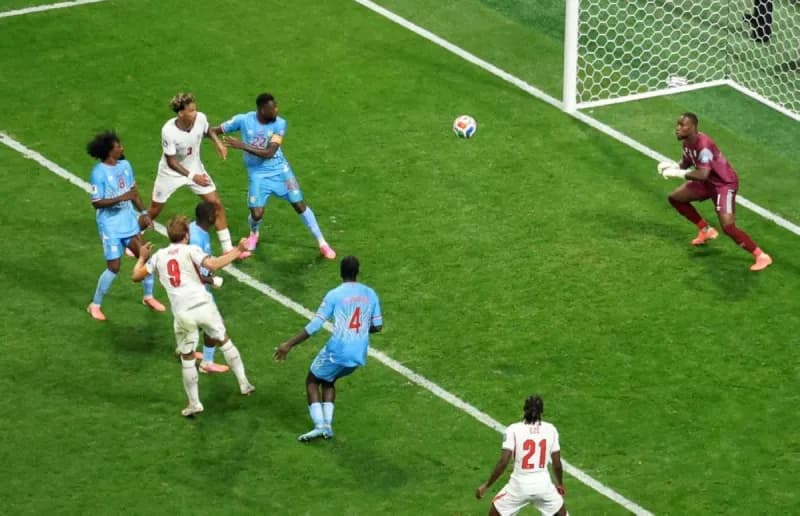
England faced significant difficulty advancing past the round of 32 against the Democratic Republic of Congo, coming close to a stunning World Cup exit in what nearly became one of the tournament's biggest upsets, before recovering just in time against an organised opponent that presented them with one of their toughest tests.
The Democratic Republic of Congo appeared the more tactically disciplined side, particularly in the first half, closing down space for Jude Bellingham and Marcus Rashford and forcing England to seek solutions from wide positions rather than through the centre, before ultimately profiting from crosses that delivered the victory.
The match saw the Leopards deploy an organised, compact defence combined with rapid transitions, exploiting the pace of Bryan Mbeumo and Yoane Wissa. This yielded an early goal and created spaces that unsettled the English defence on multiple occasions, with Congo's attacks consistently focused down the left, taking advantage of defensive weaknesses on Noni Madueke and Djed Spence's side.
Despite England's dominance of possession for much of the match, Thomas Tuchel's side struggled considerably against the opponent's solid defence and the extraordinary performance of goalkeeper Lionel Mabasi, who stood as an impenetrable wall against repeated English attacks.
Goalkeeper Lionel Mabasi was among the most prominent reasons for the DR Congo's resilience, delivering an exceptional performance and repelling repeated attempts from Harry Kane and Jude Bellingham, while also frustrating a dangerous chance for Marcus Rashford, confirming his status as the match's best player despite the defeat.
As time wore on, Tuchel recognised that breaking through the centre would not be the solution, and England turned increasingly to exploiting wide areas, with the number of crosses into the penalty box rising as they sought Harry Kane's aerial superiority.
The statistics underlined the scale of this shift: England delivered 35 crosses from open play, their highest tally in a World Cup match since facing Mexico in the group stage of the 1966 tournament — a clear indicator of their change in attacking approach.
The equaliser arrived in precisely the manner England had sought throughout the match, with Kane converting an precise cross from substitute Anthony Gordon with a header into the net, ending 75 minutes of resistance.
England did not settle for restoring parity but continued to press a Congolese side drained by the enormous defensive effort it had sustained throughout the match. The game also highlighted the importance of England's bench, as the introduction of Gordon gave the side greater pace on both flanks and higher-quality delivery from wide, which directly contributed to the equaliser and entirely altered the rhythm of the match.
Despite their defeat and elimination from the World Cup, the DR Congo left a positive impression with their organised and powerful performance, while Mabasi proved himself one of the standout goalkeepers of the tournament, having forced England to give everything they had before Kane's experience and aerial supremacy ultimately settled the contest.