
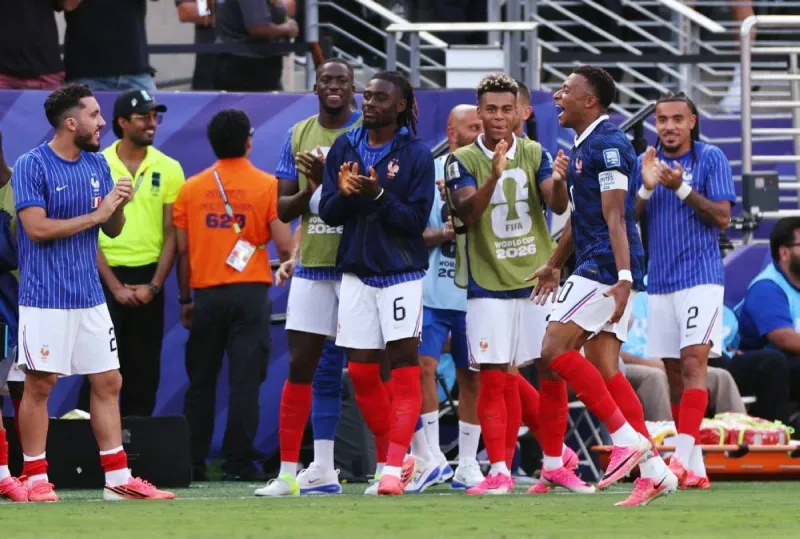
Attacking firepower and a clear quality gap settled the France vs Sweden encounter, which ended in a comfortable 3-0 victory for the runners-up of the previous edition, sending the French side into the round of 16 on merit and setting up a last-16 date with Paraguay.
The match reflected France's evident tactical, physical and mental superiority, and translated the attacking philosophy that defines Les Bleus, who imposed their rhythm from start to finish, confirming that France possess one of the most complete forward lines at the World Cup.
Match statistics revealed the scale of French dominance — perhaps more so than the scoreline itself. France could have won by more than 3 goals, as they controlled possession 61% to 39% and had 25 attempts compared to just 8 for their opponents.
Recording 13 shots on target stands as one of the most telling figures reflecting the strength of the French attack, as the team sustained relentless pressure that forced the Swedish defence to retreat for most of the match.
France's possession and superiority were underpinned by their ability to win the ball back quickly and transition immediately into the final third, which made it difficult for Sweden to organise their lines and left their defence facing wave after wave of French attacks.
The French attack was distinguished by its collective nature, not relying solely on individual solutions — particularly from the trio of Kylian Mbappé, Ousmane Dembélé and Michael Olise, who appeared the most cohesive and harmonious unit so far in the tournament. Each player creates additional space for his teammates to shine, making them exceptionally difficult for any defensive line to contain.
Attacking variety was also one of France's chief strengths in the match, not relying on crosses alone but also exploiting runs in behind, off-the-ball movement and rapid positional rotations, which consistently confused the Swedish defence and disrupted their markers.
Mbappé commanded the attention of the Swedish defence throughout the match, creating gaps that Olise and Barcola repeatedly exploited. Even when the France captain did not receive the ball, his movement alone was enough to drag defenders out of position and open up space.
Olise, for his part, delivered a performance that confirms he is no longer merely a skilful winger but an advanced playmaker with exceptional vision. His positioning between the lines and the quality of his passing left the Swedish defence in a constant state of uncertainty over whether to press him or protect the space in behind.
Olise's attacking contributions in the tournament reflect this evolution; he has become the World Cup's leading chance creator, an extension of the exceptional season he is producing for both club and country.
Although Dembélé was not at the centre of the goals in this match, his tactical impact was clear. His pace on the right flank forced Sweden to double up on him, which in turn gave Olise, Barcola and Mbappé greater space in behind.
Another hallmark of France was their increased reliance on positional rotation among the attacking players rather than adhering to traditional positions, making them even harder to track defensively.
France's counter-press immediately after losing the ball was equally prominent. They gave their opponents no opportunity to build attacks, recovering possession quickly in advanced areas, so that most of Sweden's attempts amounted to short-lived moves that ended before posing any real threat.
The match revealed that the French side did not need to produce their very best to settle the contest and secure a comfortable win. Despite squandering several chances, they remained fully in control until the final whistle, while the Swedish goalkeeper was called upon to make 10 saves just to keep the score at 3.
If the attacking trio maintain their current level — coupled with the tactical discipline France showed against Sweden — Les Bleus look like a leading title contender, not only thanks to Mbappé's talent but also by virtue of an attacking system that has become one of the most varied and compelling at the 2026 World Cup.