
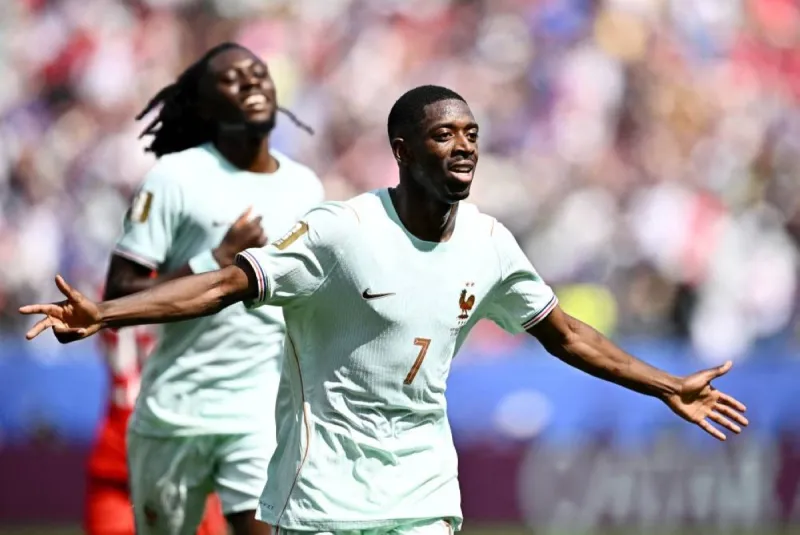
France sent a fresh warning to their rivals after their emphatic 4-1 victory over Norway in the final Group 9 match of the 2026 World Cup, proving that they do not rely solely on the abundance of stars in their squad. They also possess a complete tactical system combining high pressing, rapid transitions and flexibility in changing tempo — elements that allowed Les Bleus to finish the group stage with a perfect record and send a powerful message to their knockout-round opponents.
From the opening minutes, France's attacking intent was clear, as they deployed an advanced press to recover the ball in the final third while granting full freedom to the attacking trio of Ousmane Dembélé, Kylian Mbappé and Désiré Doué to interchange positions and move between the lines. The first signs came early, when French pressure forced the Norwegian defence to retreat, before goalkeeper Ørjan Nyland repelled successive attempts from Mbappé, Manu Koné and Doué.
In the attacking phase, France built play quickly through the midfield via Manu Koné and Aurélien Tchouaméni, while Michael Olise was deployed as a between-the-lines operator, giving Dembélé sufficient space to exploit his pace and ability in one-on-one situations.
The opening goal in the 7th minute perfectly embodied France's footballing philosophy, as Mbappé moved into depth before playing the ball to Dembélé, who exploited the space behind the Norwegian fullback and finished accurately into the net. The second goal came through one of France's most dangerous weapons — fast transitions — as Mbappé led a lightning counter-attack that ended with Dembélé's second goal in less than 20 minutes.
Despite Norway's success in pulling one back through Sivert Aasgjerd, taking advantage of a temporary gap between France's defensive and midfield lines, Les Bleus' response revealed clear tactical maturity. Rather than sitting back or losing their balance, France reasserted control of space and increased numerical density in depth, which produced Dembélé's third goal after a clever run behind Norway's midfield line and a decisive pass from Tchouaméni.
On the individual level, Ousmane Dembélé produced one of his finest international performances — not only by virtue of his hat-trick, but also because of his varied tactical role. He played as a wide attacker, then a second striker, and at times a false nine, continuously disorganising Norway's defensive structure.
Norway, for their part, attempted to adjust course in the second half by increasing pressure on the flanks and relying on the movement of Oscar Bobb and Andreas Sildilju, but France demonstrated another facet of their strength in defensive organisation and match management. This was most evident when goalkeeper Mike Maignan saved a penalty from Jørgen Strand Larsen at the start of the second half — a moment that effectively ended Norway's hopes of a comeback.
France also displayed considerable tactical flexibility after making substitutions, maintaining their attacking rhythm despite the withdrawal of Dembélé and Olise, with the threat continuing through Bradley Barcola and Rayan Cherki. The fourth goal, scored by Désiré Doué in stoppage time, was merely the crowning moment of this tactical superiority, coming from an organised attack that began from the flanks and ended with a precise cross and a well-executed header.
While the victory over Norway secured France's place at the top of the group, what matters more than the result are the technical indicators the team displayed — chief among them attacking cohesion, the ability to transition rapidly between defence and attack, and flexibility in adjusting the tactical shape during the match.
With this performance, France look like far more than just a conventional title contender, presenting themselves as a team that possesses both individual and collective solutions — the very equation that most often makes World Cup champions.