
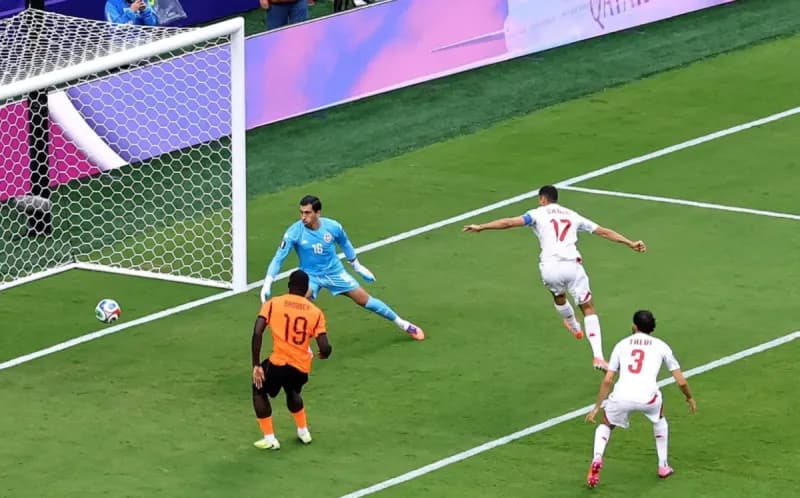
The 'friendly fire' saga continues to dominate the World Cup narrative, and the problem of own goals has become a striking statistical phenomenon that has forced its way onto the technical analysis table. These own goals are no longer mere fleeting defensive errors; they have become a genuine affliction haunting the Arab sides taking part. Shocking statistics show that 66% of own goals recorded in the tournament so far have come off the feet of Arab players.
The tournament has offered a succession of scenes illustrating this numerical predicament. The most prominent victims, including the latest, are Elias Al Sakhiri, the Tunisia captain, against the Netherlands; Mohamed Hany of Egypt against Belgium; Hassan Tambakti of Saudi Arabia in the match against Spain; Yazan Al Arab of Jordan against Austria; Mohamed Nasser Al Manaai of Qatar in the game against Canada; and Ayman Hussein of Iraq against Norway.
This high and alarming percentage reflects a compound crisis that combines mental collapse with tactical deficiency in dealing with crosses and situations requiring deep defensive recovery. Breaking down this deeply troubling figure, it becomes clear that the decisive factor is a loss of concentration in the fractions of a second before a player makes contact with the ball. The Arab player finds himself under unprecedented crowd and media pressure at this global stage, triggering both mental and muscular tension that robs the defender of his ability to direct his body correctly — producing catastrophic results instead of clearing the danger from his own goal.
From a technical standpoint, the tournament has also exposed a weakness in coordination and communication between goalkeepers and defenders, particularly when dealing with low, fast crosses that pass through the critical space — known as the 'death zone' — between the goalkeeper and the defensive line. Due to haphazard clearance attempts, defenders' feet have become an additional weapon for opposing attacks, especially in the final minutes of each half as fitness levels drop and sharpness of attention fades under fatigue.
Arab teams accounting for two-thirds of all own goals at the World Cup is not simply bad luck; it is an indicator that demands technical staffs immediately review their defensive systems. This should involve focusing on specialised training that simulates high-pressure situations inside the penalty area and intensifying the psychological preparation of players for how to act in deep defensive positions — to ensure that friendly fire does not consume whatever Arab ambitions remain at this great global tournament.