
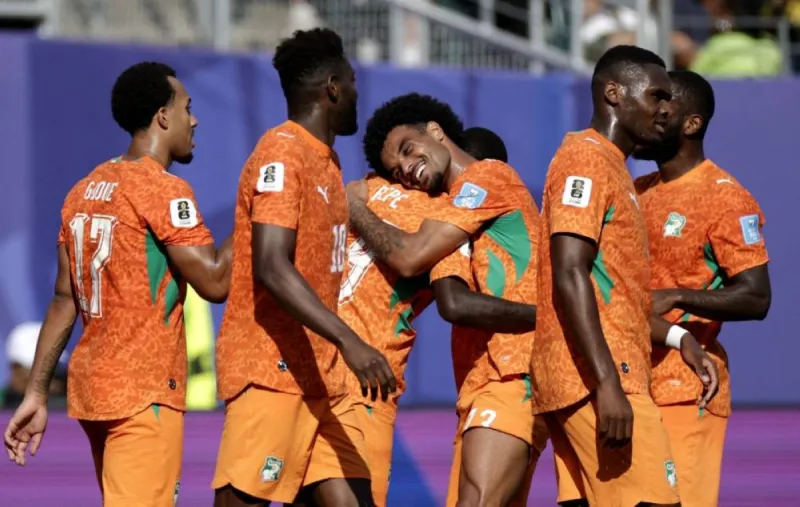
Côte d'Ivoire's national team successfully affirmed its technical superiority over Curaçao, settling the contest with 2 goals to nil in a match that reflected the gap in individual quality and collective discipline. The Elephants combined attacking effectiveness with defensive solidity to claim a deserved victory that showcased their ability to manage matches with minimal risk.
The Ivorian side needed just 7 minutes to stamp their authority on the scoreboard, as Nicolas Pépé converted a measured attacking move — finishing a pass from Yann Dioumandé — into an early goal that gave his side a psychological and tactical advantage, and forced Curaçao to gradually abandon their defensive caution in search of a way back into the game.
The early goal gave Côte d'Ivoire greater scope to control the tempo of the match, with their players confidently recycling possession and transitioning quickly between defence and attack, while a medium-press denied their opponents the chance to build attacks with any fluency.
Curaçao, for their part, sought a response through the movements of Tjaïnth Chong, Jürgen Locadia, and the Bakuna brothers, yet their efforts lacked precision in the final touch, despite some spells in which they succeeded in reaching the edges of the penalty area.
Despite their lead, Côte d'Ivoire's players did not overcommit forward; instead they maintained a clear balance across the lines, with Ibrahim Sangaré and Franck Kessié securing the midfield and cutting passing lanes — limiting their opponents' ability to create clear-cut chances — while Amad Diallo and Nicolas Pépé continued to threaten the goal with their constant movement on the flanks.
Before the end of the first half, Curaçao intensified their pressure through several set pieces and consecutive corners, but the Ivorian defensive organisation and good positioning inside the penalty area prevented any equaliser, and the first half ended with a deserved lead for the Elephants.
In the second half, it was clear that Côte d'Ivoire's coaching staff preferred to manage the game intelligently — retaining possession in safe areas and drawing their opponents out of their defensive shape. Despite some attempts from Curaçao, most notably a shot from Tjaïnth Chong that Yahia Fofana dealt with brilliantly, the Ivorian side remained the more dangerous team on the counter-attack.
The decisive blow came in the 64th minute when Ibrahim Sangaré led an organised attack, which Nicolas Pépé finished with a precise shot into the top corner — his second personal goal of the match — confirming his side's superiority at both the individual and collective level.
Côte d'Ivoire's coach made several substitutions after the second goal, introducing Elie Wahi, Omar Diakité, and Bazumana Touré, before also bringing on Jean-Michaël Seri, a move aimed at maintaining physical rhythm and giving more players competitive minutes without affecting the team's overall performance.
Curaçao's coach, meanwhile, attempted to reinvigorate the attacking line by introducing Tyrése Noslin, Gervane Kastaneer, and Jérémy Antonin, but the attempts lacked a decisive touch, while Yahia Fofana continued his commanding presence, keeping his sheet clean thanks to his good positioning and quick reactions.
The final minutes reflected the experience gap between the two sides, as Côte d'Ivoire's players expertly closed down space and managed the clock while continuing to threaten on goal whenever openings appeared, whereas Curaçao's late efforts were met by an organised defence and an alert goalkeeper.
With this 2-0 result, Côte d'Ivoire confirmed their technical readiness and their ability to combine tactical discipline with attacking effectiveness, while Curaçao departed having shown a fighting spirit but lacking the attacking solutions needed to convert their relative spells of possession into goals or genuine chances capable of changing the course of the match.