
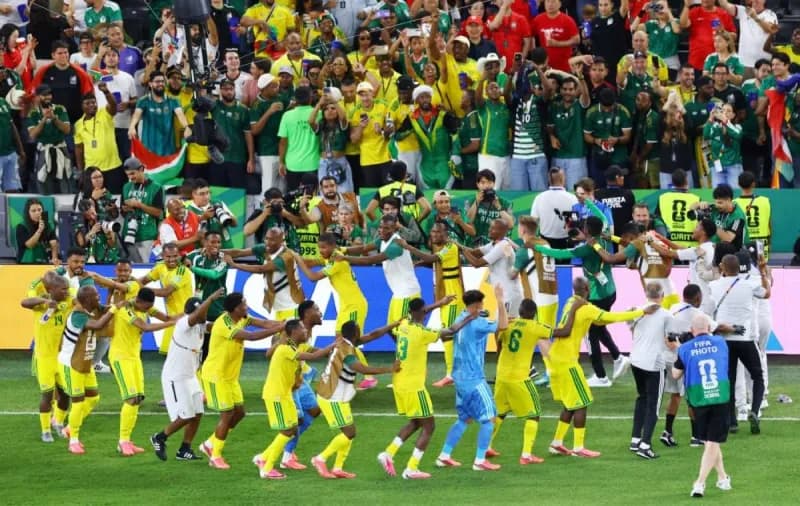
In a match that took on the feel of a final within Group A, South Africa handled their affairs with "pragmatism" to snatch a precious 1-0 victory over South Korea in an encounter defined by sharp tactical battle and a stark contrast between possession and decisive effectiveness, redrawing the competitive map of the group and keeping qualification calculations open until the final moments.
Statistics showed that South Korea were the more dominant side in terms of possession, controlling the ball 69% of the time, but that control did not translate into genuine danger, reflecting a clear dysfunction in converting possession into attacking effectiveness.
South Africa, by contrast, played in a more pragmatic and disciplined manner, relying on a defensive compact from the middle of the pitch, pressing the ball carrier, and then switching quickly through the flanks when in possession — an approach that gave the team a qualitative edge despite their lack of control.
Despite their limited possession, South Africa posed a significant threat to the Korean goal through counter-attacks, driven by swift transitions, intelligent exploitation of space, and a direct approach to finishing without wasteful individual showboating.
The Korean side attempted to circulate the ball and control the game as much as possible through a 3-4-1-2 system, seeking to impose an attacking siege on South Africa and find solutions to break through their solid defences. However, the team was let down by a lack of variety and poor build-up play in the final third, leaving their attacking effectiveness limited.
South Africa also benefited from their players' tactical discipline and strong physical performance in closing down the spaces available to South Korea's key playmakers, securing a pragmatic victory built not on luck, and making up for the disappointing performances in their first two matches by reaching the round of 32.
South Korea, meanwhile, served as a reminder to the football world that victory goes to the teams most intelligent in seizing the moment, not those who possess the ball the most. Their fate in the World Cup now depends on the results of others, after their tournament destiny had once been entirely in their own hands.