
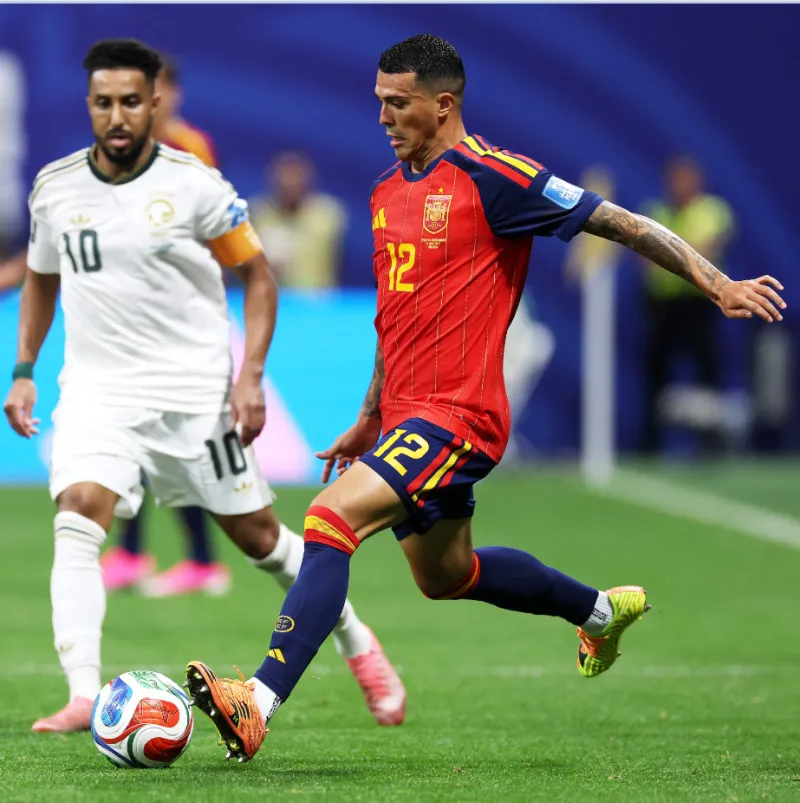
Spain's emphatic 4-0 victory over Saudi Arabia in the second round of Group 8 at the 2026 World Cup was not merely a heavy scoreline; it was a clear reflection of the gap between two sides in their management of space, structure and tempo — one possessing the tools of control, the other unable to escape its opponent's pressure.
From the opening minutes, Spain's intentions were plain: impose their familiar style of high possession and swift counter-pressing after losing the ball. La Roja needed only 10 minutes to translate their superiority, exploiting a rapid attacking transition that exposed Saudi Arabia's first major problem — slowness in defensive recovery and in dealing with crosses from wide areas. Lamine Yamal's goal was the product of a textbook counter-attack, one that began and ended faster than the Saudi defence could reorganise its lines.
The early goal granted Spain a simultaneous psychological and tactical advantage. Rather than pushing forward in search of an equaliser, Saudi Arabia found itself forced into prolonged defensive spells, allowing Spain's midfield — led by Rodri and Pedri — to take complete control of the match's rhythm. In the absence of effective pressure on the ball-carrier, the Spaniards recycled possession with ease and shifted attacks between depth and width without encountering any real resistance.
The second and third goals, both scored by Mikel Oyarzabal within the space of just 3 minutes, carried significant tactical meaning: the first came from a set piece, the second from an intelligent run inside the penalty area. This reflected the variety of attacking solutions at Spain's disposal. While Saudi Arabia focused on closing down spaces against ground-level penetrations, Spain successfully exploited aerial balls and runs from the second line, striking the defensive structure from multiple angles.
Saudi Arabia's greatest struggle was the large gap between their lines. When they attempted to press at certain moments, they lacked cover behind their midfielders; when they dropped into deep defence, they left comfortable space for Spain's playmakers on the edge of the penalty area. The partnership of Salem Al-Dawsari and Firas Al-Buraikan also received insufficient support in attacking transitions, leaving Saudi Arabia's forward play isolated and easily contained.
Spain, by contrast, demonstrated striking tactical maturity. After closing out the first half with 3 goals, they did not rush into further attacking showmanship but continued to control the match through ball circulation, forcing their opponents to chase. The fourth goal, arriving early in the second half — an own goal under sustained pressure — was the product of relentless pressing and an attacking presence that compelled the Saudi defence into error.
Despite the heavy scoreline, the full burden of responsibility cannot be placed on the Saudi backline. The problem began with the loss of control in midfield and the inability to break Spain's initial press, which exposed the defence to successive waves of attacks. The frequency of corners and second balls won by Spain also reflected the gap in overall territorial dominance.
On a positive note for Saudi Arabia, goalkeeper Mohammed Al-Owais produced several important interventions that prevented the margin from being even greater, and the team showed some organisation during intermittent spells in the second half — though this came only after the match had already been decided in practice.
In summary, Spain confirmed that they are among the sides capable of going far in the tournament when they find the space to apply their style, while the match revealed that Saudi Arabia need more effective solutions for playing out under pressure and maintaining a balance between defence and attack. The defeat was not the result of individual errors so much as a comprehensive Spanish superiority in managing the small details that make the difference in major matches.