
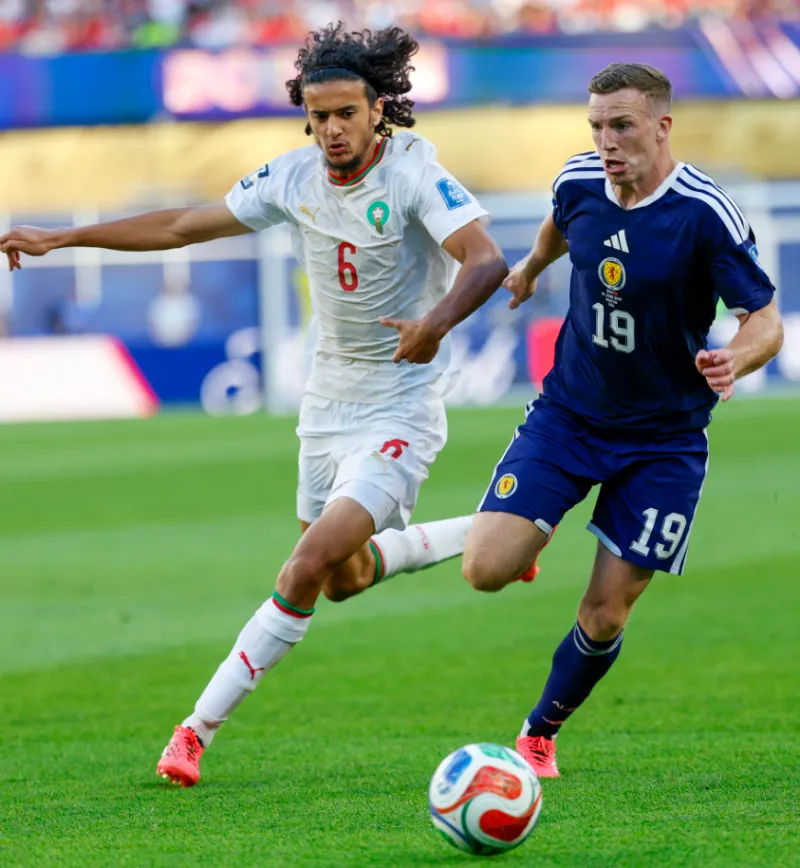
The scene was extraordinary not merely because of the magic unfolding on the pitch, but because of the hidden geopolitical and cultural layers that the World Cup cameras could never capture.
In the spotlight of that World Cup evening, Ayoub Bouaddi — a young man who has barely left the opening years of his professional career — chased the ball with the ice-cold composure of a seasoned veteran hardened by decades on the field. Close by, in the very same central circle, Naïl Aynaou moved with an excess of confidence: the confidence of someone accustomed to intense pressure since childhood, demanding the ball in the most complex moments as though it were his birthright and a territory of his own authority.
Morocco's midfield at the 2026 World Cup appeared older than the combined ages of its players, and more mature than any projection on paper or collection of assumed experience could suggest.
But this story did not begin on the grand stadiums of the World Cup. Its details were shaped years earlier, inside homes that understood sport as a daily creed long before the glare of fame came knocking.
In the French city of Creil, Ayoub Bouaddi grew up within a Moroccan immigrant family that made strict discipline the architecture of daily life. His father was not a football star trailed by camera flashes; he played handball — a noble and demanding sport that may stand somewhat apart from the roar of the biggest spotlights, yet carves into bodies and minds the values of sacrifice, collective cohesion, and steadfast daily commitment.
Bouaddi grew up in an environment that did not celebrate raw natural talent in isolation, but regarded it as a moral responsibility requiring refinement. Academic excellence was an inseparable part of his personal formation, just as training sessions were.
When asked later about the secret behind his glacial calm and early maturity amid the roar of crowds, he did not speak of coaches' tactics or the philosophy of European academies. Instead, his memory went directly to the threshold of his home, cutting through any doubt with the certainty that his parents were the ones who instilled his values and principles in him, and that his work ethic came from deep upbringing before anything else.
Perhaps that is why his tactical surges on the pitch never appear reckless or emotional. He is closer to that breed of peripatetic philosophers whose thinking is born from movement — measuring each step on a jeweller's precise scale before taking it, weighing each decision in fractions of a second before executing it, as though carrying with him the guiding voice and gravity of his family onto the field.
On the other side, Naïl Aynaou's journey played on entirely different strings. In his home in the city of Nancy, sport was present at a higher volume and with a globally resonant rhythm. His father, Younes Aynaou, is no ordinary former athlete who passed briefly through history. He is one of the greatest icons in the record of Moroccan and Arab sport — a tennis player who carved his path with thunderous shots to reach a world ranking of 14, who once stood against the giants of the game on clay and grass, carrying Morocco's name to platforms that even the most optimistic observers did not believe an Arab player could reach.
In his childhood, Naïl had no need to search for a distant role model or a legendary hero on television screens. The role model sat with him at the dinner table. He witnessed with his own eyes what it means to wake at dawn to challenge the world, what a crushing defeat in a decisive tiebreak means, and how its pain can be converted into vital fuel for the next attempt.
Naïl absorbed early what true success looks like when it is built on years of exhausting travel, solitary training, and the existential solitude that individual sports impose on their champions. Yet despite that weighty legacy, he did not choose to follow in his father's footsteps with a yellow racket. He tried tennis in his early years before football seized his imagination entirely.
It was a quiet, intelligent act of rebellion against the legacy — not a rejection of it. He chose a different game in form, yet retained the essence of what he inherited in substance: steel psychological resilience, the capacity to bear pressure when time runs out, and an unshakeable belief that the small, hidden details are what separate the champion from the transient.
And so the two schools met and complemented each other at the heart of the Moroccan national team's new engine room. From the rigour of handball and its distance from the spotlight, Bouaddi brought the philosophy of the collective, silent discipline, and self-imposed commitment. From the brilliance of tennis and its scorching one-on-one duels, Aynaou brought the mentality of the individual fighter who knows that responsibility in critical moments cannot be shared with anyone, and that the hardest battles — on the field and tactically — are decided in the mind before the feet translate them.
This fusion is perhaps what sets Morocco's new generation on a different course from its predecessors. The generation of yesterday, which crafted the historic epic of Qatar 2022, was largely made up of children of classic immigration who forged their path bitterly against circumstances of marginalisation, doubt, and prejudice in the suburbs of Europe.
Today's generation appears to add a new, Aristotelian layer to Morocco's footballing narrative: a generation raised in stable homes that believed in sport as a culture and a daily intellectual structure, not merely as a lifeline or a solitary dream of escape from difficult economic realities. It is a generation that inherited from its fathers an advance, proven knowledge of the price of success — the long, exhausting hours that climbing to the top demands, and staying there.
When a Moroccan supporter today watches Ayoub Bouaddi winning an impossible ball with cool precision without committing a foul, or Naïl Aynaou imposing his own musical rhythm in the centre of the pitch, they are undoubtedly watching two gifted players wearing a precious national shirt.
But behind that visual image, another and deeper story hides: the story of a father who carried handball to the west of France and left his son a legacy of values written in the notebooks of patience, and the story of a father who carried a tennis racket to the greatest arenas in the world and left his son the genes of an ambition that recognises no ceilings.
Between these two complementary legacies, a new heart was born for the Atlas Lions — a heart that does not content itself with inheriting raw natural talent, but inherits the genes of sporting culture itself, to re-shape it in its own unique way on the greatest and grandest stages of world football.