
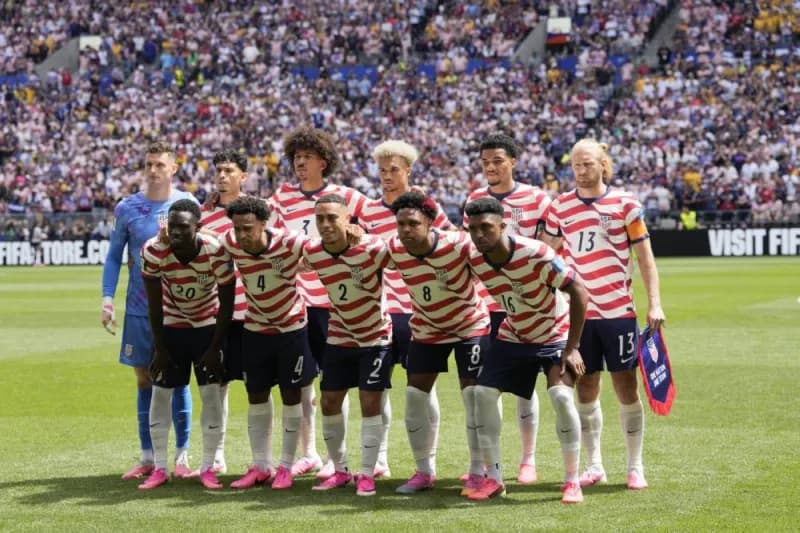
The United States men's national team's 2-0 victory over Australia carried deeper technical indicators relating to the evolution of the team's identity and its ability to manage big matches with efficiency and tactical flexibility. The win, which secured the Americans an early passage to the knockout rounds, reflected an organisational superiority more than a numerical one, and showcased a side that knows when to press, when to slow the tempo, and when to close out a match without the need for an attacking showcase.
Although the opening stages featured an early Australian warning through Mohamed Toure, the United States quickly imposed their control over the midfield zones, benefiting from the intelligent movement of the Tyler Adams–Weston McKennie partnership, which provided balance between defensive construction and attacking transition.
That dominance in the pivot area gave the hosts the ability to dictate the match's rhythm and prevent Australia from building their attacks or exploiting their pace in the spaces behind.
Attacking density
The first goal arrived in the 11th minute via an own goal after Cameron Burgess mishandled a dangerous ball inside the area, but the goal was no product of chance — it was a direct consequence of sustained American pressure on the Australian back line.
The relentless American attacking density forced the defenders into hasty decisions, which was reflected in the own goal that handed the hosts an early psychological and tactical advantage.
After taking the lead, the United States did not retreat into their defensive shape as many teams would; instead, they continued to press high and exploit the flanks, particularly through Sergino Dest and Antonee Robinson, forcing Australia to defend for long periods.
Australia, meanwhile, struggled to build out of the back in an organised manner due to the tight marking and quick counter-press applied by the American players the moment possession was lost.
Variety of solutions
The second goal, scored by Alex Freeman just before the end of the first half, served as the decisive tactical blow. Coming from a set piece, it was an indicator of the variety in the United States' attacking solutions and their lack of dependence on a single pattern in chance creation. Australia found themselves required to come back from a 2-goal deficit against an opponent well-organised defensively.
In the second half, the Australian manager attempted to change the picture through several attacking substitutions, most notably the introduction of Nestory Irankunda and Christian Volpato, but those changes failed to break the American defensive cohesion.
While Australia did create some chances — most notably a Volpato attempt and a Connor Metcalfe shot that Matt Freese dealt with — they lacked the required quality in the final third.
Defensive balance
In contrast, the United States showed clear maturity in managing the result, gradually reducing the pace of play and relying on ball circulation and space-closing while maintaining defensive balance and avoiding ill-considered surges forward.
The substitutions made by manager Mauricio Pochettino also revealed depth on the bench and the ability to maintain the same level without any noticeable drop in quality.
Overall, the match confirmed that the United States do not rely solely on home crowd enthusiasm or home advantage, but possess a fully integrated collective system that develops from match to match.
As for Australia, despite their organisation and discipline, they paid the price for their defensive errors and their inability to match the physical and technical tempo imposed by their opponents.
With qualification secured, the United States sent a clear message to their rivals: their World Cup project is now more mature and capable of competing in the later rounds.