
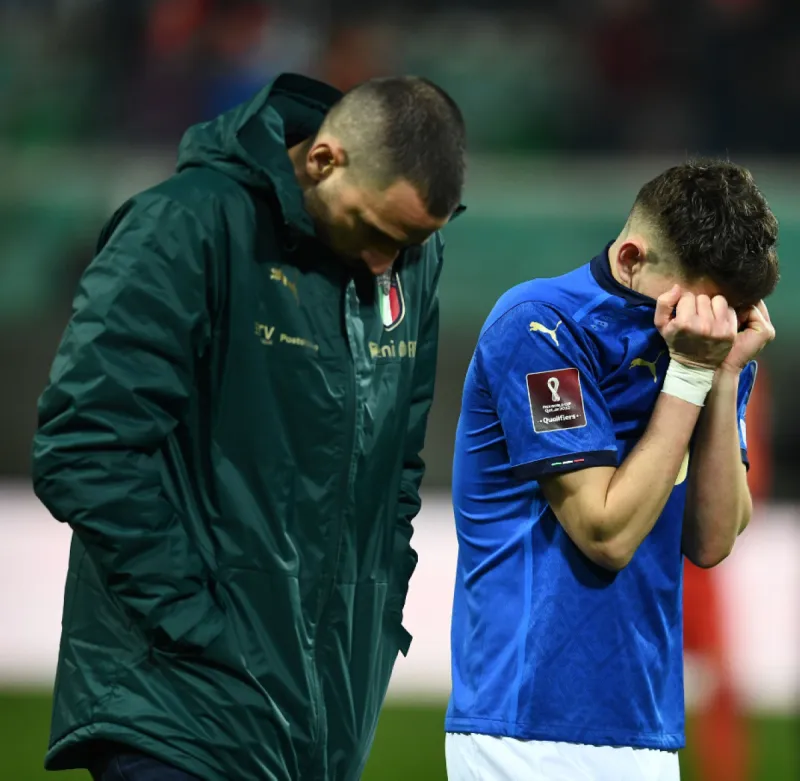
Italy's failure to qualify for the FIFA World Cup finals for the third consecutive time has triggered a wave of political and popular anger in a country obsessed with football, turning into a bitter battle over who should control the game.
The Brothers of Italy party, led by Prime Minister Giorgia Meloni, was quick to propose curtailing the powers of the Italian Football Federation (FIGC), after its president Gabriele Gravina, 72, was forced to resign in April under intense pressure following the defeat against Bosnia and Herzegovina in the World Cup qualifying play-off.
With June 22 set as the date for new federation presidential elections, Meloni's allies are pushing to cancel the vote and place the football governing body under special administration — an exceptional mechanism previously used to help Italian football overcome major corruption scandals.
In a country where the game holds a status that transcends sport to become part of national identity, the failure to reach the World Cup has become a proxy battleground over governance, reform, investment, and the limits of executive influence within independent institutions.
Government versus football establishment
"The top priority should not be holding new elections; it is not through elections alone that the right conditions for a revival can be created," Italian Sports Minister Andrea Abodi summed up his view of the crisis in an interview with Politico.
Football officials, by contrast, saw the government's moves as an attempt to impose guardianship over the game and to prevent the frontrunner, Giovanni Malagò, former president of the Italian National Olympic Committee, from assuming the post, on the grounds that he is not welcome within Meloni's party.
Gravina told Politico: "The idea of placing the federation under special administration suggests to me nothing other than an attempted occupation by the government, and it offers no vision for the future." He added: "The idea of taking control of the football world has been floated for a long time."
Opposition parties, for their part, accused the Meloni government of seeking to concentrate power in its own hands, marginalise dissenting voices, and appoint loyalists to positions of influence — arguing that this approach is not limited to football but extends to state television, the financial markets regulator, and even the judiciary.
Dysfunctional rules and institutional ageing
Yet the roots of Italy's crisis did not begin with the loss of a decisive match or a stumble in qualifying. Since their last World Cup triumph in 2006, the Azzurri have gradually declined from a world football power to a second-tier side, in a trajectory that broadly mirrors the country's economic and institutional stagnation.
As in other sectors of Italian life, football leadership suffers from ageing, while successive reform efforts have run into a wall of entangled interests and resistance from both large and small clubs alike.
In a scene that sometimes recalls the decision-making mechanisms of the European Union, the constituent bodies of the FIGC — representing amateurs, players, coaches, referees, and others — hold veto rights that effectively allow them to block any structural change.
Gravina complained about this, saying: "Under these rules, no reform process can be launched." He added that proposals to reduce the number of teams promoted and relegated each season, and to cut the top-flight league from 20 to 18 clubs in order to strengthen financial stability and raise the technical level of the competition, had been rejected 17 times by lower-division clubs.
After the Bosnia and Herzegovina shock, debate over the structural causes of Italian football's decline — such as crumbling stadiums and insufficient reliance on young Italian players — quickly gave way to a power struggle over the identity of the next federation president.
Limited options and legal manoeuvres
Italy's top-flight clubs, which hold the greatest financial clout but only 18 per cent of the electoral votes, were quick to declare their support for Malagò, 67, who is widely regarded as a successful administrator and a consensus-building figure. Players and coaches also lined up behind him, pushing his expected support above the threshold needed to win.
His rival, Giancarlo Abete — a veteran sports official who previously presided over the federation the last time Italy participated in a World Cup in 2014 — is not expected to pose a serious challenge to Malagò's prospects.
Malagò's rapid rise proved a setback for both Minister Abodi and Finance Minister Giancarlo Giorgetti, known for his passion for football, after Malagò fell out with both of them in 2018 over a controversial reform aimed at curtailing the financial influence of the Italian National Olympic Committee.
The final race before June 22
With only days remaining before the election, the government's bet on placing the federation under special administration appears to be gradually losing momentum. Legally, the authority to make such a decision rests with the Italian National Olympic Committee, not the government. Moreover, the conditions that would justify resorting to it — such as serious violations or disruptions threatening the normal running of competitions — have not been met so far.
The government's last recourse would be to challenge Malagò's eligibility through a legal review to determine whether his appointment would violate conflict-of-interest rules, given his recent experience within the Italian National Olympic Committee.
To that end, the Meloni government has tasked an independent anti-corruption authority, alongside the Italian National Olympic Committee, with examining the matter before the June 22 elections — though former football officials have ruled out any success for this endeavour.
But in a country where political calculations frequently intersect with the management of institutions, competence alone may not be enough to determine the fate of the next FIGC president — a reality Gravina understands well. "Whoever wins, I hope political relations do not prove an obstacle for them, as they were for me," he said in the aforementioned interview.