
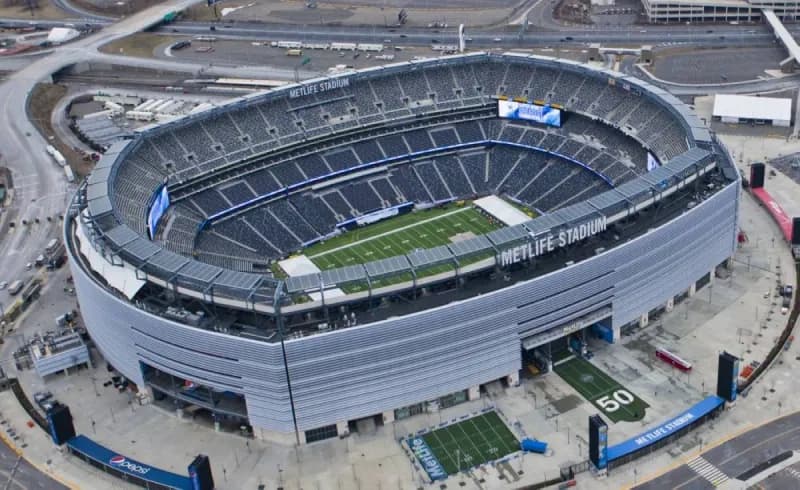
The venue for the 2026 World Cup final has come last in a ranking of the tournament's best stadiums, despite being chosen to host the most important matches of the competition, after MetLife Stadium in New Jersey received the lowest score among the 16 host venues.
The Athletic compiled a ranking of the 2026 World Cup stadiums based on assessments by its correspondents who visited the venues during the tournament, using five criteria: matchday experience, crowd atmosphere, transport and location, architectural design, and suitability for football.
MetLife Stadium, which will host the World Cup final, received just 30 points out of 50, placing it 16th and last. Its score was primarily affected by its location and difficulty of access, with the venue receiving just 3 points in the transport and location category.
The report noted that the stadium, located in New Jersey several miles from New York City, offers good sightlines from various stands and a strong atmosphere inside, but drew criticism for being situated in an isolated area catering exclusively to match attendees, alongside limited surrounding options for fans and high transportation costs.
MetLife received 9 points in the match atmosphere category, thanks to the strength of crowd presence and support inside the stands, along with 7 points each for matchday experience and suitability for hosting football matches. However, it lost points for its exterior appearance, receiving just 4 points in the design category, with the report finding that its look lacks appeal compared with a number of the tournament's other stadiums.
Lumen Field in Seattle and Mercedes-Benz Stadium in Atlanta topped the ranking, each receiving 47 points out of 50, thanks to a combination of ease of access, distinctive design, and fan experience.
The report praised Lumen Field for its location in the heart of Seattle and its connection to the surrounding atmosphere, as well as the varied design of its stands and the proximity of fans to the action, while Mercedes-Benz Stadium stood out for its retractable roof, internal air conditioning, variety of services, and ease of access via public transport.
SoFi Stadium in Los Angeles came third with 44 points, owing to its modern design, giant screens, and ease of fan movement inside, while Gillette Stadium in Boston placed fourth with 41 points, benefiting from its steep stands that help amplify crowd noise, as well as the famous lighthouse that stands 218 feet tall behind one of the goals.
Several stadiums tied for fifth place with 40 points each, among them the historic Azteca in Mexico — which hosted the 1970 and 1986 editions — and received a perfect score in design and football atmosphere suitability, as well as Arrowhead Stadium in Kansas City, which holds the world record for the loudest crowd noise, BMO Field in Toronto, BBVA Stadium in Monterrey, and NRG Stadium in Houston.
The list also included stadiums with distinctive designs, most notably Estadio Akron in Guadalajara, which was designed to resemble a volcano with a roof shaped like a volcanic crater, and placed 12th with 36 points, alongside Levi's Stadium in California, whose highest seats sit 200 feet above the ground.
The ranking showed that choosing the best World Cup stadiums depended not only on capacity or modernity, but on the complete fan experience — from arrival at the venue to the atmosphere inside and the extent to which the design reflects the spirit of football.