
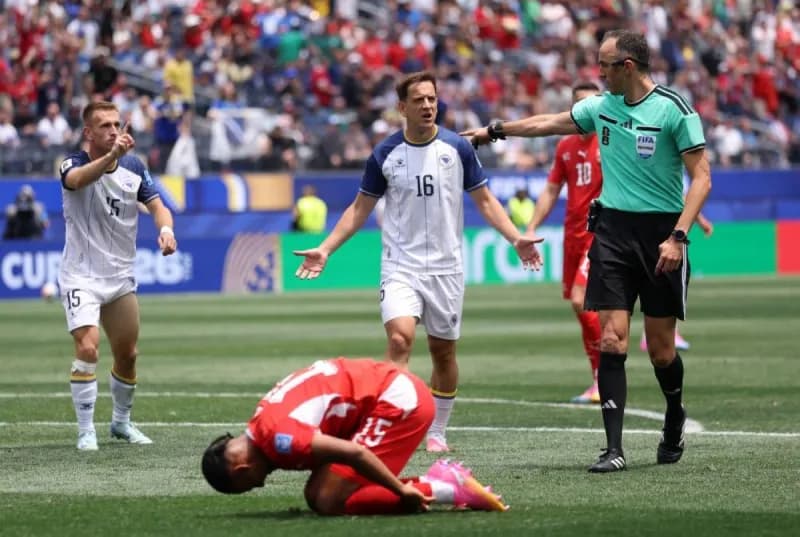
Before the 2026 World Cup kicked off — featuring an unprecedented 48 teams for the first time in the tournament's history — there was extensive debate about the amendments approved by FIFA and the International Football Association Board (IFAB), and how they could contribute to increasing actual playing time during matches and minimising time-wasting to the greatest possible extent.
FIFA sought to curb time-wasting through a package of amendments aimed at speeding up the resumption of play and reducing unnecessary stoppages on the pitch.
Among the most notable new rules was the introduction of a 5-second countdown for throw-ins and goal kicks, in an attempt to prevent players from burning time during routine situations.
Substitutes were also required to leave the pitch within just 10 seconds, putting an end to practices that had previously added lengthy periods of stoppage time in the closing minutes. In addition, players receiving treatment were required to remain off the pitch for a full minute, which curtailed the repeated instances of players going down to waste time.
After the conclusion of the first round and part of the second round of the group stage, statistics revealed a variation in actual playing time and overall match duration — and perhaps a contradiction compared with figures from the three previous World Cups in Russia 2018 and Qatar 2022 — but this apparent contradiction exposed the true effectiveness of these amendments.
According to Opta data, the total match time in the first round of the 2026 World Cup reached 96 minutes and 8 seconds, excluding cooling break stoppages, which is slightly less than the total match time recorded at the Russia 2018 World Cup of 96 minutes and 54 seconds.
The current edition also recorded a significantly lower figure than the Qatar 2022 World Cup, where total match time in the first round reached 102 minutes and 43 seconds, with stoppage time occasionally reaching around 10 minutes — which is, of course, a positive indicator.
Many had assumed that accounting for 3 minutes of water breaks per half would increase added time, but the opposite occurred: stoppage time ranged between 5 and 6, or 7 minutes at most, in contrast to the Qatar World Cup, where some matches saw 10 or more minutes added.
In terms of actual playing time in minutes, and based on estimates, actual playing time at the current World Cup averaged 57 minutes and 22 seconds — less than the Qatar 2022 World Cup average of 58 minutes and 8 seconds, while the average actual playing time at Russia 2018 was approximately 54 minutes and 50 seconds, which is lower than the figure recorded at the current edition.
Although playing time in the first round is lower than at the Qatar edition, the actual playing time as a proportion of total match time indicates that the current World Cup is seeing an increase in the average time the ball is in play on the pitch.
First-round matches in the current edition achieved the best ratio among the three tournaments, with actual playing time reaching 59.4% of match time, according to Opta, while the figure at Qatar 2022 was just 56.86%, despite the significant increase in stoppage time added.
At Russia 2018, the proportion of total match time stood at approximately 56.25%, making it the lowest of the three editions compared to 2022 and 2026.
The figures therefore confirmed that the objective was not to lengthen matches, but to increase the time the ball remains in play, as on-pitch incidents demonstrated widespread compliance by players with the new rules — with only a single violation recorded for a delayed goal kick, which was converted into a corner kick.
First-round matches also saw no instance in which a substitute was prevented from entering the pitch due to the substituted player's slow departure.
Ultimately, the first-round matches served as a clear indicator of the success of the new rules in changing player behaviour and reducing time-wasting tactics without the need for lengthy added time at the end of matches, resulting in increased actual playing time — but the question remains: will the rest of the World Cup's matches continue at the same rates, or even higher, or will there be a decline?