
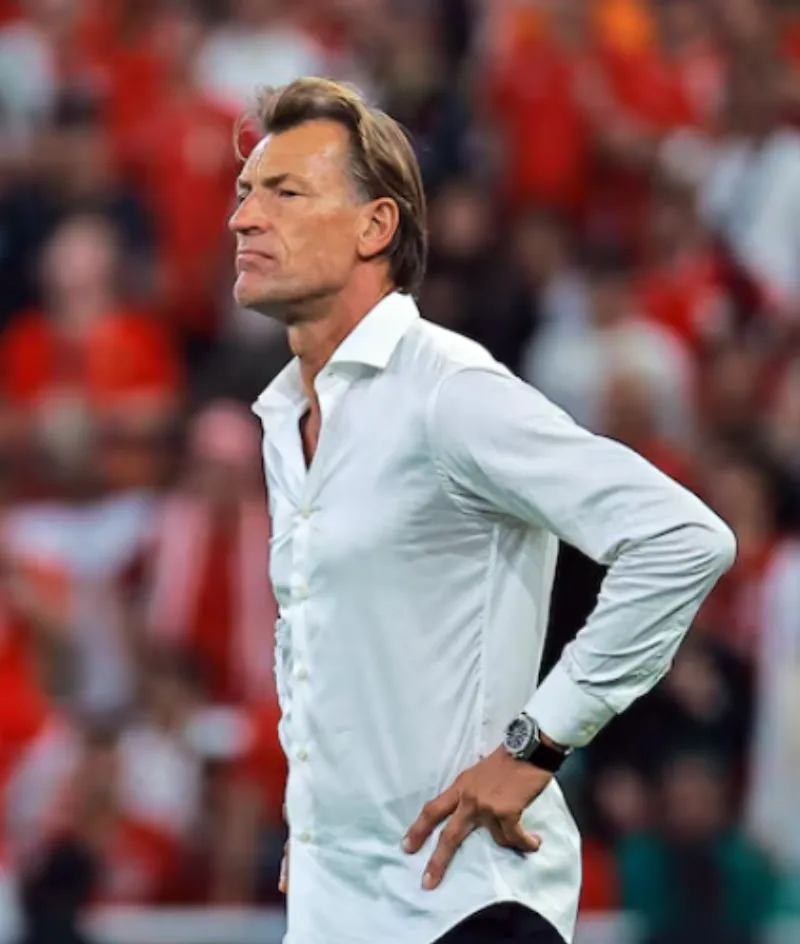
The globe-trotting French coach Hervé Renard, appointed to lead the Tunisian national team in the middle of the World Cup finals, is returning to an African side — the ground of his earliest achievements — in an attempt to relaunch his career, two months after being sacked as Saudi Arabia's manager.
Tunisia took the extremely rare decision to change coach during the World Cup, with Sabri Lamouchi paying the price for a heavy 1-5 defeat to Sweden on Sunday in the first round. This is not the first time a coach has been dismissed during a tournament, but in previous cases — Tunisia itself, South Korea and Saudi Arabia in 1998 — federations preferred to appoint a caretaker from within the technical staff rather than bringing in an outside coach.
In unprecedented circumstances, Renard will have only a few days to join the squad's camp in Monterrey, Mexico, get to know players he did not select, and prepare them to face Japan on Sunday. Another defeat could mean elimination, should the Netherlands beat Sweden on Saturday.
The 57-year-old coach — whose Hollywood-star looks, white shirt, fair complexion and long hair are part of his trademark image — has accepted what amounts to a near-impossible mission, at the helm of a squad with no star names that has never advanced beyond the first round in six World Cup appearances. But this kind of challenge is a hallmark of Renard, who will take charge at a third consecutive World Cup with a third different national team.
Renard has a reputation as a constructive coach capable of achieving remarkable results with limited means, although he has not lived up to that reputation with better-resourced teams. He had been available on the coaching market since his dismissal from Saudi Arabia in April, despite having guided the Green Falcons to qualification for the 2026 World Cup. The former player — whose record was modest, with a single first-division appearance with Cannes in the late 1980s — has always been accustomed to forging his own path away from conventional routes, ever since he began his coaching career in the fifth tier in 1999 at Draguignan, in southern France.
In Africa, he learned the trade under Claude Le Roy, serving as his assistant with Ghana from 2007 to 2008. He told Agence France-Presse in 2022 that the relationship "changed my future," while Le Roy recalls him as someone who "worked like a workhorse." The pupil parted ways with his mentor when he took charge of Zambia from 2011 to 2013, leading them to a surprise Africa Cup of Nations title in 2012. Three years later he repeated the feat with Ivory Coast from 2014 to 2015 — having succeeded... Sabri Lamouchi.
Those titles opened the doors to more prestigious posts, with Morocco from 2016 to 2019 and Saudi Arabia from 2019 to 2023 and then 2024 to 2026. He possesses considerable charisma, but results have not always matched expectations. He led Saudi Arabia to a stunning 2-1 victory over Argentina — later crowned world champions — in the 2022 World Cup group stage. Images of his half-time team talk spread widely, reinforcing his reputation as a coach who knows how to speak to his players.
Yet Saudi Arabia finished bottom of their group, as had happened with Morocco in 2018 under his stewardship. His stint with the France women's team from 2023 to 2024 ended in two quarter-final eliminations — at the 2023 World Cup and then at the Paris Olympics. Those results compound his modest experiences with Sochaux from 2013 to 2014, where he was unable to prevent the club's relegation to the second division, and with Lille in 2015.
His bid to restore his lustre comes as Tunisia's national team tries to avoid elimination. In Tunisia, fans appeared deeply sceptical about the chances of a "miracle" from the "White Wizard": Salim, a café owner, said that "sacking Lamouchi is not a solution," arguing that "the problem lies with the players, who lack quality." Wiam, a factory worker, felt it would be better for "the national team to withdraw" from the World Cup. She added: "All the people" at the Tunisian Football Federation must be changed — "everyone, from the most junior official to the most senior. Nepotism must end."