
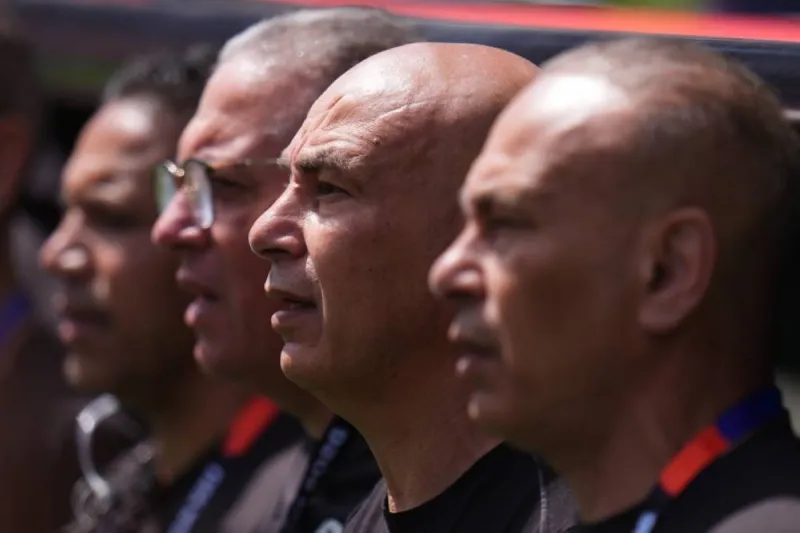
The road was never smooth for Hossam and Ibrahim Hassan. Almost every stage of their journey brought a different test — from early days on the pitch to leading the Egypt national team at the 2026 World Cup — yet their shared constant has always been an ability to handle pressure and let results inside the stadium do the talking.
The twins faced a heavy wave of criticism from the moment they took charge of the Egypt squad. Some doubted their ability to guide the Pharaohs through such a critical period; others felt the national team needed a different kind of experience at this stage. But Hossam and Ibrahim responded in the same way the public had come to know over the years: work under pressure and let the results provide the answer.
Egypt's opening appearance at the 2026 World Cup served as the first major test of the twins' tenure. The Pharaohs drew 1-1 with Belgium in the first round — a result that deferred the dream of recording Egypt's first-ever World Cup victory, yet offered a different image of a team that had competed with one of the tournament's stronger sides.
Beyond the result itself, the twins' joint presence at the helm attracted the interest of several foreign journalists at the pre-match press conference. Hossam Hassan spoke about his brother Ibrahim's role — as team director — in preparing the players mentally to compete in a tournament of the World Cup's scale, a role rooted in a long relationship forged together both on and off the pitch.
The twins' journey began in the Helwan district of Cairo, where they were born in 1966 to a father who already had 8 children — 4 boys and 4 girls — before the two brothers, separated at birth by just five minutes, became among the most prominent names in Egyptian football history.
From their earliest years the twins followed virtually one path, eventually joining Al Ahly's youth ranks after a month-long trial conducted without their family's knowledge, marking the beginning of a long journey built not only on talent but on a character hardened by competition and difficult circumstances.
Their mother was one of the most influential figures in that story. Hossam Hassan has spoken previously about their deep bond with her, noting that the two of them were accustomed to sleeping beside her right up to their participation in the 1990 World Cup, and that having her with them during travel gave them support through every phase of their careers.
On the pitch the twins forged a special partnership. Ibrahim became one of the standout wingers of his generation while Hossam grew into one of the most important strikers in Egyptian football history, and the remarkable understanding between them produced countless moments that live on in supporters' memories to this day.
Their success stretched from Al Ahly and the Egypt national team to a European chapter with Swiss club Neuchâtel Xamax, where Hossam scored a historic four goals against Celtic while Ibrahim found the net against Real Madrid, confirming the duo's presence beyond Egypt's borders as well.
Difficult decisions were never absent from the twins' careers. Their move to Zamalek at the turn of the millennium was one of the choices that provoked the strongest reactions, yet they continued on their path and added new titles to their record while wearing the white shirt.
The World Cup remains an important part of Hossam and Ibrahim's story. They were members of the Egypt generation that reached the Italia 1990 World Cup, and it was Hossam who scored the famous goal against Algeria in November 1989 at Cairo Stadium — the goal that handed the Pharaohs their qualification ticket after a long absence.
36 years on, only the positions have changed. The twins have returned to the World Cup, but this time from beyond the touchline — Hossam as head coach and Ibrahim as team director — in an experience that carries pressure, yet one that is not far removed from a career in which they grew accustomed to facing the hardest of tests.
The roles between yesterday and today have shifted, but the same relationship between the two brothers endures. From players who carried the dream of reaching the World Cup, to leaders of a squad in search of a new achievement — the twins' journey presses on, having begun inside the stadium and now being written from a different vantage point with the Egypt national team.