
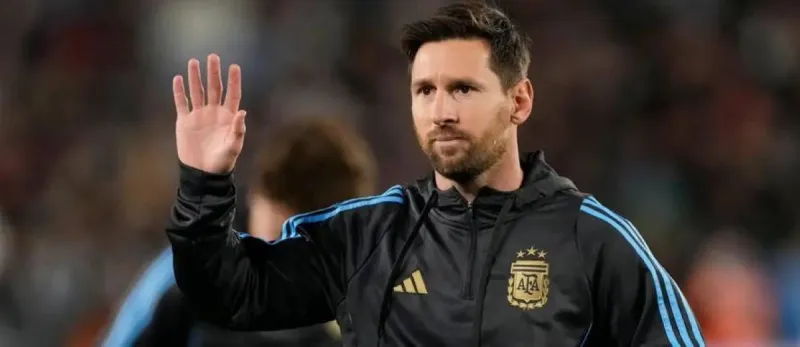
In the world of sport, some things never change — among them Lionel Messi's legendary skill, and his strict insistence on speaking only in his mother tongue, Spanish. But the latest press conference held by the Argentine national team camp in the United States shattered that pattern, detonating a bombshell surprise that quickly became a global trend.
During the conference, an American journalist directed a question to the captain of La Albiceleste, and instead of the usual wait for the simultaneous interpreter, Messi stunned those present by answering directly in a short, terse — but perfectly clear — English sentence.
American media seized on the moment with great enthusiasm, with sports journalists across the United States concluding that the two years Messi has spent at Inter Miami have begun to visibly reshape his linguistic profile, and that he has absorbed American culture faster than anyone expected.
On social media, a wave of witty and satirical comments ignited, with fans unanimously agreeing that Messi had not merely spoken English — he had spoken it with a "local Florida accent," a nod to his complete integration into the Miami atmosphere, as part of his mental and communicative preparation for what many are calling the "last dance" of his World Cup career.
Despite the charm of the moment and its marketing dimensions, it opens the door to reflection on a phenomenon that has accompanied Messi throughout his career: a fierce pride in national identity and language.
Over two decades in Europe, Messi moved between Barcelona and Paris, living in richly multicultural environments, and despite understanding and having a command of other languages, he imposed his linguistic pride on everyone around him. At a time when stars race to learn English to win over global sponsors, Messi always held that his Spanish — in his distinctly Rosario, Argentine accent — is an inseparable part of his identity as a player and as a human being. On the grandest of stages, from the Ballon d'Or ceremonies in Paris to press conferences at World Cup finals, Messi forced the global media to translate for him, sending a veiled message: "Anyone who wants to hear from the greatest of all time must understand him in his own language."
Sociological critics argue that Messi's attachment to his language served as an umbilical cord connecting him to fans in Argentina, who for many years reproached him for spending most of his life in Europe. That insistence on his language and local accent rebuilt bridges of trust and full loyalty with the people of his homeland.
Sports media experts, meanwhile, believe that the English sentence Messi delivered in Florida does not signal an abandonment of his linguistic heritage, but rather a "clever salute" to the host country that has embraced the final chapter of his legendary career.
Messi has proved, even while speaking a few words of English, that he is the one who sets the rules — when to stay silent, when to speak, and in whatever language he chooses — leaving the world, as always, running after him to understand what he said.