
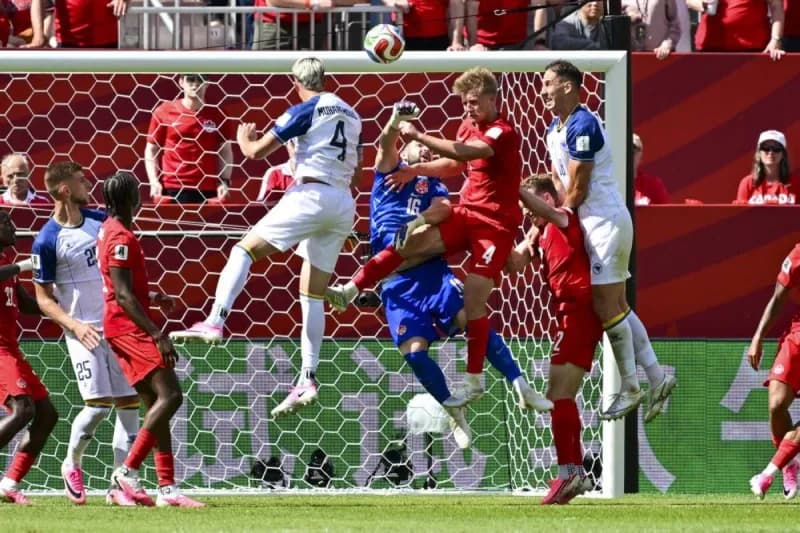
Canada settled for a 1-1 draw against Bosnia and Herzegovina in the opening match of their 2026 FIFA World Cup campaign at BMO Field in Toronto, in a game that revealed many positive and negative aspects of the hosts' performance. Canada continued to wait for their first victory in World Cup history, held back by 4 key factors.
Despite strong crowd support and long periods of territorial dominance, the Canadian side paid the price for its defensive errors at set pieces, as well as a lack of attacking effectiveness in front of goal, before substitute Kyle Larin rescued a point with an equaliser in the closing minutes.
Set-piece struggles
The match highlighted one of Canada's most significant weaknesses: defensive organisation at set pieces. Bosnia and Herzegovina's goal came from a corner kick that exposed poor positioning and marking by the hosts, with players appearing reactive rather than proactive. This allowed the visitors to exploit their physical advantage inside the penalty area and open the scoring with ease.
The incident revealed problems in reading the ball's trajectory and in individual and collective coverage — issues that could prove far more costly against teams with greater attacking quality in the remaining group matches.
The final touch
Canada managed to create a good number of chances but lacked the final touch and decisiveness in front of goal. Jonathan David wasted a clear-cut opportunity in the first half that could have changed the course of the match early on, while the forwards struggled to convert the chances that came their way despite good movement and space creation.
Ismaël Koné stood out as one of Canada's best performers, playing a pivotal role linking midfield and attack and exploiting the spaces between opposition lines to generate numerous chances — yet the final touch was missing for his teammates on more than one occasion.
Substitutes and late solutions
The attacking substitutions proved effective immediately upon entering the pitch, as Kyle Larin and Promise David injected greater dynamism into Canada's forward line. The equaliser came from a fine collective move initiated by Koné, before Promise David played a smart pass to Larin, who finished the attack with a powerful strike to bring the hosts back into the game.
The substitutes' immediate impact raised questions about whether they could have been brought on earlier, particularly given the attacking difficulties the team had shown since the start of the match.
Pressure and the wait goes on
After the equaliser, Canada pushed forward with all their lines in search of their first-ever World Cup winning goal, maintaining sustained pressure on the Bosnia and Herzegovina defence in the closing minutes — but their attempts did not translate into further goals.
While the draw kept Canada's qualification hopes alive, it also confirmed the team's need to improve their attacking effectiveness and defensive organisation — particularly at set pieces — if they are to achieve the historic feat of reaching the knockout rounds for the first time.
Overall, Canada took a point that could prove significant in the group standings, but it came with clear tactical messages for coach Jesse Marsch, who will be expected to address the defensive vulnerabilities and improve finishing efficiency ahead of the two decisive fixtures against Qatar and Switzerland.