
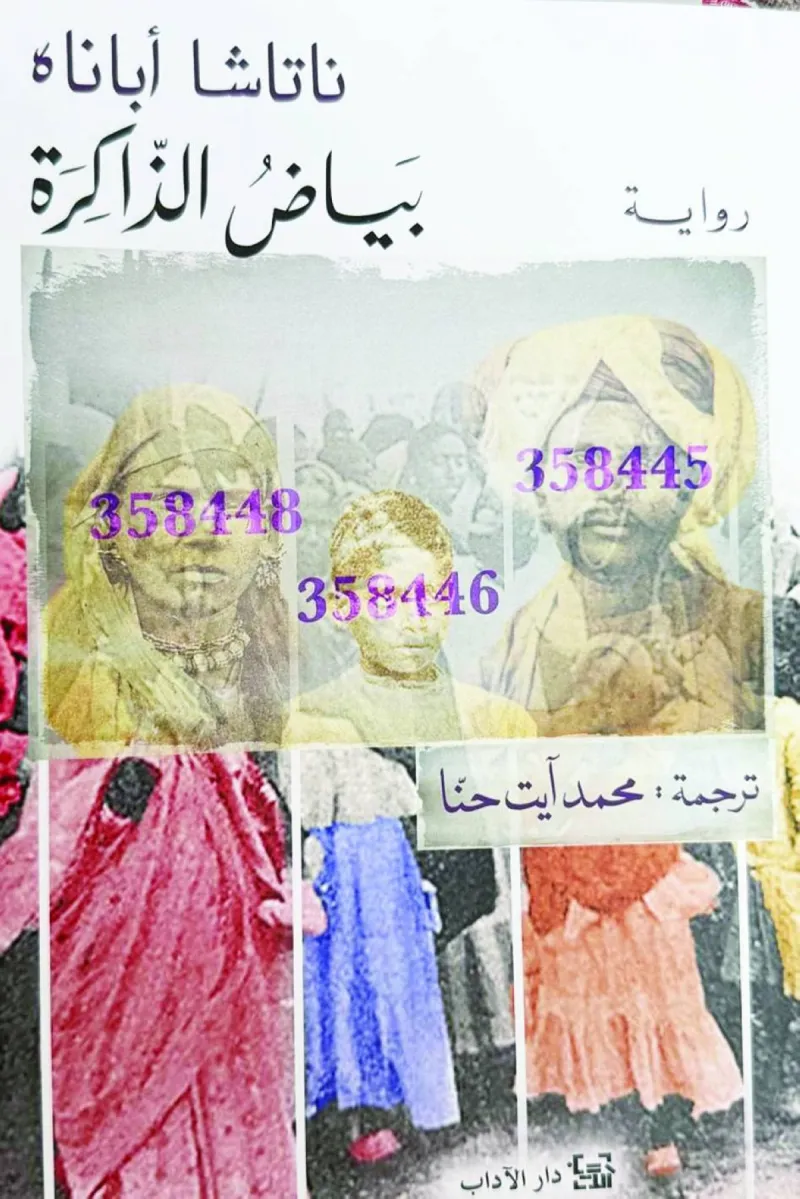
In her novel White of Memory, Natasha Appanah offers a text that transcends the boundaries of conventional storytelling to become a precise excavation of individual and collective memory, and of colonialism's imprint on bodies, languages and identity.
Appanah herself belongs to this history: she was born on the island of Mauritius in 1966, before moving to France and becoming a celebrated Francophone writer.
This division between her Mauritian roots and French identity is clearly reflected in her work, lending her novel a particular sensitivity to questions of exile, identity and memory. The novel opens with an epigraph drawn from Vietnamese-American novelist Ocean Vuong: "Memory is a choice. That's what you told me one day, turning your back to me, as if a god were speaking to me."
On the surface, the novel appears to be the story of a woman searching for her roots following her mother's death in 1999. But it gradually becomes a mirror for centuries of silence surrounding the history of slavery in Mauritius and the Indian Ocean — from the time the French began bringing enslaved people from Madagascar and East Africa in the 17th century, specifically after the founding of the French East India Company in 1664.
It is worth distinguishing between that company and its British counterpart: the French East India Company was a French enterprise founded by Colbert to serve French influence in the Indian Ocean, while the British East India Company, founded in 1600, was more powerful and far-reaching, and ultimately seized Mauritius from the French in 1810.
Appanah sets about dismantling the concept of "whiteness" as a metaphor for emptiness — for the spaces deliberately erased from history.
Whiteness here is not purity but enforced absence: the absence of records, names and narratives belonging to the marginalised.
Many of the enslaved people who arrived in Mauritius between 1720 and 1810 were recorded only by number rather than name, a practice systematised by the French administrator Bertrand-François Mahé de La Bourdonnais, who devised a system for classifying enslaved people by number instead of name.
This legacy appears in the novel through photographs bearing numbers and no identity, as if they were the remnants of souls not permitted to be written.
The narrator-protagonist discovers 3 cards from the Indian immigration archive at the Mahatma Gandhi Institute on Mauritius — cards bearing the numbers of her great-grandparents and their son, who is the grandfather of her immediate grandparents, all descended from the state of Andhra Pradesh in India. Around them, and around the protagonist's own parents, the novel's historical narrative revolves.
The protagonist, Violet, carries a punctured memory. She moves toward the past as though walking through fog, and the whiteness becomes an attempt to reclaim what has been erased and to reconstruct an identity stripped away across generations.
Here the novel recovers the history of "indentured labourers" brought after the abolition of slavery in 1835, primarily from India, in a wave of forced migration orchestrated by the British, numbering more than 450,000 workers over the course of the 19th century. This history appears in the novel as an additional layer of displacement and uprooting.
The novel adopts a structure built on fragmentation and dispersal. The short passages, temporal leaps and multiplicity of voices are not merely aesthetic choices but a formal translation of the idea of broken memory.
The narrative advances through shards, as though the reader is assembling scattered mosaic pieces. The photographs that appear on the cover are not decorative elements but structural keys: each image is a trace leading to an incomplete narrative, and each incomplete narrative reveals a new layer of forgotten history.
In this way the novel comes closer to a historical investigation than to linear storytelling, and the reader becomes a partner in reconstructing the story rather than merely a recipient of it.
Appanah reopens the file of Indian Ocean slavery — a file that has remained marginalised compared with the history of Atlantic slavery.
Yet she does not offer a direct political discourse. Instead, she embodies the effects of colonialism in everyday details: in the language the characters speak, in the body that carries a memory the mind does not recognise, and in the persistent sense that identity is borrowed or incomplete.
The novel recalls the names of historical figures who played a role in shaping this legacy, among them Charles Dizan, who documented the Indian Ocean slave trade in the mid-19th century.
Appanah's language deepens this feeling: it is transparent, simple on the surface yet laden with layers, drawing close to poetry without tipping into ornamentation. She uses short sentences, sensory images and a quiet rhythm that lends the text great sensitivity, making the reader inhabit the experience rather than merely hear about it.
The Arabic translation by Mohammed Ait Hanna, published by Dar Al Adab in 2025, is one of the strengths of the Arabic edition: it preserves the transparency of the original without sacrificing its emotional and poetic register. The following passage is quoted: "I imagine all those intertwined hands, and the silent prayers of the two grandparents on their bed made of fragrant flowers — marigolds and roses and hollyhocks and Indian jasmine. What I love most is this blessing that accompanies them on their final crossing, what I love most is this honour granted to the living on their last migration."
At its core, White of Memory is not a novel about the past but about reclaiming the right to narrate.
It argues that peoples whose histories have been erased recover them not only through documents but through imagination as well — that writing itself is an act of resistance, and that retelling a story, even through fragments, is a step toward possessing oneself.
In this sense the novel offers a text that is quiet in its language, profound in its effect, political without slogans and human without sentimentality. It restores dignity to a history long confined to the margins, expands the boundaries of the novel by interrogating memory, identity and absence, and reminds us that whiteness is not emptiness but a space waiting to be written again.