
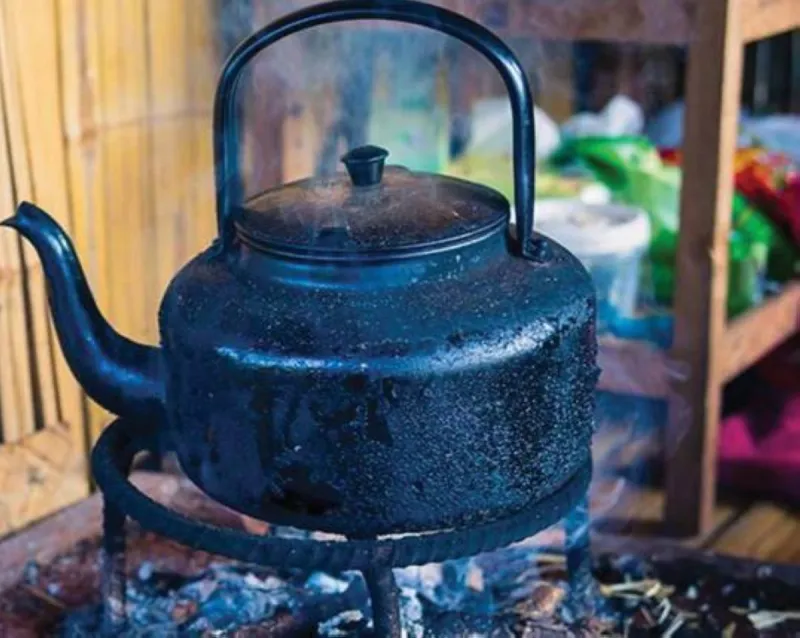
The song "Khidri Al-Chai Khadriyyah" (Brew the Tea, Brew It), which first appeared in the 1930s and is still heard to this day, is considered one of the enduring masterpieces of authentic Iraqi heritage. It was composed by the Iraqi poet Abdul Karim Allaf (1894–1969), though some attribute it to the poet Muhammad Al-Haddad and others to the folk poet Mulla Suleiman Al-Shakarji. The music was composed by Iraqi musicians Saleh and Daoud Al-Kuwaiti, and the song was performed by more than one female singer, including Saddiqa Al-Mallaya and Antoinette Iskander. However, the singer who performed it most masterfully was Salima Basha Murad (1900–1974), wife of the late great artist Nazem Al-Ghazali.
The words of the song go:
Brew the chai, brew it
My eyes — for whom shall I brew it?
Without you, my soul, my mood is always troubled
After my love, O people, for whom shall I pour it?
No one else's eyes deserve to drink it
I swear I will not brew it, nor sit to prepare it
Unless my beloved comes and I rejoice in his presence
By God and by your life, I will never brew it
And I will take an axe in my hand to smash the teapot
The song reflects the exalted place of tea in Iraqi culture, speaking of it as Iraqis' foremost drink and a symbol of hospitality and affection. Iraqis customarily drink their tea "khuddar" — brewed slowly over glowing embers — and serve it in small glasses called "istikan" rather than in cups as in other countries.
Yet the mention of tea here is set within a love story of longing and heartache. Its protagonist is a Baghdadi woman whose husband has gone to Basra for work and remained absent for a long time. His absence pained her, and she grew to miss the moments they shared drinking tea together so deeply that she could no longer bring herself to prepare or drink it without him. When one of her friends came to visit and found her preoccupied and despondent — so much so that she had forgotten her customary duties of hospitality and had not risen to prepare tea for them to share — the friend asked the reason for her gloom and distraction. The Baghdadi woman replied that she could not bring herself to brew the tea since her absent beloved had gone, and she swore she would neither pour it, nor drink it, nor sit to prepare it as long as he was away. She even vowed to take an axe and smash the teapot (qouri).
It is worth noting that the text of the song is not uniform across different sources; it has been written and sung in various versions over time, with verses added or removed as successive female singers performed it — and it has been performed only by women, since preparing tea was traditionally a woman's task in old Iraqi society. However, in 1951 it was performed by the Iraqi Inshad Ensemble, composed of both men and women.
For example, some who sang it added to the original text lines such as:
They told me: brew the chai
But how can I brew it?
How can I strain the water?
How can I bring it to a boil?
(Meaning: how can I steep the tea over the fire, how can I strain the murky water drawn from the river, and how can I bring it to a rolling boil to draw out the good flavour of the tea?)
Others removed verses and replaced them with the following lines:
Gone is the one who used to drink the chai
And he has settled in the city of Basra
Denying, by God, all that was between us
(Meaning: my beloved, who used to share tea with me, has left and gone to live in the city of Basra, denying by God all the closeness that existed between us.)
And some altered it, writing in the voice of the Baghdadi woman in love:
If I had the authority of religious law, I would forbid the chai
While my beloved is absent
From sugar and chai
I would repent and abstain
(Meaning: if she had the power of religious law, she would forbid everyone from making and drinking tea for as long as the beloved is absent; she would even distance herself from tea's very ingredients, including the sugar.)
And there are those who added as a prelude:
Mother, my husband has been taken from me
Dada, my husband has been taken from me
Sister, my husband has been taken from me
I covered him at midnight
I sat until morning and could not find him