
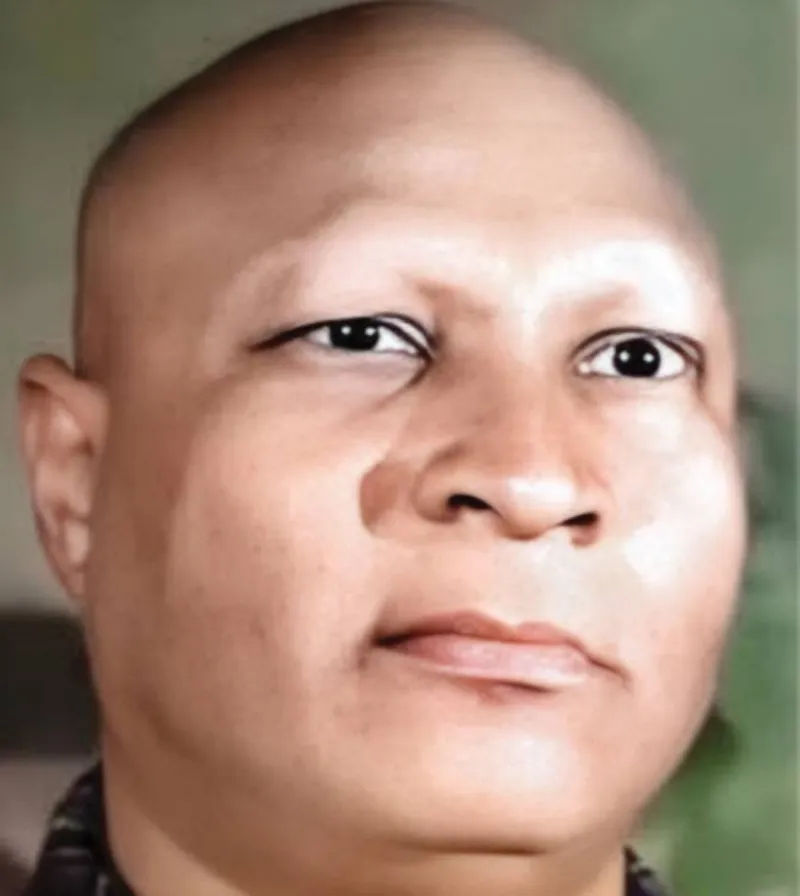
Who among lovers of Egyptian cinema could forget "Salouma the Bald," who appeared in the 1974 comedy film Shayateen ila al-Abad (Devils Forever) alongside Adel Imam, Safaa Abu Al-Saud, and Mohamed Reda? In that film, the man who would become known in artistic circles as the owner of the most famous bald head, the most imposing physique, and the most terrifying face made his mark — the actor Nasr Seif. Although his unconventional physical appearance made him famous for playing villainous roles in gangs involved in crime, thuggery, theft, and kidnapping, he simultaneously lent those roles a comic quality, largely by delivering and receiving beatings in near-total silence. In this context, critic Hisham Abu Saada described him as one of the most important stars of silence.
The public memorized his name, his face, and his piercing, terrifying gaze by heart, and eagerly awaited his films despite the small spaces and marginal roles he was given.
The artist Nasr Seif was born in the Camp Caesar neighborhood of Alexandria governorate on 8 February 1933, and died there on 15 June 2011 at the age of 78. He studied at the Faculty of Arts at Alexandria University, graduating with a bachelor's degree, before beginning his working life as an electricity bill collector. He then crossed paths with director Niazi Mustafa, who offered him work in cinema to make use of his looks and build in villainous roles. Our subject agreed at once, driven by his love of the arts and by his prior experience acting on the university theater stage. Niazi Mustafa thus introduced him to the public for the first time in 1960, in a small role in the film Antar Yaghzu Al-Sahraa alongside Farid Shawqi, Coca, and Maryam Fakhr El-Din. The following year, in 1961, director Hassan Al-Imam cast him in the film Al-Kharsa alongside Samira Ahmed, Emad Hamdy, Zaki Rostom, Hassan Youssef, and Faker Faker.
Offers continued to pour in thereafter, and he went on to appear in approximately 166 works spanning films, plays, and television series, the vast majority in brief extras' roles. Among his most notable films are: 30 Yom fi Al-Sijn, Wadaan Ayyuha Al-Layl, and Al-Moshaghiboun in 1966; Jarima fi Al-Hay Al-Hadi in 1967; Shanabo fi Al-Masida in 1968; Isabat Hamada wa Toto in 1982; Al-Ghoul in 1983; Ihna Bitou Al-Isaf in 1984; Bukhait wa Adila and Al-Lis wa Al-Thalab in 1995.
Seif also appeared in ten theatrical productions, the most famous being the play Shahid Ma Shafsh Haga, in which he played the role of a dancer's killer who stood in the dock during the interrogation of the case's sole witness, "Sarhan Abd Al-Basir" (played by Adel Imam). In this production he delivered the line that became his trademark catchphrase: "God bless you, Professor Khalifa." He also appeared alongside Adel Imam in the television series Ahlam Al-Fata Al-Ta'er, and participated in some works with the Thalathy Adwaa Al-Masrah troupe, Amin Al-Heneidi, and Fouad Al-Mohandes during the 1960s. His final work before his death was the play Ya Ana Ya Inti Ya Dunya in 2010.
The public also remembers his appearance alongside Samir Ghanem and Laila in the film Ihna Bitou Al-Isaf, in which he played "Bamboni," the leader of the Purple Brigades gang, which storms the embassy of the fictional state of Mambouzia Al-Ulya in Cairo and takes a number of hostages — a comedic allusion to the actions of the radical Italian group the Red Brigades at the time.
Equally unforgettable is his role in the film Tabounet Hamza, in which he plays a falafel restaurant owner who repeatedly refuses to buy pickles from Wahid Seif and Younes Shalaby, declaring: "We said we don't want any — what, has a vaccination arrived?" before teaching them a lesson with kicks and punches and pouring barrels of pickles over their heads.
We close by noting that Nasr Seif, who was artistically imprisoned in roles of crime and horror, was nothing of the sort in real life. Quite the opposite: by all accounts of those who knew him, he was kind, generous, tolerant, witty, and warm.