
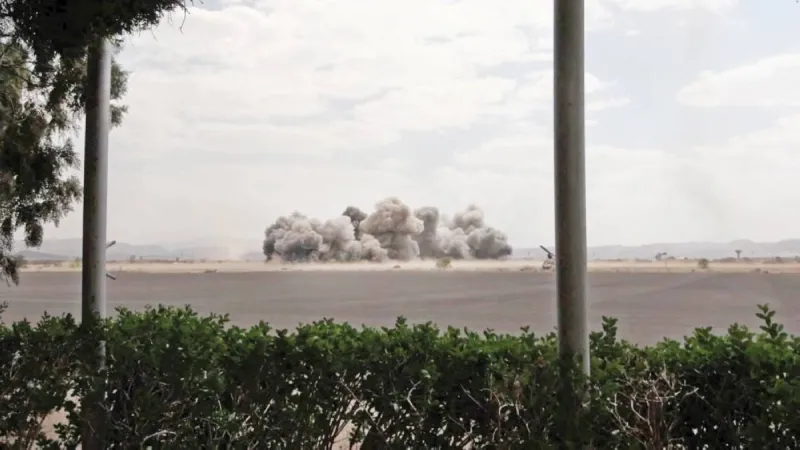
As military and political pressure on Iran continues to mount, Tehran has attempted to impose a new equation in Yemen by activating its arm there — the Houthi militia — bringing the Yemeni arena back to the forefront of regional escalation. Saudi Arabia announced the interception of ballistic missiles fired by the Houthi group towards the kingdom's southern region.
Yemen's Ministry of Defence said its forces targeted the runway of Sanaa airport to prevent an Iranian aircraft from landing, describing the action as necessary to stop a violation of Yemeni airspace. The government-affiliated General Civil Aviation Authority announced the closure of all airports to air traffic until further notice.
The head of Yemen's Presidential Leadership Council, Rashad Al-Alimi, confirmed that he had ordered that the confrontation not be widened in a manner that would serve Iran's objectives. He stressed the need to prevent any violation of Yemeni airspace and accused Tehran of using Yemen as a card in its regional conflict, emphasising that the measures taken by the government aim to protect Yemeni sovereignty and prevent any further escalation.
In a field development, a spokesperson for the Saudi-led coalition announced that air defences had dealt with a threat posed by ballistic missiles fired by the Iran-aligned Houthi group towards the kingdom's southern region, in an escalation that coincides with the tensions gripping the Yemeni arena.
Prior to that, the Houthis threatened to retaliate for the targeting of Sanaa airport's runway, signalling the possible widening of the confrontation, amid assessments that Iran is attempting to push the Houthis into using the Bab al-Mandab card to broaden the conflict in the region.
The United Nations Special Envoy for Yemen, Hans Grundberg, called on all parties to refrain from any steps that could ignite a new round of violence, urging them to return to UN-sponsored dialogue in order to preserve the relative calm the country has experienced since the truce declared in 2022.