
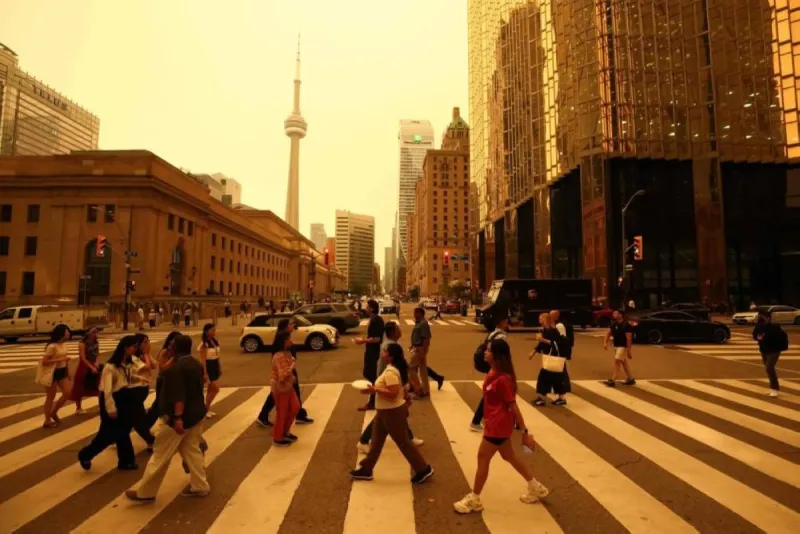
Smoke from Canadian wildfires covered large parts of the northeastern United States, prompting health warnings, but a cold front expected over the weekend is forecast to help dispel the dangerous haze in time for Sunday's World Cup final in the New York area.
More than 80,000 people are expected to attend the World Cup final between defending champions Argentina and European champions Spain at the open-air New York-New Jersey stadium, while another 50,000 are expected to watch the match from Central Park in Manhattan.
New York City began feeling the effects of the wildfires this week, with local authorities issuing an alert urging residents to reduce strenuous outdoor activities and take extra breaks if they were outside.
On Thursday, several air quality monitoring platforms rated air quality in New Jersey, where the match venue is located, as "unhealthy for sensitive groups".
Alex DaSilva, a meteorologist at forecasting company AccuWeather, told Reuters in an interview: "Areas where the smoke is denser can actually cause respiratory problems. So those who may be a little more sensitive or have respiratory issues may want to stay indoors as long as possible.
"Saturday will see heavy rain, which will help disperse a large amount of the smoke.
"I think we'll see a cold front pass through the area on Sunday morning, which should push out any remaining smoke we're seeing now."
New York Governor Kathy Hochul said on Thursday that the smoke was causing unhealthy air conditions across the state.
Hochul said: "Smoke from Canadian wildfires will continue to cover New York today. Air quality is expected to deteriorate, with very unhealthy conditions affecting most of the state. Stay indoors if you can."
Smoke from wildfires originating in northern Canada has become a common summer phenomenon across wide swathes of the United States in recent years.
DaSilva said that while spectators should try to limit their outdoor activities as much as possible on the day before the final, any risks would be lower by the time the match kicks off at 3:00 p.m. Eastern Time (7:00 p.m. GMT) on Sunday.
He added: "We'll see some of this smoke exit the region as the weekend approaches."