
While the Iraqi government, led by Prime Minister Ali Al-Sudani, plans to shift the relationship between Baghdad and Washington away from its military character toward other areas linked to economics and investment, the American administration maintains that deepening its partnership with Iraq is closely tied to the achievement of Iraqi sovereignty and the disarmament of armed factions.
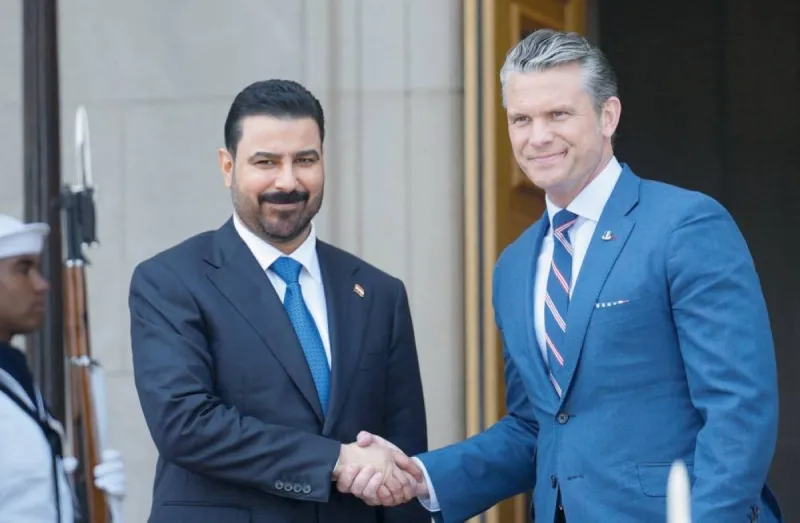
On the sidelines of a visit by Iraqi Prime Minister Mohammed Shia' Al-Sudani to Washington, he met at the Pentagon with US Secretary of Defense Pete Hegseth to discuss defining the shape of the security and military relationship between the two countries, in light of preparations for the full withdrawal of US forces operating in Iraq under the international coalition by the end of next September.
The US secretary spoke about the details of his meeting with Al-Sudani in a post, saying: "I hosted Al-Sudani at the headquarters of the US Department of Defense — the Pentagon," affirming that "Washington looks forward to strengthening its partnership with Iraq."
He said that a normal defence relationship between the two countries requires a stable security environment free of terrorist intimidation, pointing to more than 600 attacks targeting American citizens and facilities in Iraq over recent months, which he attributed to Iran-backed militias.
He also welcomed the Iraqi government's efforts to disarm these groups and strengthen state control over all armed entities.
He noted that "the United States also looks forward to Iraqi security forces — including the Peshmerga forces and other security forces in the Kurdistan Region — taking a leading role in counter-ISIS efforts, as the military mission of Operation Inherent Resolve approaches its end."
According to the US secretary, "achieving security and stability in Iraq would open the door to enhanced commercial and defence cooperation between Baghdad and Washington."
For his part, Al-Sudani stressed that his government is committed to keeping weapons exclusively in the hands of the state, affirming that after 30 September there will be no need for any armed faction and that Iraqi forces will be capable of protecting Iraq's borders and territory.
He added that some factions have already surrendered their weapons and transitioned to political activity — a development that US officials described as a genuine test of the Iraqi government's ability to assert its sovereignty.
Al-Sudani directed that the new post-withdrawal relationship with the United States be framed within the parameters and requirements of Iraqi sovereignty and in accordance with an approach that supports full authority for Iraqi forces.
The meeting came after Al-Sudani's meeting with US President Donald Trump at the White House, which was held in a positive atmosphere. President Donald Trump expressed strong personal support for the Iraqi prime minister, describing him as a strong and intelligent leader who could become one of the great leaders of the Middle East.
The commander-in-chief of the armed forces directed the formation of a committee tasked with liaising with the American side to define the shape of the security and military relationship between the two countries, in light of preparations for the full withdrawal of US forces from Iraq.
Al-Sudani affirmed that "Iraq looks forward to building balanced and sustainable relations with the United States, founded on the basis of mutual interests and mutual respect," noting that "the government is pressing ahead with implementing its programme aimed at consolidating security and stability, strengthening the rule of law, combating corruption, and supporting development and economic reform trajectories."
Al-Sudani also revealed that his government has placed combating corruption and restricting weapons to state hands at the top of its priorities.
This came during a meeting he held at his residence in Washington with US Treasury Secretary Scott Bessent.