
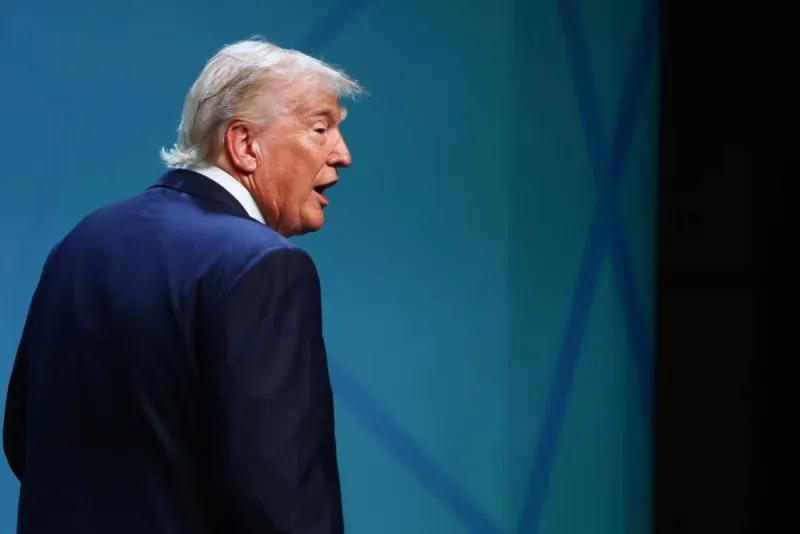
The United States launched a new round of strikes against Iran on Monday night, escalating hostilities even as Donald Trump insisted that reaching a deal with Tehran remained "possible."
The US military announced on Monday that it had carried out a new round of attacks against Iran. US Central Command (CENTCOM) said in a post on X on Monday that "these strikes will continue to inflict significant losses on Iranian forces and degrade their ability to attack innocent civilians and commercial vessels in the Strait of Hormuz," noting that the strikes began at 16:45 local time (20:45 GMT).
Shortly before that, President Donald Trump had said the United States would strike Iran "hard" that night, having earlier announced the reimposition of a naval blockade on Iranian ports in the Strait of Hormuz region — an area that has seen an unprecedented scale of strikes since the April ceasefire in a war whose repercussions continue to shake the global economy.
Trump told broadcaster Hugh Hewitt: "We're going to hit them hard tonight, and we're going to hit them hard tomorrow."
Iran's official IRNA news agency reported four new explosions near Bandar Abbas, the coastal city in southern Iran overlooking the Strait of Hormuz.
Trump said Iranian leaders "cannot do anything whatsoever" about the strikes, adding: "They have nothing going for them but their big mouths."
At the same time, however, Trump told reporters in the Oval Office that a deal with Iran "is still possible."
The United Arab Emirates said on Tuesday that Iran had attacked "two national tankers" in the Strait of Hormuz, killing one crew member and wounding 8 others.
The Ministry of Interior condemned on X "the flagrant attack, which constitutes a serious violation and a clear breach of international law and threatens the security and stability of the region."
Trump had written on his Truth Social platform, following a series of overnight strikes that CENTCOM said were aimed at preventing Iran from attacking ships: "The United States will from now on be known as the 'Guardians of the Strait of Hormuz.'"
He also announced the reimposition of a "'blockade on Iran,' so named because it only prevents ships or agents of Iran from entering or leaving."
The US military announced on Monday that the United States would resume its blockade of Iranian ports. Later, the president said he would address the nation on Thursday via television. Trump did not disclose what the address would cover, and the White House could not immediately be reached for further details.
Trump's last major televised address to the nation was on April 1, when he offered the first comprehensive public justification for the war with Iran — more than a month after the start of the American-Israeli military campaign.
Tehran has also been seeking to impose transit fees, while Trump in turn wants to collect "a fair 20 percent of the value of cargo" passing through the waterway, despite the fact that it is governed by international law that is meant to guarantee freedom of navigation without obstruction.
Iranian Foreign Minister Abbas Araghchi responded to Trump's proposal on Monday evening in a post on X, writing: "Iran has always been the guardian of the Strait and will remain so."
The minister wrote: "The US president is absolutely right. Everyone who ensures the safe passage of commercial vessels through the Strait of Hormuz should be compensated" — adding sarcastically: "Clearly 20 percent is too much. We will be fair."
Iran has stated it will "under no circumstances" allow Washington to interfere in the management of the strait, which the Islamic Republic took control of at the start of the war.
Tehran has held the "American enemy" responsible for the "return of insecurity" to the region, while the Islamic Revolutionary Guard Corps accused the United States of endangering global oil supplies.
The issue is of paramount importance after months of rising prices caused by the paralysis of the strait, through which — before the war — one-fifth of global crude oil production passed.
After approximately 40 days of bombardment in a war that began with Israeli-American strikes on Iran on February 28, a ceasefire entered into force at the start of April.
On June 17, both sides signed a memorandum of understanding containing several provisions, most notably a halt to the war on all fronts, the reopening of the Strait of Hormuz, and the initiation of negotiations aimed at reaching a final agreement within a 60-day deadline, extendable by mutual consent.
The previous Tuesday, confrontations resumed against the backdrop of attacks on vessels in the Strait of Hormuz attributed to the Islamic Republic.
Clashes resumed at an unprecedented pace over recent weeks, prompting Trump to repeatedly declare that the ceasefire had "ended" and leading to the collapse of the memorandum of understanding.
The White House confirmed to Agence France-Presse that the president sent a formal notification to Congress last week indicating the resumption of the war with Iran.
Iranian Foreign Ministry spokesman Esmail Baghaei told a press conference in Tehran, attended by AFP correspondents: "There is no doubt that this document [the memorandum of understanding] is going through a crisis. But Iran has never been the one to violate its commitments."
He noted, however, that Iran continues its diplomatic consultations with Qatar, Pakistan, and Oman — the current mediators in the conflict — with the aim of "avoiding escalation" with the United States.
The document had stipulated the reopening of the strait, but Tehran only allowed a single navigational lane along its coastline and threatened ships that did not adhere to that route.
The military adviser to Iran's Supreme Leader, Mohsen Rezaei, warned, as quoted by ISNA news agency, that "this strategic waterway is more important than dozens of atomic bombs, and the Islamic Republic will protect it."
CENTCOM said on X that the latest US strikes targeted "Iranian air defense systems, coastal radars, missile capabilities and drones, in addition to small boats."
According to Iranian state media, the bombardment struck wide areas in the west and south of the country, particularly Qeshm Island and Bandar Abbas at the Strait of Hormuz, as well as Khuzestan Province bordering Iraq, where 2 people were killed.
CENTCOM said on Monday that the United States had for the first time used loitering maritime drones in combat to strike Iran's Bandar Abbas port.
Four explosions were heard on Monday evening in the southern Iranian city of Bandar Abbas, according to official media.
The death toll since Wednesday has reached 25, according to an AFP tally based on Iranian media and official sources.