
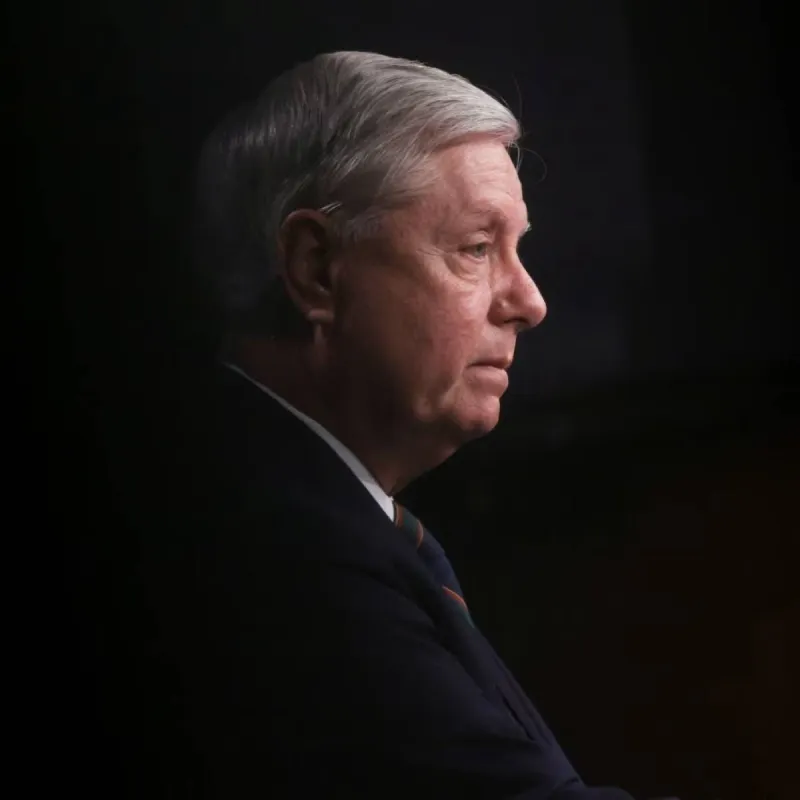
The office of Republican Senator Lindsey Graham announced early Sunday morning that he had died Saturday evening after a "short and sudden illness," without providing additional details about the cause or location of death, according to reports by The Wall Street Journal, The New York Times, and The Washington Post.
Graham had just returned from a visit to Ukraine, where he met President Volodymyr Zelensky on Friday and toured a drone manufacturing facility. It was his 10th visit to Ukraine and his last trip abroad. He had also been scheduled to appear Sunday morning on an NBC programme, according to The Washington Post.
The Wall Street Journal reported that emergency teams responded Saturday evening to a call about a medical emergency involving a person suffering cardiac arrest at Graham's Capitol Hill residence, citing a recording of police radio communications obtained by the newspaper.
Trump wrote on social media that Graham was "one of the greatest people and Senators I have ever known," adding: "He was always working, and was a true American patriot. We will miss Lindsey greatly."
The death of one of the most influential Republican senators sent shockwaves through Washington. Republican Senator from Ohio Bernie Moreno said it was "complete shock and disbelief at the loss of a great American," while Senate Majority Leader John Thune said: "My heart is heavy with grief this morning."
From a tavern to the Senate
Lindsey Olin Graham was born on 9 July 1955 in the town of Central, South Carolina, a small town in Pickens County that took its name from its location midway along a railway line between Charlotte and Atlanta, according to The Washington Post.
Graham grew up with his sister Darline in the rooms behind the tavern run by his parents, Florence James Graham — known as "F.J." or "Dod" — and Millie Walters Graham. The establishment, known as the "Sanitary Café," combined a bar, a restaurant, a pool hall, and a liquor store.
While his father served customers at the bar, most of them factory workers, Graham would rack pool balls and answer phone calls. The Washington Post quoted him in a previous interview as joking that he learned everything he needed to know about politics in that place — he sometimes had to tell a wife calling to look for her husband: "He says he's not here."
In his 2015 memoirs, Graham wrote, according to The New York Times: "My home was a bar," but added that he was as loved within those walls as any child could be by devoted parents.
He was the first in his family to attend university, and joined the Reserve Officers' Training Corps at the University of South Carolina, hoping to become a military pilot. However, an ear problem and poor grades in mathematics prevented him from realising that ambition.
His life changed dramatically during his undergraduate years. In 1976, when he was 20, his mother died of Hodgkin's lymphoma. About 15 months later, his father died of a heart attack, leaving Graham responsible for his younger sister Darline.
Graham became his sister's legal guardian; she moved in with relatives, and he later legally adopted her after graduating from law school so she could benefit from his military benefits.
Graham told The Washington Post that he suddenly found himself responsible for a teenager, and that his acute sense of responsibility sometimes led him to be overprotective — he would not let her go out, would smell her clothes to make sure she had not smoked, and would listen in on her phone calls.
For her part, Darline Graham Nordone described her brother as "a brother and a father and a mother all in one," according to The Washington Post. She also told The New York Times in 2015: "Lindsey was always my dad. There was no doubt in my mind or anyone else's that he was my guardian."
The military lawyer
Graham received his bachelor's degree in 1977 and his law degree in 1981, both from the University of South Carolina. After graduating, he joined the Judge Advocate General's Corps of the United States Air Force, serving as a prosecutor and defence attorney in Europe.
He gained national attention when he defended an Air Force pilot accused of marijuana use and appeared in a segment on CBS's 60 Minutes examining flaws in drug-testing procedures within the Air Force.
After completing his active duty service, he returned to South Carolina but continued his military career in the state's Air National Guard, and was called up for service within the United States during the Gulf War in 1991.
In 1995, he joined the Air Force Reserve, remaining for 20 years before retiring at the rank of colonel. During that period, he served on multiple deployments in Iraq and Afghanistan, and became the first senator in decades to perform military service in a combat zone while still in office, according to The Washington Post.
Political rise on the Republican wave
Graham began his political career as a member of the South Carolina House of Representatives before winning a seat in the US House of Representatives in 1994 as part of the Republican wave that returned the party to control of the chamber after decades of Democratic dominance.
He served 4 terms in the House and rose to national prominence in 1999 when he was one of the Republican congressmen who presented the impeachment case against President Bill Clinton before the Senate.
During the trial, Graham drew on his Southern drawl and folksy style to level criticism at Clinton over his relationship with White House intern Monica Lewinsky. The Washington Post quoted him as saying, in reference to a late-night phone call made by Clinton: "Where I come from, when you call somebody at 2:30 in the morning, you're up to no good."
In 2002, Senator Strom Thurmond — who had held South Carolina's Senate seat for nearly half a century and was 100 years old upon his retirement — stepped down. Graham ran to succeed him and defeated his Democratic opponent by a margin of 10 percentage points, in what The Washington Post described as the most expensive Senate race in the state's history at the time.
Since entering the Senate in 2003, Graham held his seat for more than 2 decades. A month before his death, he defeated 5 challengers in the Republican primary, avoiding a runoff and heading towards a general election in which he was widely expected to win a 5th term.
McCain's partner and hawk of military intervention
Despite the shifts Graham's domestic positions and political relationships underwent, all 3 newspapers agreed that his vision of foreign policy remained the most consistent aspect of his career.
Graham was among the most ardent advocates of the use of American military force, supporting the wars in Iraq and Afghanistan, opposing military withdrawal from both countries, and calling for the allocation of American funds to support allies and confront adversaries abroad.
His interventionist positions were cemented through his close relationship with Republican Senator John McCain, the party's presidential nominee in 2008. Graham had backed McCain during the 2000 Republican primary in South Carolina against George W. Bush, even though Bush went on to win the nomination and the presidency.
Israel and Iran: the most prominent files
Graham was one of the strongest supporters of Israel in the Senate, cultivating close ties with its leaders and defending its security as an integral part of American national security.
The New York Times quoted Israeli Prime Minister Benjamin Netanyahu as saying after Graham's death: "Lindsey understood that the security of Israel and America are inseparable," adding: "Israel has lost one of its greatest friends."
Speaking to Fox News, Netanyahu described Graham as "a great friend," saying: "He did not bow to campaigns or their winds. He knew who were the good guys, he knew who were the bad guys, and he never confused the two."
On the Iran file, Graham was one of the most prominent voices calling for a hardline stance. He pressured Trump to take a firm position on Tehran, supported military action against its facilities, and warned against reaching a premature deal with it.
Trump's closest ally?
Graham's relationship with Trump represented the most controversial chapter of his career. He began as one of Trump's fiercest critics within the Republican Party before transforming into a close ally, a constant adviser, and a golf partner.
During the 2016 presidential campaign, Graham described Trump as a "demagogue," "race-baiter," "xenophobe," and "religious bigot."
In an interview with CNN in 2015, according to The New York Times, he said: "You know how you make America great again? Tell Donald Trump to go to hell."
But his tone began to change after Trump reached the White House. In April 2018, he declared his support for Trump's re-election in 2020 and became one of the influential voices in the administration, particularly on foreign policy.
The relationship between the two developed through regular rounds of golf. The Wall Street Journal quoted Democratic Senator Dick Durbin as joking that Graham managed to get Trump to listen to him because he "consistently loses at golf when he plays with the president."
As one of Trump's most prominent defenders and advisers, Graham enjoyed unusual access to the president and used flattery and the granting of credit to Trump in attempts to steer policy.