
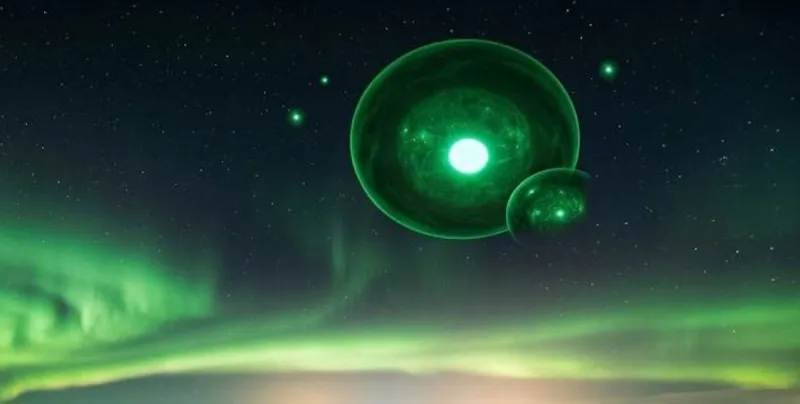
Since late 1948 and early 1949, a puzzling phenomenon has baffled American scientists and officials following a series of sightings of brilliantly glowing green objects in the skies over areas near sensitive installations, among them the Los Alamos nuclear laboratory. Despite more than seven decades having passed, the "green fireballs" remain one of the most controversial atmospheric phenomena on record, after early investigations failed to produce a definitive explanation for their nature.
The sightings prompted the US government to convene secret meetings attended by prominent scientists, including physicist Edward Teller and meteorite expert Lincoln LaPaz, to study descriptions of objects that appeared suddenly, moved along unfamiliar trajectories, and maintained their brightness without clearly matching the known characteristics of meteors.
Newly declassified documents reveal fresh details about those investigations and shed light on the extent of interest shown by American scientific and military institutions in understanding the phenomenon, particularly given the repeated sightings near facilities linked to the nuclear programme during the Cold War.
According to a report published by Newsweek, the documents have reopened one of the oldest unidentified aerial phenomena (UAP) files in the United States, after disclosing details of a secret meeting held in 1949 inside Los Alamos laboratory to discuss mysterious sightings of "green fireballs" that had confounded scientists and military officials.
These files date back to the Cold War era, when US authorities attempted to explain unusual atmospheric phenomena that appeared near sensitive installations — particularly sites linked to the nuclear programme — at a time when any unidentified phenomenon near such locations attracted considerable security and scientific attention.
The meeting brought together prominent scientists, among them physicist Edward Teller, then-Los Alamos laboratory director Norris Bradbury, and meteorite expert Lincoln LaPaz, alongside government and security officials, to examine a series of sightings of bright green objects that appeared in the sky during late 1948 and early 1949.
LaPaz described one incident that occurred in December 1948 as bearing no resemblance to a conventional meteor fall, explaining that the object appeared suddenly with intense brightness, maintained its luminosity as it moved along a nearly horizontal trajectory, and then split into bright green fragments.
A phenomenon unlike meteors
Investigators studied several cases of what later became known as "green fireballs," in which objects were observed at relatively low altitudes — between 8 and 10 miles — moving at a near-constant speed over long distances.
LaPaz noted that some characteristics of these objects did not correspond to the behaviour of known meteors, particularly the absence of accompanying sounds despite their intense brightness. He explained that large meteors bright enough to appear this way typically produce sounds and explosions audible from great distances, none of which were recorded in those incidents.
Witnesses consistently described the colour of the objects as vivid green, while measurements cited in the investigation transcripts indicated that their wavelengths were concentrated at approximately 5,218 angstroms — a colour range LaPaz likened to the green glow produced by copper salts in a flame test.
LaPaz noted that this colour is not a characteristic feature of known meteors, which typically contain very small quantities of copper, further complicating any explanation of the phenomenon at the time.
Researcher Joshua Golembeski said the phenomenon described in the documents may correspond to two categories of sightings that are still recorded to this day: the first being spherical objects resembling "green fireballs," and the second being objects with a more defined appearance or structure.
He added that both types have appeared in reports linked to areas near nuclear facilities, noting that this pattern has historically occurred at sites such as Los Alamos, Sandia, Kirtland, and Hanford, and has also featured in some recent reports examined by specialised US government programmes.
Special attention due to nuclear installations
The documents revealed that the investigations attracted significant attention owing to the proximity of some sightings to important nuclear facilities, prompting scientists and officials to study the phenomenon in secret within Los Alamos laboratory.
Researchers believe the significance of these files lies not only in the nature of the objects observed, but in the level of official attention that accompanied the investigations, which involved some of the most prominent scientists of that era alongside officials from various government and security agencies.
The documents also offer a picture of how American institutions handled mysterious atmospheric reports in the early days of the Cold War, when any unexplained phenomenon near nuclear installations represented both a security and a scientific concern.
Despite 77 years having passed since those sightings, no definitive explanation for the "green fireballs" has been reached. Some researchers believe they may be linked to rare atmospheric or astronomical phenomena, while others maintain that certain details in the reports still require a complete scientific explanation.