
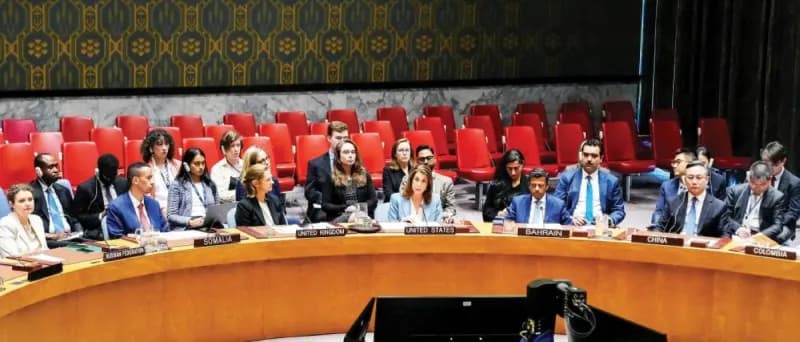
The UN Security Council witnessed a fresh round of division over Iran's nuclear file on Wednesday, after Russia and China blocked a draft resolution aimed at discussing developments in Iran's nuclear programme and related measures — a move reflecting the continuing divergence among major powers over how to handle the sensitive issue.
At the same time, the council of the International Maritime Organization (IMO), headquartered in London, agreed to reject any Iranian effort to assert sovereignty over the Strait of Hormuz.
Russia and China exercised their veto power in the Security Council, obstructing international efforts to discuss the implications of Iran's nuclear programme during one of the council's sessions.
The United States and European countries, by contrast, argued that a Security Council discussion of the file had become a necessity in light of reports of the expanding scope of Iran's nuclear activities, stressing that Tehran's continued development of its nuclear programme raises serious concerns about regional security and stability and demands more effective international action.
The US representative to the Security Council strongly criticised the Russian and Chinese stance, saying: "We reject Russia and China's prevention of a discussion on the Iranian nuclear file — member states have the right to discuss this matter."
The United Nations called on all parties to work towards reaching a constructive resolution to the file.
The French representative to the Security Council said Iran must ensure the Strait of Hormuz is reopened without conditions, cease its support for armed groups, and halt its efforts to destabilise the region.
Bahrain's representative, speaking during the Security Council session on Resolution 2231 related to the Iranian nuclear agreement, said the region had witnessed "one of the most dangerous waves of escalation in its modern history" as a result of Iran's actions. He argued that Tehran had failed to meet its obligations under Resolution 2231 of 2015, as well as under the Islamabad memorandum of understanding.
Bahrain's representative stressed that any addressing of the Iranian nuclear file must be reflected in Tehran's behaviour in the region, arguing that sustainable security in the Middle East cannot be achieved while Iran continues to target regional states and threaten navigation in the Gulf.
He added that "for Iran, diplomacy is not a path to resolving disputes but a means of managing crises and buying time," signalling Manama's scepticism about Tehran's sincerity regarding the negotiating track.
The Russian and Chinese move came amid escalating disagreements between Western countries and Iran over Tehran's compliance with the 2015 nuclear agreement, compounded by growing international concern over the levels of uranium enrichment Iran has achieved in recent years.
In a parallel development, the IMO council, based in London, agreed to reject any Iranian efforts to assert sovereignty over the Strait of Hormuz or to establish a body to control maritime traffic through it, ruling that such unilateral steps violate international law and the rights of coastal states.
The council called on member states not to recognise any Iranian measures aimed at hindering freedom of navigation or interfering with the right of transit passage through the strait, stressing the need to maintain the flow of global trade and secure one of the world's most vital maritime corridors.
These developments come amid heightened tension between the United States and Iran following an exchange of military strikes in recent days, and continuing diplomatic efforts to reach a lasting agreement that would ease the confrontation and guarantee navigational security in the Gulf.