
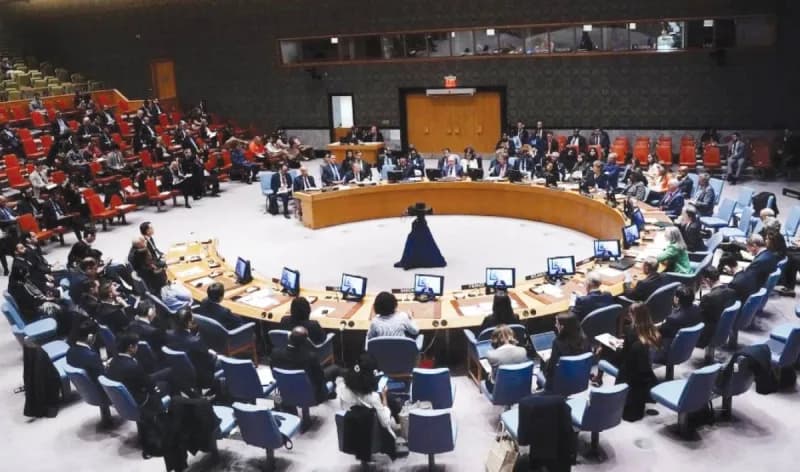
The UN Security Council held an emergency session yesterday, at Bahrain's request, to discuss security developments in the Middle East amid escalating tensions between the United States and Iran and their repercussions for regional security and international navigation.
The Council called on all parties to exercise maximum restraint and to intensify diplomatic efforts to preserve stability and ensure freedom of navigation and the continued flow of trade through the Strait of Hormuz.
The Kingdom of Bahrain affirmed that recent Iranian attacks using ballistic missiles and drones against civilians on its territory constitute a direct violation of Iran's obligations under a memorandum of understanding, expressing confidence that the Security Council would not stand by as a spectator to aggressions that undermine its credibility, and stating that the kingdom reserves its full right to self-defence.
This came in a speech delivered by Bahraini Foreign Minister Abdullatif bin Rashid Al Zayani before the UN Security Council, in which he confirmed that Bahrain had requested the emergency session after Iran resumed the firing of ballistic missiles and armed drones toward the kingdom, targeting civilian areas, in direct violation of its obligations under the memorandum of understanding signed in Islamabad on 17 June, which stipulated a permanent cessation of military operations.
Al Zayani noted that this is the second time the Security Council has convened an emergency session to address this pattern of attacks, pointing out that the first session was held following the attack that targeted the Barakah nuclear power plant in the United Arab Emirates — an attack that pushed the region to the brink of a nuclear safety catastrophe.
He said that Bahrain is returning to the Security Council today because the aggression has not stopped, stressing that what the kingdom is experiencing is not an isolated incident but represents a continuing pattern of aggressions, noting that the kingdom has been subjected to 808 attacks since 28 February, comprising missile and drone strikes targeting residential neighbourhoods and civilian infrastructure on which citizens depend in their daily lives.
He pointed out that these attacks have resulted in the killing of 3 people and the wounding of hundreds, including women and children, adding that Gulf states have also been subjected to similar attacks, reflecting a troubling pattern of escalation.
Al Zayani explained that one of the strikes targeted an ammonia storage tank at the Gulf Petrochemical Industries Company within a populated area, forcing authorities to evacuate a zone with a radius of 2 kilometres and creating a real risk of a chemical disaster.
He added that other attacks targeted areas near Kuwait International Airport, stressing that those sites are not military targets but rather the pillars of civilian life and basic infrastructure on which the population depends.
Al Zayani emphasised that the Security Council session concerns not only Bahrain but also the UN Charter, the protection of civilians, and the authority of the Security Council to enforce its resolutions.
He noted that Security Council Resolution 2817 condemned these attacks and demanded they cease, yet they continue, calling on the Council to ensure implementation of its resolutions and fulfilment of international obligations.
He affirmed that Bahrain's message is clear: these attacks must stop, Security Council resolutions must be implemented, and international commitments must be respected, stressing that the Council's credibility rests not merely on issuing resolutions but on ensuring their implementation and adherence.
Al Zayani concluded his remarks by affirming that Bahrain will remain committed to peace, dialogue, and stability, will continue to exercise maximum restraint, while fully preserving its inherent right to self-defence.