
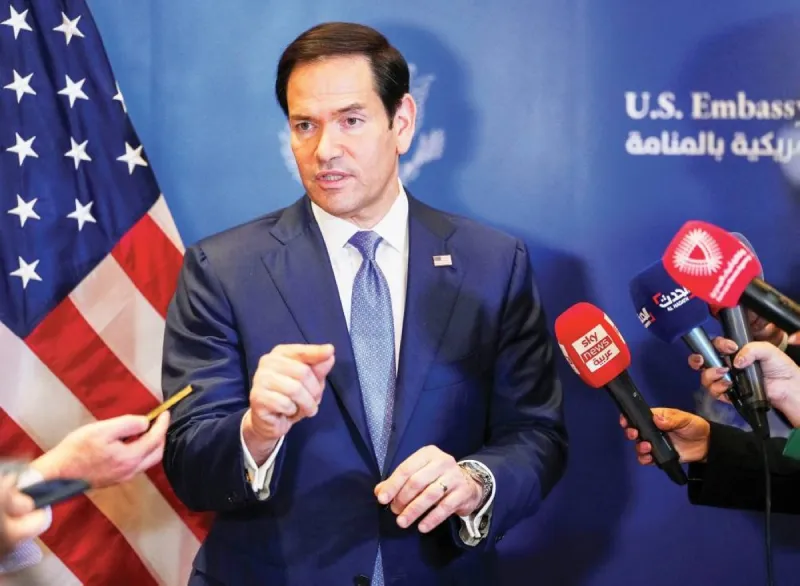
US Secretary of State Marco Rubio said that statements made by Iranian officials contradict reality.
Speaking on the sidelines of the US-Gulf ministerial conference in Manama, the US secretary said: "We have now reached a stage in this matter where you hear, for example, that the Iranians say one thing, but in return something completely different happens on the ground."
He added: "So here is what I want to say to everyone: it has become clear to us, and I believe it should be clear to all of you, that the Iranian regime will continue to issue all kinds of escalatory rhetoric, and they will have people appearing on television screens and in their official media to make all manner of statements."
However, according to the US secretary, what matters to us is not their press conferences; what truly matters is whether ships are moving or not — in the Strait of Hormuz.
If ships are moving as they should, that is what we will base our judgment and response on. But if this rhetoric is, on the other hand, backed by actual threats to ships that cause their movement to halt, that constitutes a violation of the agreement, and we will take a firm stance on it.
Rubio continued: "So what we are monitoring now is the continued flow of ships, specifically through this passage used for evacuation efforts led by the International Maritime Organization. This must continue, and as long as it does, they can hold as many press conferences as they wish — but if it stops, then there will be a problem."
Rubio said the memorandum of understanding is not supposed to be a comprehensive document covering everything; rather, it sets out the broad framework for the negotiation process. He noted that it included some specific matters related to the immediate reopening of the straits and so forth, but what it ultimately does is lay out the broad parameters of the negotiation process.
Rubio said during the meeting that the United States will not accept the imposition of transit fees in the Strait of Hormuz by Iran.
He affirmed that the Strait of Hormuz is an international waterway that belongs to no single party, warning that imposing transit fees on the strait could spread like a contagion to other waterways around the world.
"If we were to accept the imposition of fees for using an international waterway simply because it is close to a country's territory, this would spread to the rest of the world like a contagion," he said.
Rubio also reiterated that Iran will not obtain a nuclear weapon. "We want a fair agreement with Iran that all parties agree to," he said.
"We are now working to reach an agreement that serves the Iranian people." He noted that the United States hopes to reach good outcomes in negotiations with Iran, saying: "We are now in a new phase and we hope to achieve our peace-seeking aspirations."
Separately, Omani Foreign Minister Badr Al-Busaidi affirmed that future arrangements concerning the Strait of Hormuz do not entail the imposition of any transit fees.
During the US-Gulf ministerial meeting in Bahrain, the Sultanate of Oman expressed its support for the memorandum of understanding signed between the United States and Iran, and for the importance of fulfilling its objectives in the pursuit of lasting peace, restoring freedom of navigation through the Strait of Hormuz, and ensuring its safe flow.
Al-Busaidi noted that the sultanate, as a state bordering the strait, bears a special responsibility to support international efforts aimed at securing maritime navigation in accordance with its responsibilities and obligations under international law and the United Nations Convention on the Law of the Sea.
He also confirmed that future arrangements relating to the strait do not involve the imposition of any transit fees, as quoted by the Oman News Agency.
Gulf Cooperation Council Secretary-General Jasem Al-Budaiwi said the joint ministerial meeting discussed numerous files, foremost among them the situation in the region, ways to enhance its security and stability, and de-escalation and mediation efforts.
Al-Budaiwi explained that the meeting reaffirmed that any future understandings or arrangements must include the requirements of the GCC member states in a manner that preserves their interests and guarantees their security and stability, and that they must be grounded in the principles of international law, respect for state sovereignty, good neighbourliness, and non-interference in internal affairs, so as to contribute to consolidating regional security and stability.
He affirmed that the GCC states welcomed, during the meeting, all diplomatic efforts that contribute to de-escalation, the enhancement of security and stability in the region, and the safeguarding of maritime passage security — including the Strait of Hormuz — freedom of navigation, and respect for the rules of international law, in a manner that achieves security and prosperity for the peoples of the region and the world.