
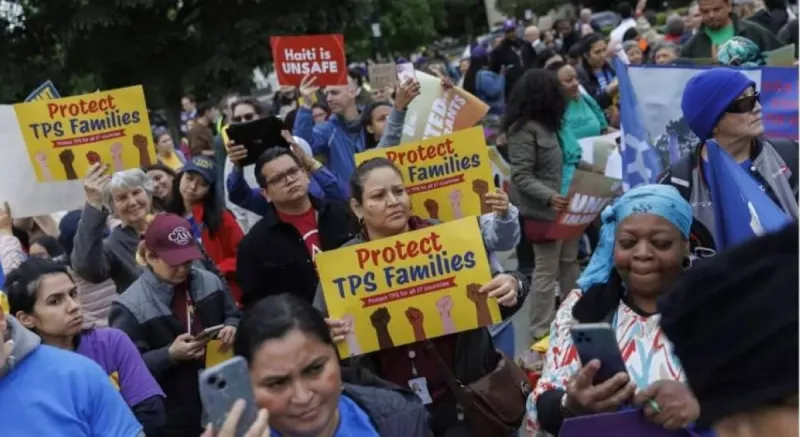
The United States Supreme Court upheld on Thursday a decision by the Donald Trump administration to revoke Temporary Protected Status for approximately 350,000 Haitians and 6,000 Syrians residing in the United States.
The court, which has a conservative majority, ruled 6 to 3 that the Department of Homeland Security's decision to terminate the Temporary Protected Status of Haitian and Syrian migrants is not subject to judicial review.
The programme benefits individuals considered at risk if they return to their home countries due to war, natural disasters, or other exceptional circumstances.
During oral arguments before the court in April, lawyers representing Haitian and Syrian Temporary Protected Status holders argued that conditions in their home countries remain unsafe, and that the administration's decision was driven in part by racial hostility.
Justice Samuel Alito rejected assertions that race was a "motivating factor" in President Trump's decision to revoke Temporary Protected Status for Haitians.
Alito wrote in the ruling: "None of the statements attributed to the President or the Secretary of Homeland Security were overtly racial in nature, and all of them expressed in their substance policy orientations that could be grounded in race-neutral justifications."
Trump ran his election campaign on a pledge to expel millions of migrants and sought to dismantle the Temporary Protected Status programme as part of his broader crackdown on immigration.
At the height of his 2024 election campaign, Trump stoked concerns about Haitian migrants by claiming they were eating Americans' pet animals.
The Supreme Court's ruling could have implications for more than 1 million beneficiaries of the programme from more than 12 countries.
Temporary Protected Status has been revoked for nationals of Afghanistan, Cameroon, Ethiopia, Honduras, Burma, Nepal, Nicaragua, Somalia, South Sudan, Venezuela, and Yemen, among others, in addition to Haitians and Syrians, since Trump took office.
Haitians were granted Temporary Protected Status in 2010 following a devastating earthquake, and their country continues to suffer from extreme poverty, widespread gang violence, and chronic political instability.
Syrians were granted the status in 2012.