
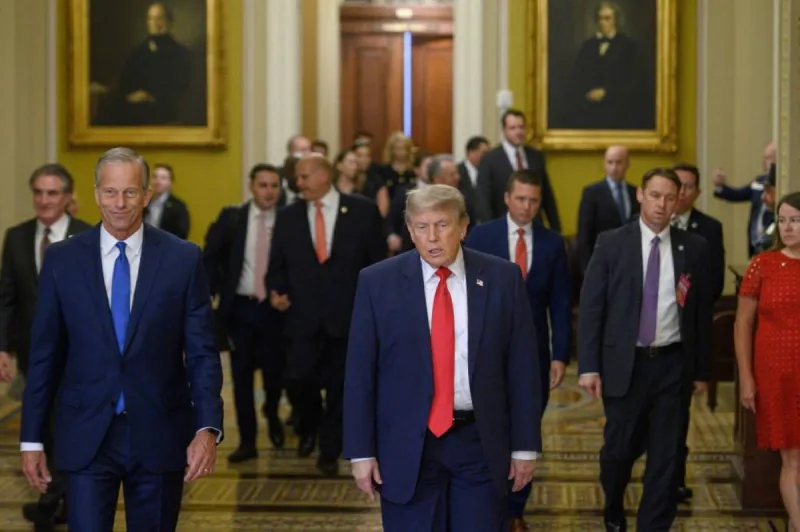
US President Donald Trump asked Congress on Wednesday for additional funding of $88 billion, the bulk of it to cover the costs of the war with Iran, as anxiety among both parties over the conflict and its political price mounts.
The White House request for $87.6 billion in supplemental funding includes tens of billions for the Department of Defense, alongside allocations for American farmers, the response to an Ebola virus outbreak in central Africa, and domestic infrastructure projects.
The proposal comes a day after Congress adopted a largely symbolic resolution calling on Trump to end hostilities against Iran unless lawmakers grant explicit authorisation for military action.
It also comes as the US administration attempts to convert a preliminary agreement with Tehran into a final settlement, following months of war that have rattled global energy markets, driven up prices, and exposed divisions within the Republican Party.
White House budget director Russell Vought presented the request in a letter addressed to House Speaker Mike Johnson, urging Congress to move swiftly on what he described as "important and urgent requests." The largest share of the package will go toward covering military costs linked to the conflict with Iran.
The administration requested approximately $67 billion for the Department of Defense, including $21 billion for munitions and other military capabilities, $17.3 billion for operational costs, and $12.1 billion for classified programmes and projects.
It also requested around $768 million for the Department of Energy to bolster nuclear and energy security matters related to Iran, and $300 million for the Ministry of Foreign Affairs to secure and construct embassies in countries bordering Iran.
The request is far below the $200 billion figure that Defence Secretary Pete Hegseth mentioned in March as what the Pentagon might need to fund the war, which began with US-Israeli strikes on Iran in late February.
The request is expected to face a difficult path in Congress, where most Democrats oppose the war and some Republicans have begun raising questions about its cost, objectives, and prospects for an end.
In the Senate, passing major spending legislation typically requires 60 votes, meaning Trump will need Democratic support unless Republicans find an alternative legislative route.
Senate Minority Leader Chuck Schumer accused Trump of seeking more money after dragging the country into a "reckless war."
Senator Patty Murray, the senior Democrat on the Senate Appropriations Committee, said Trump launched the war without congressional authorisation or broad public support, and is now asking taxpayers to "foot the bill."
The request also includes more than $11 billion in aid for farmers following damage caused by trade disruptions and economic fallout linked in part to Trump's tariff policies.
The spending also includes $1.4 billion to respond to the Ebola outbreak in the Democratic Republic of Congo, Uganda, and other areas; $1 billion to renovate Pennsylvania Station in New York; and $500 million for restoration and construction projects in Washington.