
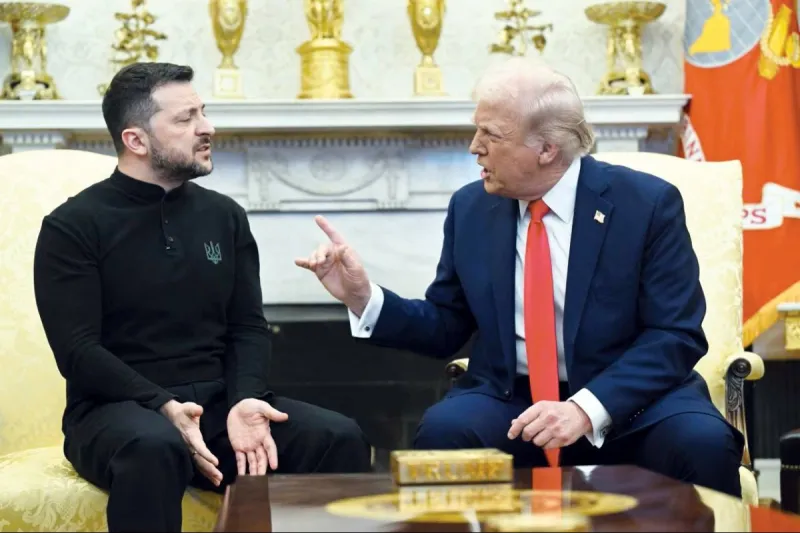
US President Donald Trump's declaration that the Iran file has become a "second priority" and that his administration's attention will now shift to the war in Ukraine raises questions that go beyond the statement's immediate implications.
The US president speaks as though the crisis with Iran is behind him — or at least as though the path to a final agreement is sufficiently paved and assured to allow him to move on to another international file no less complex.
The question that imposes itself is whether the actual facts justify this degree of confidence, or whether Trump is attempting to get ahead of events politically before they become final realities on the ground.
The final US-Iran agreement still has 60 days ahead of it, with major obstacles and potentially dangerous pitfalls along the way. Many substantive details related to implementation mechanisms, guarantees, sanctions, and the nuclear programme remain hot items on the table.
Nevertheless, the language Trump has used has changed markedly in recent days. After weeks of talk about the danger of war and the possibility of a widening confrontation, he has begun speaking of the agreement as something nearly settled, and has moved on to discussing subsequent files that deserve focus.
This may reflect a conviction within the US administration that the main obstacles have been overcome and that what remains is limited to technical and political arrangements that can be resolved, given the intensive activity and accelerating diplomatic moves by mediators.
It is fair to say that the parties involved are no longer trading the accusations that prevailed in earlier stages; instead they are discussing the shape of the understanding and the mechanisms for implementing it. That in itself is a development suggesting that negotiations have entered their final phase.
Yet the more accurate picture is that the situation appears more complex than the statements — and perhaps the wishes — suggest. Opposition within Iran to any agreement with America at all has begun to take on a clearer character as the moment of decision approaches.
Israel, too, makes no secret of its objection to any deal that grants Tehran political or economic gains without comprehensively addressing its regional influence. Even within the United States itself, it does not appear that all political and party circles view the agreement through the same lens.
What happened in Lebanon in recent days offers a clear example of the fragility of the situation. The Israeli strike on Beirut's southern suburbs prompted Trump to intervene personally, issuing a direct and public warning against steps that could undermine the chances of reaching a deal.
Had the Iran file truly exited the danger zone, a security incident in Beirut would not have been capable of provoking this level of American concern. This indicates that the agreement, despite the progress made, remains vulnerable to any field or political escalation in the region.
Trump's statement may be directed at the domestic American audience as much as at the outside world. The US president has sought, since returning to the White House, to present himself as the dealmaker capable of closing major crises.
Having spent weeks talking about Iran and the war in the Middle East, his shift to speaking about Ukraine may be an attempt to show that another thorny file is under control and that the administration is ready to move on to a new challenge.
Trump may also be betting on the strength of his influence over Kyiv — we recall how President Volodymyr Zelensky's political rhetoric shifted positively toward a diplomatic solution after each meeting he held with Trump. The choice of Ukraine specifically is not a trivial detail either; the war there represents today the most complex international file for Washington and its allies, and Trump understands
that any success in the Middle East will give him additional political momentum if he decides to launch a new initiative toward Moscow and Kyiv.
But the facts indicate that the road is still long before the Iranian crisis can be considered a secondary file. The agreement, if concluded, will immediately enter a far more sensitive phase: implementation, monitoring, and mutual compliance.
Past experience has shown that many agreements do not face their most dangerous tests during negotiations, but after they are signed. It may therefore be premature to speak of a complete shift in American attention from Iran to Ukraine.