
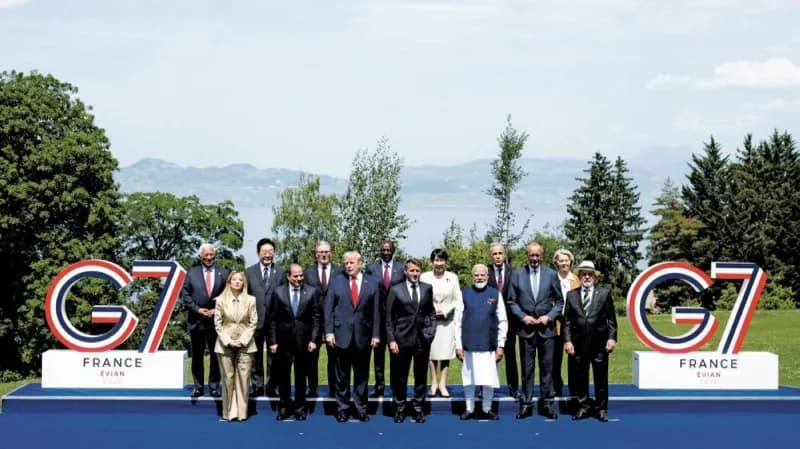
G7 leaders agreed on Wednesday to increase pressure on Russia to push it toward ending the war in Ukraine, alongside pledging to strengthen international efforts to address the global debt crisis and support heavily indebted countries implementing economic reform programmes.
The positions emerged during the G7 summit held in the French city of Évian-les-Bains, with the participation of Ukrainian President Volodymyr Zelensky, who held a series of meetings with the leaders of participating countries, including US President Donald Trump.
In a joint statement, the group's leaders said they would strengthen efforts aimed at addressing "increasing global debt vulnerabilities that threaten economic stability and limit the fiscal space needed for interventions required to improve public services."
The statement called for increased support for countries suffering from heavy debt burdens that are implementing strong reform programmes but lack investment opportunities, and urged multilateral development banks to encourage the use of risk-sharing instruments.
On the Ukraine file, European diplomatic sources said the group's leaders agreed to intensify pressure on Moscow through measures targeting Russia's oil and gas sectors, while reaffirming continued military and economic support for Ukraine.
A French diplomatic source said the leaders "decided to increase pressure on Russia through sanctions on gas and oil," adding that they also agreed that "battlefield developments are tilting in Ukraine's favour."
German government sources also quoted the leaders as agreeing on the need to increase support for Ukraine and tighten pressure on Russia, stating that Ukraine has now achieved a position of "strength" while Russia faces mounting pressure.
For his part, US President Donald Trump said after his meeting with Zelensky that "Russia has to make a deal" to end the war, adding: "Russia has lost a tremendous number of people, and so has Ukraine… I will do everything I can."
Trump hinted at the possibility of reimposing American sanctions on Russian oil soon, saying: "We'll be able to do that soon — the oil is flowing now," in a reference to the stability of oil flows through the Strait of Hormuz following the agreement relating to Iran. Zelensky, for his part, confirmed that G7 leaders had discussed imposing further sanctions on Russian energy exports, the banking sector, and Russian military production, noting that they agreed that "Russia is not winning."
The Ukrainian president said: "We agreed unanimously that Russia is not winning, that it is losing a lot of people, and that they need to reach a deal as soon as possible." He added that Ukraine intends to continue its operations against Russian military infrastructure and energy facilities, calling for increased political pressure on Moscow to compel it to negotiate.
Zelensky confirmed that air defence was among the most prominent issues he discussed with the group's leaders, saying: "Everyone understands this, everyone will help, and the entire international community will work to strengthen our defences."
The Ukrainian president also called for a "decisive and tangible" response to recent Russian strikes, and revealed that he had proposed a meeting with Russian President Vladimir Putin, but said Moscow is "not ready" for that.
The summit also featured discussions on other international issues, including the agreement relating to Iran and its implications for global energy security, as well as the situation in the Middle East. However, the war in Ukraine and the global debt crisis dominated the agenda on the second day of the leaders' meetings.