
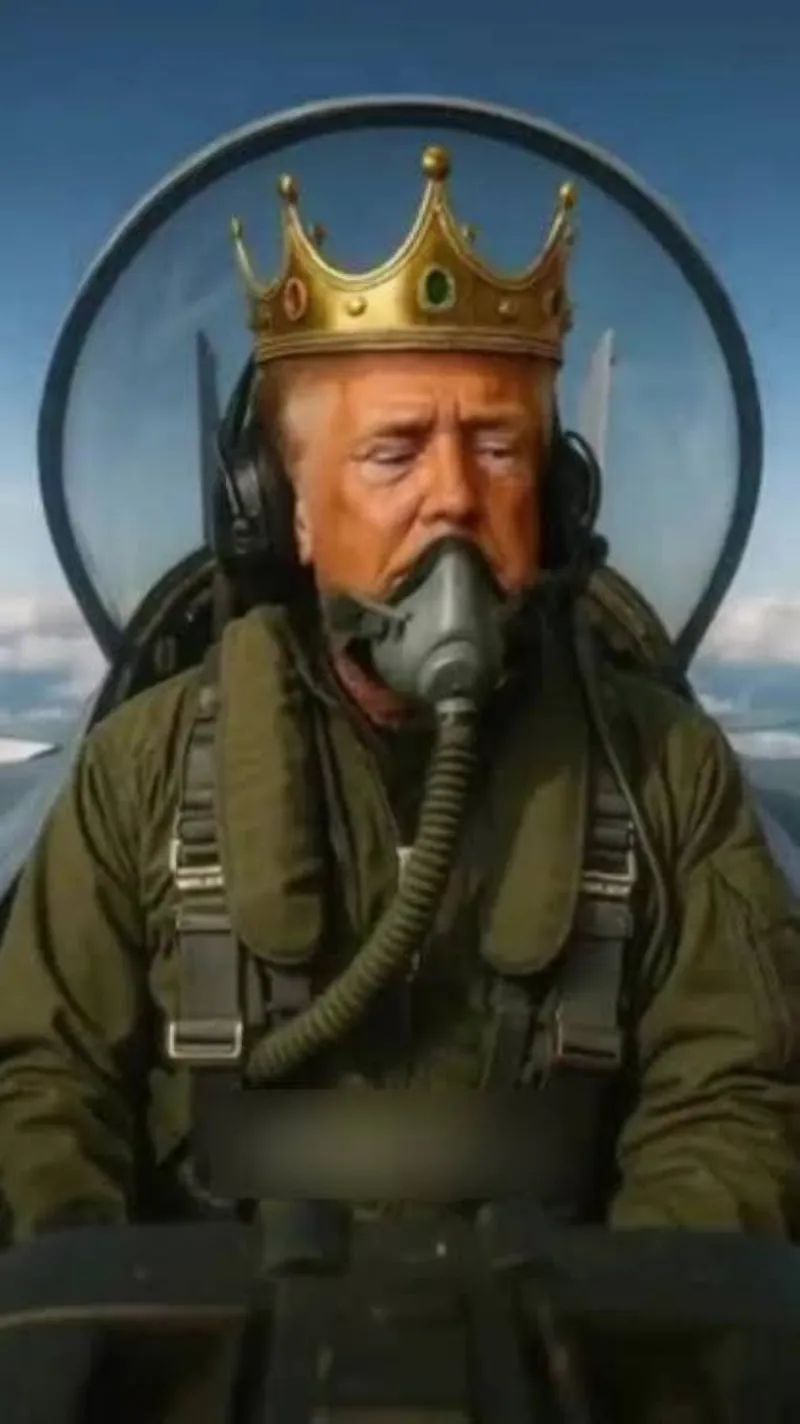
Artificial intelligence in American politics is no longer merely a behind-the-scenes tool for crafting messages or analysing voters. In the case of President Donald Trump, AI has become part of the spectacle itself: imagined images and videos, exaggerated personas, a king wearing a crown, a fighter jet bearing his name, and mocking clips posted on Truth Social as though they were political statements written in the language of memes.
The latest episode came in the wake of the "No Kings" protests, which broke out in several American cities in opposition to what organisers see as an expansion of Trump's powers and an authoritarian streak in his administration. While the protesters' slogan declared "No Kings," Trump's response was the precise opposite: an AI-generated clip showing him wearing a crown inside a fighter jet labelled "King Trump," dropping a brown liquid onto crowds of demonstrators.
The video was no passing political joke. It revealed a new phase in the use of power through artificial imagery — not to persuade people of any particular truth, but to flood them with a provocative image that goads opponents, entertains supporters, and dominates the news cycle for hours, perhaps days.
Vice President JD Vance shared another clip showing Trump as a king before whom Democratic figures crumble. At that moment, AI ceased to be merely a tool of the imagination and became an extension of a political style built on mockery, exaggeration, and the conversion of criticism into visual spectacle.
Since his first campaign, Trump has treated social media not merely as an advertising platform but as an arena of combat. What is new today is that AI grants him a virtually unlimited capacity to produce alternative personas for himself: the military commander, the king, the superhero, the businessman rebuilding Gaza, or even a figure carved into Mount Rushmore alongside historic presidents.
Two different audiences
AI speaks to two audiences simultaneously. Supporters see these clips as wit, strength, and a provocation aimed at opponents they characterise as unable to take a joke. Opponents, on the other hand, view them as evidence of contempt for the protests and for political rivals, and perhaps as encouragement for a discourse that blurs the line between mockery and symbolic violence.
Herein lies the effectiveness of these clips. They do not attempt to unite the audience; they deepen divisions and profit from them. Every outburst of anger from opponents becomes additional proof, in the eyes of supporters, that the message has landed. Every indignant share increases the video's reach. In this sense, the clip need not be sophisticated, persuasive, or even befitting a head of state. It need only go viral.
Power without cost
The advantage of AI in this brand of politics is that it is fast, cheap, and requires no major production apparatus. Within hours, one can create a scene that would previously have demanded a film crew, special effects, and studios. For a political figure who thrives on the speed of engagement, this is an enormous advantage. There is no need to wait for an official television advertisement or mount a large paid campaign. A single clip on Truth Social suffices; the platforms, the newspapers, and collective outrage take care of the rest.
Yet this speed carries a problem of its own. The easier it becomes to produce an image, the more the boundaries erode — between joke and propaganda, between satire and incitement, between imagination and manipulation. And when a head of state uses artificial images of himself and his opponents, the question is no longer merely technical but ethical and political: who sets the limits of imagination when imagination itself becomes an instrument of power?
The weapon of confusion
The purpose of these clips does not appear to be rational persuasion. They are closer to a weapon of distraction. They force the opponent to respond to something absurd, push the media to cover it, and give supporters easy material to share. At the same time, they relegate serious messages to the background. Instead of discussing the protesters' demands, the story becomes about the video of the king, the jet, and the brown liquid.
This is no accident. It is part of a political style that understands the modern news cycle is short and that a shocking image can defeat a lengthy report. And AI makes producing such images easier, faster, and stranger than ever before.