
The Russian-Ukrainian conflict has shifted over the past two months from a war of attrition along conventional front lines to a strategic battle of annihilation striking deep into the cities and vital installations of both sides.
The equation is no longer limited to border skirmishes; it has transformed into a mutually destructive bombardment that is pushing international diplomatic calculations to the brink.
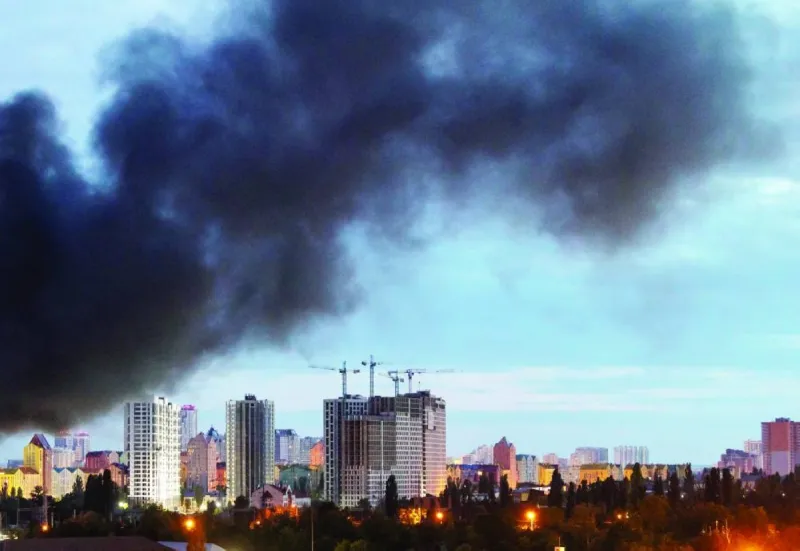
Russian forces launched a missile attack on the Ukrainian capital Kyiv yesterday, wounding at least 10 people. Moscow simultaneously carried out precision-weapons strikes targeting facilities belonging to Kyiv's military-industrial complex, as well as infrastructure at the port of Yuzhne in Odesa Oblast, which serves as a logistics hub for Ukrainian forces.
Kyiv, for its part, did not remain on the defensive, but instead took the battle to the nerve centre of the Russian economy through a strategy of "refinery warfare."
The military command in Kyiv announced yesterday that Ukraine used drones to attack 21 Russian oil tankers in the Sea of Azov overnight.
Field reports have documented the success of long-range Ukrainian drones in striking and disabling critically important energy facilities deep inside Russia during the first week of July, most notably the Taneco refinery in the Republic of Tatarstan and the Ilsky refinery in Krasnodar, as well as oil storage tanks and ports in Taganrog and Azov.
These were devastating strikes whose impact Russia implicitly acknowledged when the government decided to impose restrictions on diesel exports to protect the domestic market from fuel shortages.
The intensity of the "refinery war" has escalated to become a central axis of the Russian-Ukrainian conflict, with Kyiv carrying out strategic drone strikes deep inside Russia to disable approximately 43% of refining capacity and reduce Kremlin revenues.
Moscow has responded with extensive bombardment of Ukraine's energy and fuel network, broadening the scope of the conflict into a war of economic and geopolitical attrition.
Amid this fierce field exchange, military analysts argue that Britain's announcement of a historic military support package worth 60 billion euros, accompanied by joint plans to produce Patriot missile systems on Ukrainian soil, represents a fundamental change in the nature of the conflict.
Political experts believe these strategic shifts are pushing the crisis toward a "point of no return" and confirm that Western powers are preparing for a war that could last years, narrowing the margins for diplomatic manoeuvre in the foreseeable future.
Forecasts suggest that the summer of 2026 will continue under the language of fire, with each side seeking through its painful strikes to undermine the other's sources of power. Russia is pressing to exhaust Ukraine's air-defence stockpiles before winter.
Ukraine, meanwhile, is attempting to cripple Russia's energy lifeline in order to force Moscow — in the future — to negotiate from a position of weakness.
Ambassador Rakha Ahmed Hassan, former Assistant Foreign Minister of Egypt, says the Russian-Ukrainian conflict is entirely devoid of any signs of a political solution under presidents Vladimir Putin and Volodymyr Zelensky, arguing that "territory" is the core of the problem and its intractable knot, which prevents either current government from showing any flexibility on concessions.
Ambassador Rakha, in exclusive comments to Al Bayan, notes that Russia now treats the four regions it annexed as "sovereign Russian territory" rather than Ukrainian land, and is moving militarily to defend them, while Kyiv categorically rejects this reality — to the point of refusing pressure from US President Donald Trump to cede those territories to settle the situation. Kyiv is backed here by the European Union's position, which views a Moscow victory as an existential and future threat to the security of alliance member states.
Ambassador Rakha explains that the possible spaces for negotiation between the two sides are confined solely to security and political issues open to discussion, such as guaranteeing that Ukraine does not acquire nuclear weapons or withdraw from its path toward NATO membership.
On the question of borders and territorial sovereignty, however, the prevailing zero-sum positions make a diplomatic solution impossible in the foreseeable future, and make it abundantly clear that this violent conflict will remain ongoing and open-ended across fronts of mutual attrition.
Dr. Amr Al-Deeb, Director of the International Geopolitical Operations Centre in Moscow, argues that the mutual military escalation will not lead to a decisive field outcome in the near term, but is instead pushing the conflict toward an advanced phase of attrition in which each side seeks to raise the ceiling of its conditions ahead of any future political settlement.
He affirms that Russia's powerful strikes on Kyiv carry firm messages to the West that Moscow is capable of raising the tempo of escalation to any level, in addition to its readiness to destroy any defensive systems or supply bases that reach Ukraine.
Al-Deeb, in exclusive comments to Al Bayan, explains that Kyiv's bet on building a self-sufficient domestic defence manufacturing system to produce Patriot missiles locally with billions of euros amounts to a form of "military suicide," because Ukraine cannot confront the powerful Russian military without a continuous direct flow of Western support.
He adds that the Ukrainian and Western messages behind the local manufacturing project focus on the long-term goal of demonstrating non-surrender, while Russian instruments are focused on achieving decisive results in the present, which will cause this project to fail in the foreseeable future — particularly given Washington's growing conviction of the necessity of a settlement.
Al-Deeb concludes that the situation has not entered a phase of complete deadlock, but is passing through an extremely dangerous phase of conflict in which each side is seeking through military force to improve its positioning and shift the equation in its favour. He warns that what lies ahead may bring an expansion — of uncertain timing — of the war beyond its current boundaries, if settlement efforts fail.