
More than four years after the outbreak of the Russian-Ukrainian war, the confrontation between Moscow and Kyiv is entering a new phase that goes beyond traditional front lines, with increasing strikes on energy facilities and vital infrastructure deep inside both countries' territories.
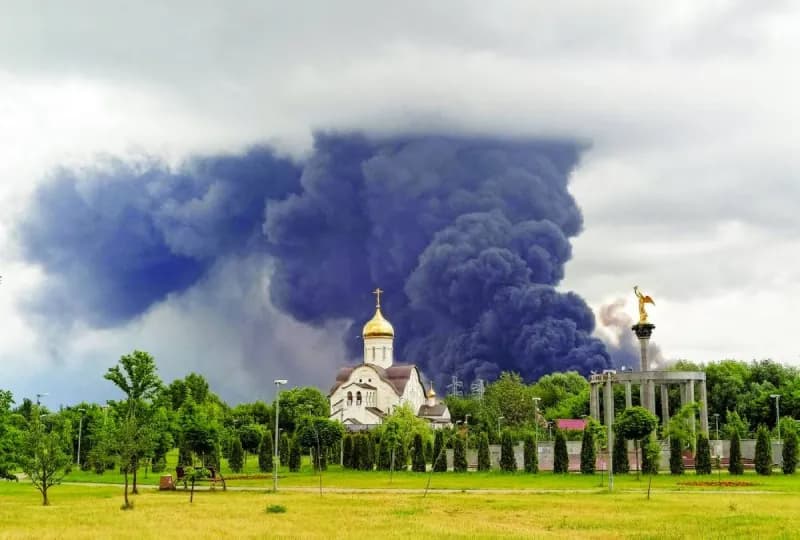
In the latest episode of this escalation, Moscow suffered one of the largest drone attacks in years, targeting a major oil refinery and causing disruptions to air traffic, while Russia announced it had carried out sweeping strikes on fuel and energy facilities inside Ukraine, in parallel with ongoing military operations across multiple fronts.
Russian Foreign Minister Sergei Lavrov said yesterday that Russia would carry out "large-scale coordinated strikes on a regular basis" following a major Ukrainian drone attack targeting the capital, Moscow. Russia's Ministry of Defence announced yesterday that its air defence systems had shot down 992 Ukrainian drones, 4 "Flamingo" cruise missiles, 3 HIMARS rockets, and 10 guided aerial bombs over the preceding 24 hours.
The ministry said Russian forces launched "a broad strike using high-precision weapons from land, air, and long-range drones" the night before last, targeting facilities belonging to the Ukrainian fuel and energy complex that serves the Ukrainian armed forces.
It added that the strikes hit a fuel and petroleum products depot in the Boryspil area near Kyiv, as well as the Zatorynо oil refinery in Poltava Oblast in central Ukraine, confirming that all designated targets were hit.
At the same time, the head of Kyiv's military administration, Tymur Tkachenko, said Russia had attacked the capital with ballistic missiles, urging residents to take shelter until the air raid alerts ended.
Authorities in Sumy Oblast in northeastern Ukraine also announced that one person had been killed in a drone attack, as air raid sirens sounded across wide areas of the country.
On the ground, Russia's Ministry of Defence announced the capture of the town of Ray-Oleksandrivka in eastern Ukraine, saying its forces had continued to advance on several fronts, while claiming Ukrainian losses of more than 1,000 soldiers in a single day.
In contrast, Russian authorities said Ukraine had launched a massive drone attack on Moscow and other regions the night before last, in one of the largest attacks to target the Russian capital in years.
Russia's Ministry of Defence announced that air defences had intercepted and destroyed 555 Ukrainian drones over multiple regions of the country during the night, while Moscow Mayor Sergei Sobyanin confirmed that around 180 drones heading toward the capital had been shot down.
Sobyanin said a number of the drones managed to reach the Gazprom Neft oil refinery in southeastern Moscow — one of Russia's largest refining facilities, with a production capacity of approximately 11 million tonnes per year.
Authorities announced the suspension or restriction of flight operations at the capital's main airports, with passengers evacuated to safe areas.
Russian reports indicated that the attack caused damage to residential buildings and commercial facilities on the outskirts of Moscow, while a Ukrainian drone attack in Rostov Oblast killed one person and wounded 2 others.
Ukrainian President Volodymyr Zelensky described the attack as "a completely justified response to Russian strikes on our cities and communities," insisting that the strikes had targeted facilities supporting "the Russian war machine."
Zelensky said Ukraine did not want the war to continue, but warned that "Moscow will burn" if Russian attacks on Ukrainian cities persist, adding that "what matters is that the Russian people begin to feel that one person — Putin — is waging this war, while ordinary citizens pay the price."
The escalation came hours after Zelensky held talks with US President Donald Trump, French President Emmanuel Macron, and a number of European leaders, as part of efforts to bolster military and political support for Kyiv.
He described the meeting as "coordinative" in an attempt to bring the war to an end.
In a separate development, Ukraine and Russia announced a new operation to exchange the remains of fallen soldiers. Ukrainian authorities said Moscow had handed over the remains of 522 individuals, identified as Ukrainian military personnel, while Russian officials confirmed receipt of the remains of 33 Russian soldiers.
Prisoner and remains exchanges are among the few channels still active between the two sides, at a time when political efforts to end the war remain stalled amid continuing combat, long-range strikes between both parties, and an expanding target set that encompasses energy facilities and critical infrastructure deep inside both Russian and Ukrainian territory.