
Dubai – Al Bayan and agencies
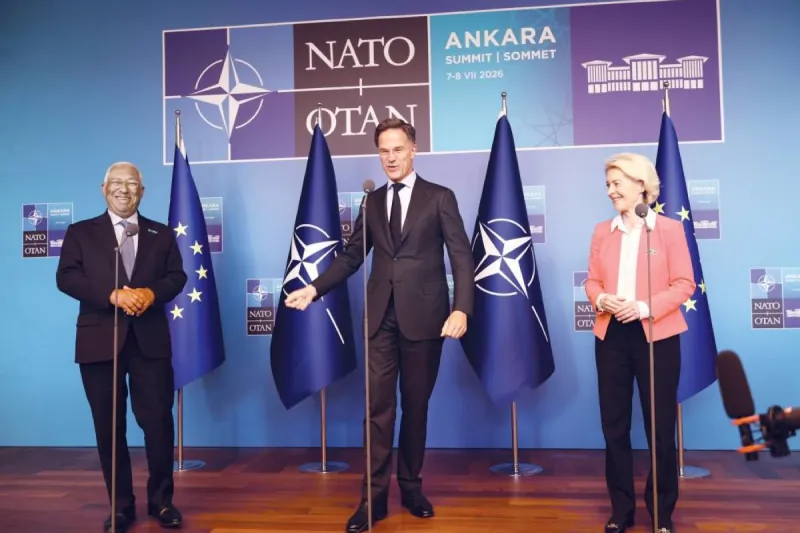
From its very first day, the NATO summit in Ankara became a broad political and military test for the alliance, amid openly declared American anger at the stance taken by several allies during the war against Iran, European efforts to demonstrate greater seriousness in raising defence spending, and parallel discussions over the crisis in the Strait of Hormuz and the possibility of launching a multinational naval mission that Tehran has so far rejected.
US President Donald Trump arrived in the Turkish capital to take part in the two-day summit being held at the Turkish presidential palace, amid a charged atmosphere within the alliance, after he expressed "deep disappointment" at NATO's position during the war against Iran.
Trump told Turkish President Recep Tayyip Erdoğan during their meeting that he felt disappointed with the alliance, adding that "had the summit not been held in Turkey, I probably would not have attended."
Trump said, in remarks carried by Agence France-Presse, that Washington had not sought direct military assistance, but that he had, in his own words, been "testing" the allies to see whether they would stand by the United States, after Washington had stood by them in the past.
Those remarks came weeks after tension within NATO that stemmed from some European countries refusing to facilitate the use of their bases or airspace for US operations linked to the war against Iran.
Alongside the summit's proceedings, Iran loomed large on the sidelines through the issue of the Strait of Hormuz. NATO foreign ministers met with their counterparts from Gulf states, including the United Arab Emirates, Bahrain, Kuwait and Qatar, to discuss the crisis over opening the strait and a Franco-British proposal to launch a multinational naval mission, according to Reuters.
Belgian Foreign Minister Maxime Prévot said ahead of the meeting that the UAE, Bahrain, Kuwait and Qatar "were directly targeted by Iranian attacks this spring," arguing that the stability of those countries and the stability of Europe "are closely linked," and that the matter extends beyond the Strait of Hormuz, despite its importance to European energy security.
France and Britain presented plans during the talks for a multinational naval mission in the Strait of Hormuz, at a time when the two countries are leading efforts to form a coalition of around 12 nations to guarantee safe passage through the vital waterway after tensions ease or a settlement is reached. Diplomats noted, however, that any long-term arrangement would ultimately require Iran's consent — a country that has repeatedly rejected any foreign military presence in the region.
Tehran had last week rejected statements by French President Emmanuel Macron regarding pressing ahead with the naval mission, while Iranian Foreign Minister Abbas Araghchi announced yesterday that talks aimed at a final agreement between Tehran and Washington would not begin if American threats continued.
Against the backdrop of these disputes, NATO Secretary-General Mark Rutte appeared to seek to placate an angry Trump over the alliance's stance on the Iran war, by announcing defence contracts worth billions of dollars aimed at boosting NATO's capabilities and convincing Washington that Europeans and Canada are shouldering a greater share of the burden. Rutte said that member states and companies on both sides of the Atlantic would sign contracts worth "billions of dollars."
A NATO diplomat indicated that the total value of the contracts exceeds 50 billion dollars. Rutte's remarks at the opening of the summit highlight the commitments of European countries to increase defence spending — a central issue for Trump, who has repeatedly criticised the alliance and urged its members to "do more."
Rutte said: "One year ago in The Hague, allies pledged to invest far more in defence, to 5% of GDP by 2035, and we are already making significant progress."
Rutte announced the addition of a 10th Airbus A330 MRTT aircraft to the alliance's multinational tanker and air transport fleet, alongside a multinational project involving A400M aircraft.
He also revealed a major contract involving Swedish company Saab to replace NATO's AWACS surveillance aircraft with 10 GlobalEye aircraft.
On the subject of drones, Rutte announced that allies intend to invest more than 40 billion dollars in counter-drone capabilities over the next five years, noting that NATO is expanding its capacity to deploy and operate drones while simultaneously building counter-drone defences to detect and neutralise them.
These announcements form part of a broader drive to increase defence spending within the alliance. NATO members pledged last year to raise defence- and security-related spending to 5% of GDP by 2035, comprising 3.5% for core defence investments and 1.5% for defence-related security items. Rutte said European allies and Canada had already increased their spending to around 4% of their GDP, asserting that the alliance was witnessing "tangible transformational progress."
Germany informed the alliance that its defence spending for the current year had reached 124.7 billion euros, an increase of 25.5% compared with last year, making it the second-largest defence spender within NATO after the United States.
The Czech government also announced an increase in its defence budget that will allow it to reach the 2% of GDP target for the first time. German Defence Minister Boris Pistorius welcomed the decision, describing it as a landmark in strengthening transatlantic security. Yet these deals did not conceal the depth of the trust crisis between Washington and some European capitals.
Trump hinted during his meeting with Erdoğan at the possibility of withdrawing all American troops from Europe, in the context of his remarks about Greenland, saying that control of it "should go to America, not Denmark," and describing it as surrounded by Chinese and Russian vessels.
Asked about a further reduction of US forces in Europe, he said only: "We'll see." Ukraine also featured as a second pressing issue at the summit. German Chancellor Friedrich Merz expressed hope that the summit would send a strong message of support for Kyiv, warning that Russia continues to pose a serious threat through cyberattacks, sabotage, espionage and disinformation campaigns.