
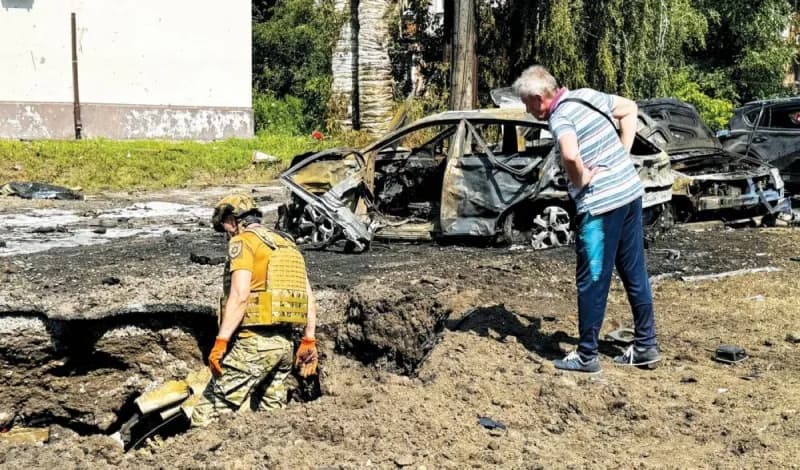
The Russia-Ukraine war has entered a new phase that might be called the "intensification" phase, amid escalating attacks by both sides and deep strikes on energy infrastructure, raising the prospect of broader escalation reaching a full-scale war. This prompted US President Donald Trump to act to prevent the situation from spiralling out of control, renewing efforts — after a prolonged diplomatic impasse — to relaunch negotiations between Russia and Ukraine. Trump said he believes Russian leadership is ready to reach a deal on settling the conflict in Ukraine in the near future.
In an interview with Fox News, Trump said he believes President Vladimir Putin is ready to conclude a deal, adding: "I think he's ready to make a deal, soon."
Trump also said he hopes the conflict in Ukraine will end before the close of his current presidential term, which ends on 20 January 2029.
For its part, Russian Ministry of Foreign Affairs spokeswoman Maria Zakharova said yesterday that Moscow rejects the deployment of a multinational force from Kyiv's allies in Ukraine in the event a peace agreement is reached.
She added that Russia would consider such a force a direct threat and a legitimate military target.
Zakharova's remarks came after Western nations in the "Coalition of the Willing" supporting Ukraine reaffirmed their commitment this week to deploying such a force following a ceasefire.
The new settlement initiative being paved by Trump puts forward a set of political and security conditions that Kyiv and its allies consider a basis for any future settlement. Experts say one of the prerequisites for a successful political resolution to the Ukrainian war requires internal changes in both Russia and Ukraine.
However, each side is seeking to align the terms and outcomes of any settlement with its own demands. Russia has previously stated it will not accept any halt to the war along current front lines without strict security guarantees from NATO. A ceasefire agreement and a partial resolution of the conflict built on interim understandings around security guarantees remain possible, but without a comprehensive end to the conflict.
Experts stress that the effectiveness of any process to end the war will remain contingent on the ability of international sponsoring parties to transform guarantees from promises into enforceable commitments.
The United States offered 15-year security guarantees on 29 December 2025 as part of a peace plan, while Kyiv has requested longer guarantees spanning 30 to 50 years for long-term stability.
Ukrainian President Volodymyr Zelensky had already proposed renewed direct talks with Putin on 4 June, and the Russian presidency (the Kremlin) issued a public invitation to Zelensky to visit Moscow, conditional on his readiness for a "serious and responsible dialogue" to end the conflict between the two countries. However, the proposal quickly evaporated as battlefield escalation continued.
In a related context, Russian Foreign Minister Sergei Lavrov accused European countries of attempting to undermine understandings between Russia and the United States regarding a settlement of the Ukrainian crisis.
Lavrov stressed that the president has repeatedly emphasised that Moscow knows how to achieve its goals if those understandings are not implemented, noting that these goals were defined by Putin in his address to the Russian Ministry of Foreign Affairs last June.
On the battlefield, the Russian Ministry of Defence announced yesterday that air defence systems had intercepted and destroyed 93 Ukrainian drones overnight over the territory of several regions of the country.
In the same context, the ministry stated that its armed forces had continued shelling the Ukrainian ports of Odessa, Chornomorsk and Dnipro-Buzky, which are used to deliver supplies to Ukraine's armed forces.